
Every few months, someone announces, usually with great confidence and little evidence, that Zionism is a modern invention: an ideological fad, a European mistake, a political overreaction. The story is soothing. Jews, we are told, once lived happily everywhere else until history took an unfortunate detour somewhere between Herzl and the United Nations. If only Zionism had never happened, everything would have been fine.
This theory collapses instantly if one listens to Ethiopian Jews. For more than 2,500 years, Ethiopian Jewish leaders preserved Jewish law, ritual, and identity in one of the most isolated Jewish communities on Earth. They did so without armies, without universities, without international conferences and without op-eds explaining themselves. And every single day, they prayed toward Jerusalem.
Anti-Zionism depends on a convenient fiction: Jewish attachment to Israel is modern, manufactured, or imposed by power. Ethiopian Jewish history answers not with theory but with dates.
In 1848, decades before political Zionism even had a vocabulary, a priest named Daniel ben Hananiah and his son were formally sent by their community to Jerusalem to establish contact with world Jewry. This was not tourism; it was a diplomatic mission from Africa to Zion, premised on the uncontroversial assumption that Jerusalem was home.
In 1862, the legendary religious leader Abba Mahari attempted something even more inconvenient for modern critics. He led thousands of Ethiopian Jews on a mass journey toward Jerusalem on foot, through famine and danger, without colonial sponsors, social media campaigns, or international sympathy. The effort failed heroically because history often resists redemption before yielding to it.
By 1934, documented groups of Ethiopian Jews were already reaching British Mandate Palestine, often traveling alongside Yemenite Jews through Italian-controlled Eritrea. These were quiet, determined acts of return, undertaken without permission and without applause; an approach to Zionism that predates press releases. In the late 20th century, that ancient will translated into modern rescue through figures such as Baruch Tegegne, whose advocacy from the 1970s onward helped lay the groundwork for Operations Moses and Joshua.
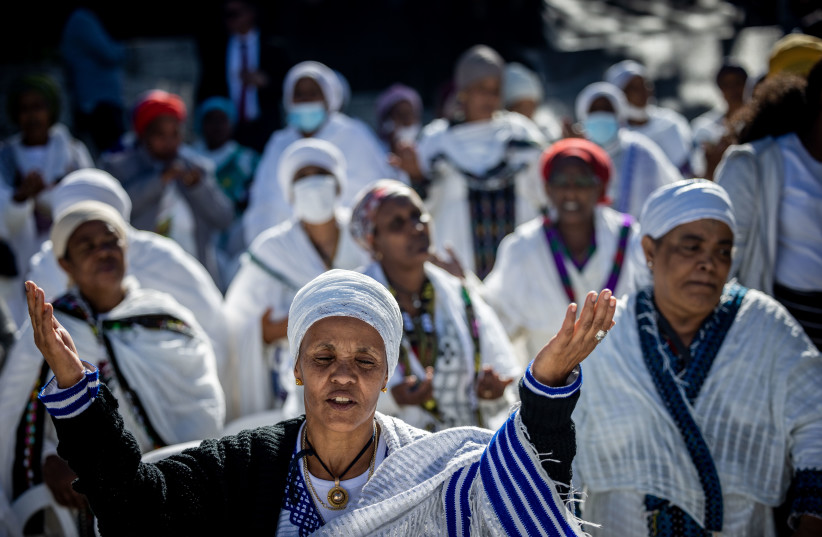
Zionism, in this telling, was not imposed from above; it was dragged into reality by people who refused to wait politely for history. That lineage did not end with arrival. It deepened. Leaders such as Liqa Kahenat Raphael Hadane Takuyo, who made aliyah in 1985 and passed away in 2020 at the age of 97, devoted decades to rebuilding Ethiopian Jewish religious life in Israel.
His authority rested not on nostalgia but on service, guiding a community through the spiritual dislocation of immigration while insisting that ancient traditions could survive modernity intact.
Today, that inheritance continues institutionally. Kes Avihu Azariya has established schools to train new Qesim. Kes Samai Elias ensures that Ethiopian Jewish faith and Zionist commitment remain lived and transmitted. This is not an argument. It is a timeline. And timelines are unforgiving to myths.
Before Zionism had a name
Long before Zionism acquired a name, Ethiopian Jews lived its substance. Their leaders taught children that exile was temporary, Jerusalem eternal, and Jewish identity non-negotiable. They did not debate whether Jews were a people or merely a religion.
They assumed what Jews had always assumed: history scatters but memory returns. That assumption now makes some people uncomfortable.
Today’s anti-Zionist argument presents itself as enlightened skepticism. Zionism, we are told, is colonial. National identity is outdated. Jewish peoplehood is optional. Attachment to Jerusalem is excessive unless, of course, it belongs to someone else. Ethiopian Jewish history is deeply inconvenient to this narrative.
It is difficult to call Zionism a European colonial project when Black African Jews walked across deserts, faced starvation, and risked death simply to reach Jerusalem. It is hard to claim Jewish identity is a modern fabrication when an isolated community preserved it for millennia with no expectation of recognition or reward.
Their leaders were not political theorists. They were guardians of continuity, transmitting Torah orally when books were banned, enforcing Shabbat when it brought danger, and teaching that Jewish dignity did not depend on acceptance by the surrounding world.
This is what anti-Zionism rarely admits: The Jewish return to Zion was not invented by power. It was sustained by powerlessness. Antisemitism thrives on the idea that Jews are temporary guests in history. Anti-Zionism repackages this idea with better vocabulary. Ethiopian Jewish leaders dismantle it entirely. They are living proof that Jewish attachment to Jerusalem is neither racial nor recent, neither colonial nor cosmetic.
I write this as a member of the community formed in the womb of a Zionist mother, born a Zionist Ethiopian Black African Jew. I write with a cry to belong, to serve, and to contribute to Zionist leadership as a servant of a vision that has shaped my life from birth.
If anti-Zionism claims moral seriousness, it should answer one simple question: What do you do with Jews who never stopped believing they belonged in Jerusalem? So far, silence has been the loudest response.
The author is a former NYC Supreme Court investigator and educator in conflict resolution, restorative peace, and moral diplomacy expert. His upcoming book is Moral Diplomacy for a Broken World, inspired by the late Rabbi Jonathan Sacks.