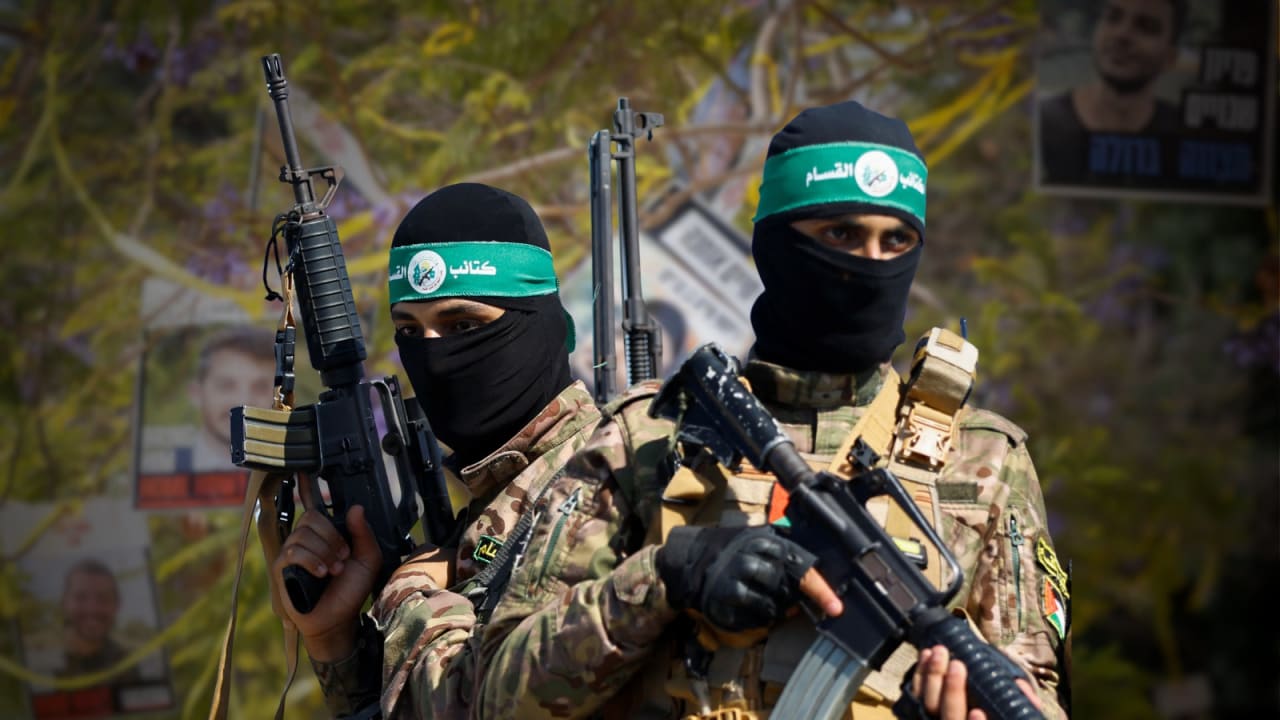
Hamas published "Our Narrative… Al-Aqsa Flood: Two Years of Steadfastness and the Will for Liberation" on Wednesday.
The terror group touted the document as a clear portrayal of "a narrative that stands clear and evident," which is that the people of Gaza and Palestinians as a whole are "a people who cannot be erased, a resistance that cannot be defeated, and a memory that cannot be forgotten."
After reading the entire 42-page document, which, after taking repetitions into account, is only about four slides worth of content, a few notable issues stand out.
Why did they feel the need to produce a document that's 42 pages long when it could've essentially been an email? Why is the production quality so poor, compared to previous Hamas publications that appear to have had a lot of effort put into them? And most importantly, is this document Hamas's way of officially saying it won't disarm?
Let's break down what it says.

The report has a few recurring themes that are ever-so-slightly changed to appear as new text. These include the ideas that October 7 was justified, the massacre was a pivotal moment for the Palestinian people, Israel is globally isolated, Hamas did nothing wrong, and any accusation of human rights violations is just Zionist lies.
This was all but to be expected, so surely after an initial introduction and declaration of victory, the terror group notorious for well-thought-out media production would have ample substance to back these claims, right? Wrong.
Chapters One through Eight of the Hamas manifesto
The first chapter, "The Motivation and Contexts of the Al Aqsa Flood," essentially says how October 7 didn't happen in a vacuum, and how Palestinians have been under occupation and oppression for over a century, and how the UN reneged on its commitment to an independent Palestinian state that the Palestinians were oh so happy to receive with open arms.
History revisions aside, a few things in this chapter stood out. The first was the necessity to repeat the narrative that Hamas and Gazans are unbreakable. Combined with odd spacing errors and weird behaviors in the report revolving percentages and using "<" and ">" arrows instead of quotes, the text began to read as if someone gave AI a prompt that said, "You are a Hamas militant fighter, write a report about how October 7 was justified and a great victory." This occurs throughout the report multiple times, but is abundantly clear from the beginning. At the very least, it was translated from Arabic in a very rushed manner and put out before any kind of editing was done.
The next chapter, "The Al-Aqsa Flood – The Day of Glorious Crossing (October 7, 2023)" contains a brief introduction before immediately going into a 2023 poll showing that Gazans support Hamas and the October 7 invasion despite the heavy toll.
After that, the chapter ends with a quick summation of the events of October 7 without any specifics. The terror group says, "For thefirst time since the Zionist/Israeli entity was established75 years ago, the resistance was able to execute a field maneuver, successfully breaching and controlling all lines ofthe occupation army surrounding the Gaza Strip, neutralizinghundreds of soldiers, and seizing complete positions in justa few hours."
The spacing errors in the direct quotes have been left intact to appreciate the quality of the production.
Hamas also asserted that "That day was a Palestinian crossing into a new equation in the global consciousness. It proved that the resistance is capable of breaking the image of the «invincible» army, and that the will for liberation is stronger than any military arsenal."
So if October 7 was such a monumental and justified victory, why such a short chapter? Why not go into specifics of the resistance's heroism and historic acts? Why start a chapter with a poll stating "Gazans are happy we did this" before even explaining what "this" is? Is there something Hamas is trying to hide or deflect?
Let's see in the next chapter.
Chapter Three (and my personal favorite) - "Investigation into the October 7 Attack – Yes to Uncovering the Truth" essentially answers all of my previous questions.
The chapter starts off by saying, "From the very first moment of the October 7 attack, the Israeli entity attempted to distort the truth. It launched a global disinformation machine, involving Western media and Zionist lobby groups, to transform the legitimate military operation—which targeted the Israeli army’s Gaza Division, a military unit that had perpetuated killing and siege against Gaza—into claims about targeting civilians and children."
Now it has become clear why the end of Chapter Two left so many questions unanswered.
The group then demands from us in Orwellian fashion to reject the evidence of our eyes and ears, saying, "The Israeli entity promoted a series of lies and fallacies about killing children and raping women, paving the way
to proceed with an all-out genocide project that was pre-planned and aimed to erase Gaza from existence."
And at this point, if you still had any concerns that Hamas may have committed crimes against humanity, worry no longer because they round off this section with clear assurances.
"However, because the Israeli entity´s leaders continue to brazenly repeat their lies, we affirm the following:
• Killing civilians is not part of our religion, morality, or education, and we avoid it whenever we can.
• Killing civilians, committing brutal massacres, and ethnic cleansing are original Zionist behaviors since this entity´s establishment, and there are thousands of conclusive pieces of evidence that prove this, leaving no room for doubt or debate."

So there you have it. Don't worry about the horrifying videos across X and Telegram published by Hamas terrorists themselves executing family members one-by-one, so their loved ones' last moments are filled with the ultimate despair. This manifesto clearly outlines that anything of the sort is forbidden, and you must be imagining it.
While the manifesto up until this point sounded borderline comedic, the rest of the report is actually quite alarming.
The next chapter, "The Course of the War on Gaza," is filled with statistics that Hamas notoriously lies about. Not just the Gaza death toll that has no distinction between journalist and civilian, but the claim that more terrorists have been killed in the Gaza war than in World War 1, World War 2, Vietnam, Yugoslavia, Afghanistan, and
Ukraine combined.
Clearly taken from an Amnesty UK report that received heavy backlash for omitting the fact that around 1,400 journalists were killed in the Holocaust.
Hamas also produces false statistics on Israeli casualties. The chapter later states, "In February 2025, the new Israeli army chief, Eyal Zamir, admitted to 5,942 soldiers killed, while medical reports indicated approximately 13,000 Israeli fatalities in Gaza, Lebanon, and the West Bank."
Total Israeli casualties since the beginning of the war have always been public, and currently lie around 2,000. Notably, this number isn't just significantly smaller than Hamas's assertions, but it is a total of soldiers and civilians.
Also, the most striking element of this false report is that Zamir took the role of IDF chief of staff on March 6, 2025. and had made no such statement. Neither did his predecessor, Herzi Halevi.
To sum up the next chapter, Hamas just says it was always willing to negotiate a ceasefire and was flexible at every turn. It was the Zionist entity and the enabling of the evil US regime that stalled an agreement for so long.
Chapter Six, "The Most Prominent Achievements of the Al-Aqsa Flood," is the most egregious example of repeating themes for the sake of content, as I flagged earlier.
In this chapter, Hamas takes the themes that Hamas cannot be defeated, Israel is exposed and isolated, and October 7 was justified because it brought the plight of the Palestinians to the forefront of the global stage, and repackaged them into 20 different paragraphs and insisted they were different ideas.
Because if this is the most pivotal victory in Hamas's history, its list of achievements must be monumental, right?
I'm going to skip the next chapter, called "Hamas cannot be isolated," because it essentially repeats the themes of the previous chapter. The only noteworthy text in this section is the last paragraph.
It reads, "Therefore, Hamas´s participation in popular representation and politicaldecision-making is an inherent right that does not accept externaltrusteeship, and no external alternative can be imposed on the willof the Palestinian people."
This is concerning, especially when tied to the second paragraph of the final chapter, "The Current Stage Priorities."
While this chapter mainly states the need for a complete IDF withdrawal from Gaza and the completion of its reconstruction, and bland repetitions of the previously discussed themes, the second paragraph is essentially the message Hamas was trying to put out to its supporters while burying it in 42 other pages and hoping others wouldn't notice.
It reads, "Administering the Gaza Strip is an exclusively Palestinian affair to be handled by national factions, without excluding any component, and by insisting on our independent Palestinian national decision. Our Palestinian people are among the world´s richest in expertise and competencies, and possess all the means to manage their own affairs.
Attempts to impose political trusteeship on them from any party are rejected and can only be considered a form of occupation. Gaza´s future can only be determined by an independent Palestinian will and the collective participation of all components of our people, free from any trusteeship."
In these two paragraphs, Hamas is stating loud and clear that it is here to stay, and the illusion of agreeing to US President Trump's Gaza plan is a means to an end. While it might join part of this imaginary technocratic government that is yet to be formed, Hamas will remain a political influence. It also has no intention to disarm, as it earlier states that isolating Hamas is depriving the Palestinians of their "right to armed resistance."
So there you have it. A 42-page document that at first glance appears to be a rushed job to get a small PR win before the holidays and the new year. Hamas has repeated these lies time and time again, so why is this such a problem?
The hidden danger and context of Hamas's statements
Israel is at a critical point in the current Gaza ceasefire. The body of one Israeli hostage, Ran Gvili, is still in Gaza. Hamas is still in power and refuses to give up its weapons. Nevertheless, pressure from all third-party mediators, including the United States, is rising to transition to Phase II of the plan, despite Phase I having been completed.
Likud MK Dan Illouz told The Jerusalem Post in a very recent interview that any ceasefire that moves to Phase II without these conditions being met is not the deal that Israel agreed to or supports.
Prime Minister Benjamin Netanyahu is scheduled to meet Trump at the White House next Wednesday. By publishing this manifesto now, Hamas is making it abundantly clear that it has no intentions of respecting the terms of the deal and disarming before Phase II.
Combining that with the weekly, if not daily, ceasefire violations by Hamas terrorists in the Gaza Strip, it's crucial that Netanyahu drives the following point home to Trump: The pressure to move on to Phase II is misplaced.
Rather than putting joint pressure on Israel to move on to the next phase without all of the hostages returned or without a disarmed Hamas because "99% is good enough, I guess," won't achieve the permanent end to the conflict that Trump touted so proudly in the Knesset just months ago.
If there were doubts that Hamas was not going to respect the terms, publishing this manifesto makes that point clear as day.
The second main danger of this document is the misinformation. As I've stated previously, Hamas lies all the time, so why would this be any different?
To understand this, one must look at what happened when Hamas published its previous manifesto, a 16-page document titled “Our Narrative: Operation Al-Aqsa Flood."
While it contains similar declarations of victory and denials of rape, murder, and other atrocities, its publication had a meaningful impact on public opinion on the war in the US and even pressure on the Biden administration.
The document spread like wildfire online and was even distributed on college campuses, including King's College, in November 2024.
Trump currently feels cornered due to a lot of internal issues in the US - the release of the Epstein files, and the ambiguity revolving military action in Venezuela, to name a few. In instances like these, Trump has a tendency to try to see where he can pull off wins. Moving onto the second phase of the Gaza ceasefire can be sold as a win, while admitting that there's still a long way to go cannot.
If this publication renews a wave of campus protests or even generic support for moving to Phase II before all the conditions are met, Trump would have an incentive to keep up the pressure campaign despite anything Netanyahu tells him.
So, while the manifesto may appear to be mangled AI-generated slop that was published in a rush to have something before the world's attention disappears for Christmas break, Hamas is stating loud and clear that it has no intention of going anywhere.
While we all have high hopes that the new year will bring all of our hostages home and an end to the conflict, Hamas's declaration of victory is really a declaration of continuing to fight.