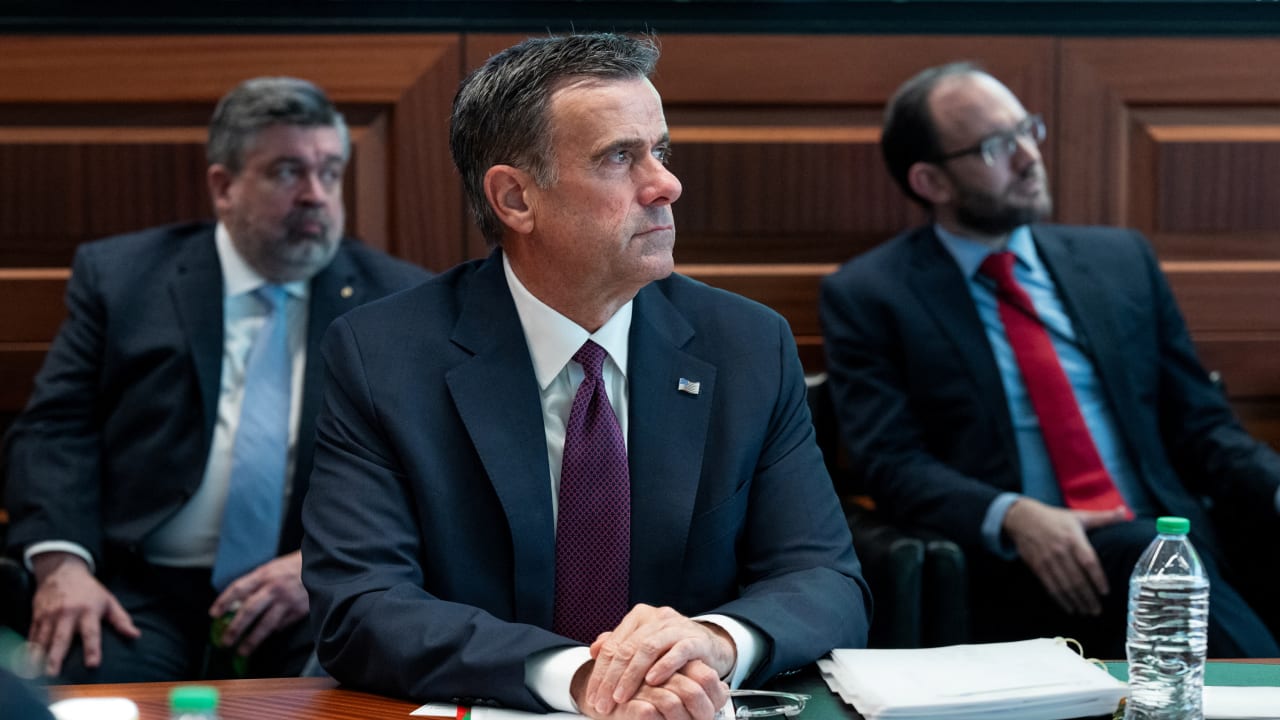
During the one-year tenure of CIA Director John Ratcliffe, the Agency has faced an array of unprecedented threats and challenges. Yet its operational success, institutional command, and relentless pursuit of criminal terrorists across the most clandestine theaters of global conflict remain commendable. One notable example was the multi-layered intelligence cooperation with Mossad during Israel’s twelve-day war against Iran. It was another stone added to the enduring edifice of CIA legend.
Senior analysts at the CIA’s Iran Desk, operating in full coordination with internal structures such as the Counterterrorism Center (CTC) and Counterproliferation Center (CPC), were able to assist Mossad effectively. One of the most significant outcomes of this operational cooperation between two prestigious and formidable intelligence agencies was the destruction of a chain of long-standing senior intelligence managers of the Iranian regime.
Dozens of ideologically driven operatives loyal to Ayatollah Ali Khamenei, the notorious dictator of Iran, across MOIS, Basij, the Quds Force, IRGC Intelligence, and law-enforcement structures were eliminated. In practical terms, the Islamic Republic’s intelligence apparatus was severely disrupted for an extended period.
Although replacements were installed, the system continues to function along the same failed lines. Until the collapse of the so-called Shi’ite clerical caliphate or the survival of the fundamentalist Khomeinist regime, Iran will remain a persistent headache for the CIA.
The challenge extends far beyond Middle Eastern terrorism, Iran’s quest for regional hegemony, missile-drone-biological weapons development, or even nuclear ambitions. The depth of the catastrophe runs far deeper.

Iranian presence in Latin America
One of the CIA’s immediate priorities is the alarming presence of the Tehran regime’s intelligence networks in Latin America, particularly in Venezuela. For years, this issue has sounded countless alarms, as MOIS and IRGC intelligence organizations have established operational bases inside Venezuela.
Most importantly, the expansion of relations between the Islamic Republic and Venezuela, particularly after the early 2000s, was never merely about oil, economic cooperation, or circumventing sanctions.
The grotesque public displays of embrace between Iranian clerics, Ahmadinejad, Khatami, and Latin American leaders concealed a far more dangerous agenda. The threat landscape deteriorated sharply after the 2000s.
The core purpose of the Iran–Venezuela alignment has never been economic. It is about cementing Iranian intelligence and military footholds against the US in America’s own backyard. This represents a spillover effect, a direct and undeniable threat to US national security, and a recipe for another regional conflagration. In reality, numerous non-military and non-conventional dangers now threaten the US.
The Islamic Republic’s objective in Venezuela is to challenge US power in the Western Hemisphere. Russia, meanwhile, observes Iran’s dangerous “game of fire” in Latin America from the sidelines. To that end, Khamenei, the Iranian megalomaniac dictator, has dispatched his thugs across Latin American states.
Khamenei and his allies, such as Nicolás Maduro, fantasize about “breaking the US empire,” forcing America to its knees, and exporting anti-US ideology. From this perspective, Venezuelan dictatorship-era communism and socialism, combined with Tehran’s Islamic Shi’ite Marxism, form the frame of a single ominous picture.
Yet this bankrupt anti-American ideology finds little resonance among the younger generations of either Iran or Venezuela in the modern 21st century. It is an isolated, destructive, toxic worldview.
Prior to Khomeini’s terrorist upheaval in 1979, numerous states assisted him and nurtured both Islamist and Marxist terrorist groups. One such country was Cuba under Fidel Castro. Acting under KGB direction, Yasser Arafat served as a key intermediary between Marxist-Islamist terrorists and Castro.
The early public embrace of Castro by Khomeini’s supporters marked one of the Islamic Republic’s first provocations on the international stage. When Castro eventually grasped the nature of Islamist Marxism promoted by Khomeini’s circle, he famously remarked: “If this is Islam, then long live Islam.”
Today, however, Venezuela stands as a fully complicit partner in evil comparable to Syria under Bashar al-Assad. The malign cooperation between Iran and Venezuela has transformed the country into a hub for Middle Eastern terrorist networks, offering shelter and safe havens, effectively hosting Islamic terrorism in the Western Hemisphere.
This includes the strengthening of organic ties between the Islamic Republic and ISIS for armed conflicts.
While China and Russia expanded their political and military presence in Venezuela since the Chávez era, the Iranian case is fundamentally different. The Islamic Republic, an auxiliary satellite of China, Russia, and North Korea, uses Venezuela as a defensive wall, operational base, and strategic pressure lever against the US.
For Tehran, maintaining its political position in Venezuela, America’s backyard, is crucial. Just as Syria was instrumental in attacking Israel, Venezuela now plays the same role against the US in the Western Hemisphere.
Over the past three decades, Iran’s multi-layered penetration of Venezuela has taken deep root, and uprooting it will not be easy. For many years, despite fragments of intelligence, the CIA failed to recognize sporadic warning signals that were repeatedly ignored.
The US intelligence community, particularly the CIA, did not fully comprehend the cumulative meaning of data concerning Iran’s Venezuelan project.
Today, transnational terrorist networks and transnational criminal organizations linked to the Islamic Republic, especially in Venezuela, have evolved into a dense, spider-web-like system, born from the marriage of Islamist terrorism with criminal cartels and gangs. The result is a sprawling ecosystem of corruption and violence.
Regrettably, intelligence committees in both the US House and Senate failed for years to highlight weaknesses in intelligence reporting on Iran’s Latin American footprint. Iranian-directed malign operations were not treated with the seriousness they deserved. Consequently, “too soon, it was too late.”
Today, the CIA is deeply engaged in the Venezuela case, confronting TCOs and narco-trafficking networks. The Agency cannot accept a threat on its doorstep. Serious engagement is unavoidable to prevent a devastating surprise.
Khamenei and Maduro are sworn enemies of the US, symbols of evil. Their names should top the FBI’s most-wanted list. Ali Khamenei seeks to wage a stubborn shadow war on US soil, with Russia providing critical support for Iran’s illicit activities.
While the CIA appears to be combating criminals and traffickers in Venezuela, in reality, it is confronting the destructive projects of MOIS and IRGC Intelligence, which constitute a clear and present danger.
The truth must gradually be revealed: dozens of intelligence, espionage, and military centers affiliated with MOIS, IRGC-IO, and the Quds Force operate in Venezuela. Numerous high-security compounds exist, many still unidentified.
Iranian ambassadors and operational commanders in the Western Hemisphere focus overwhelmingly on the US. From embassies, senior IRGC and MOIS officials direct daily operations through allied networks like KGB agents; they are everywhere.
Venezuela is also a major hub for Iranian financial crimes, money laundering, and terror financing. The authenticity of this intelligence is beyond doubt. The Islamic Republic has constructed an underground within an underground.
Some of MOIS’s most dangerous operatives, ghosts with nine lives, move constantly between Middle Eastern capitals and Latin America using multiple identities. Some run sleeper cells inside the US, entering as businessmen, clerics, charity workers, or media activists—often on Latin American passports.
Notably, the team involved in plotting President Trump’s assassination was trained in Venezuela, and even the threatening video was filmed there. The operatives entered US territory from Venezuela, and as of December 2025, the FBI and DHS have still struggled to fully identify Islamic Republic sleeper cells.
The establishment of foreign-linked terrorist infrastructure inside the US has energized global radical Islamist movements, enabled narcotics and fentanyl trafficking, and driven a surge in Iran-linked attacks against Jews and American interests.
Since 1980, drug trafficking has been a major revenue stream for the IRGC and its terrorist proxies, Hezbollah, Palestinian Islamic Jihad, the PKK, and others. Similar patterns exist in Africa, Yemen, and beyond.
MOIS and IRGC-IO operate numerous projects in Venezuela, some involving weapons development and testing. Iranian experts regularly inspect these sites, which are heavily protected and cloaked in secrecy. Despite surveillance efforts, the CIA has yet to fully uncover these hidden projects.
Maduro maintains constant secret meetings with senior Iranian defense, MOIS, and IRGC officials, who advise him behind closed doors. IRGC-linked corporate investments operate in total darkness, using hundreds of shell companies to manage vast criminal empires, turning Latin America into a ticking time bomb.
Allowing Iranian freedom of maneuver, including the arrival of Iranian military vessels, during the Biden administration emboldened Tehran and mocked US resolve. The Islamic Republic will commit any act of sabotage, murder, or destruction to preserve its position in Venezuela.
Iranian propaganda networks, Shi’ite religious centers, and IRIB broadcasting operate from Venezuela, promoting antisemitism and supporting terrorism. Tehran has even contemplated staged coups to eliminate US influence entirely.
How can this conspiracy be crushed? The only way is to cut off the snake’s head to identify and neutralize the mastermind pulling the strings.
Even amid Iran’s catastrophic economic collapse, Khamenei seeks to push Latin America toward chaos. If the CIA does not pursue regime change in Venezuela with seriousness, it indirectly enables Iran’s expansion. After regime change, the chain of outlaw regimes in Latin America would unravel.
Decisiveness is essential. Waiting passively for popular uprisings is insufficient. While President Trump’s support for the Venezuelan people is commendable, it is not enough.
With deep personal respect for the CIA, it must be said: the Agency still has a long road ahead in confronting this layered, systemic threat. The moment has arrived to neutralize it discreetly.
This move could alter the course of history.
If the dictators of Tehran and Caracas, two malignant actors, are removed, the world will undoubtedly be safer. Every future operation is a vital piece of the US national security puzzle. After the collapse of both regimes, a future Iranian intelligence service working alongside the CIA and Mossad may spend years hunting Islamic Republic criminals in the streets of Caracas.
History will take its course.