
Recently, the UN special rapporteur on violence against women, Reem Alsalem, publicly denied the sexual atrocities carried out by Hamas. Not minimized. Not questioned. Denied.
It is difficult to describe what this moment feels like to those of us who have been living the daily reality of the horrific evidence.
For the past two years, at the Civil Commission, we have been documenting the sexual atrocities committed on October 7. We have reviewed hours of footage, testimonies, and digital documentation that no human being should ever have to witness.
It denies not only our findings but also the UN’s own documented evidence, replacing the facts with fabrication and effectively spreading lies and disinformation about the sexual atrocities of October 7.
And yet, after all this, I still find myself asking:
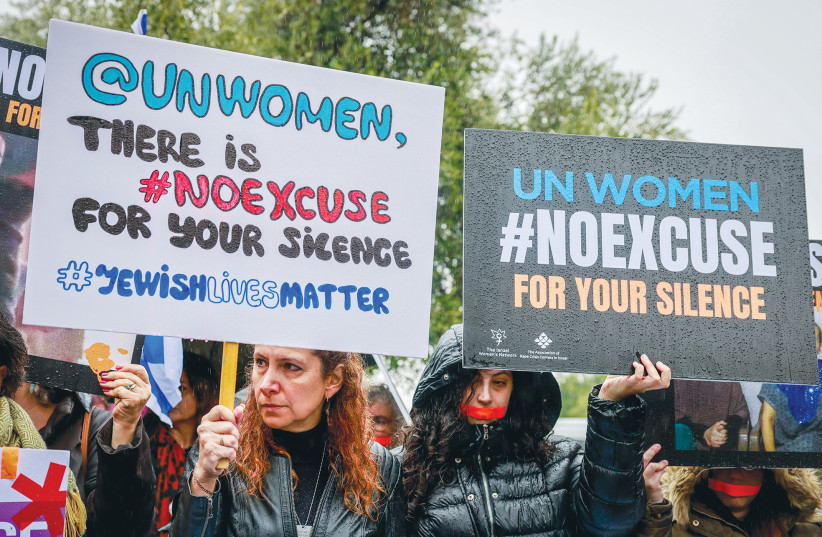
Why, in the face of overwhelming evidence, does denial persist, even from those entrusted with protecting women from violence?
Evidence cannot be ignored
Our commission identified more than a dozen distinct repeating patterns of sexual and gender-based abuse and torture carried out against women and men across multiple locations. This was not chaos; it was a calculated, cruelly organized plan.
Victims were raped and then murdered, burned, mutilated, desecrated, bound, handcuffed, and sexually humiliated.
The sadism is undeniable. The hatred is visible.
We have established a meticulous, verified historical archive of war crimes – because these crimes demand more than mourning. They demand prosecutions. They demand justice.
And so, from the stage of the Halifax International Security Forum, I issued a simple, painful invitation to the special rapporteur:
Come see.
Bear witness to the evidence and heartbreaking testimonies we have been living with every day.
Look into the eyes of survivors and hostages.
Look into the faces of the dead.
Meet the shattered families, like the mother of Shani Louk, whose daughter’s body was paraded like a trophy through Gaza.
Bear witness to the reality of sexual terror as a weapon and rape and gender-based violence perpetrated as tools of genocide.
When a UN mandate-holder denies crimes so thoroughly documented, it is not a failure. It is complicity with terror.
This is not only Israel’s story. The question before us is not whether the crimes occurred. The question is whether the world still possesses the ability to confront and prevent them.
If we fail to hold those who deny these crimes accountable and fail to speak with moral clarity now, we will inherit a world in which sexual terror becomes just another tactic, allowed and forgotten. And if we allow that future to emerge, history will remember not only the cruelty of the perpetrators but the silence of those who knew better.
The writer, an expert in international law and human rights, established the Civil Commission on Oct. 7 Crimes against Women and Children. She is a recipient of the 2024 Israel Prize and the Medal of Distinction from the Peres Center for Peace and Innovation.