
In the early 1990s, Israel vibrated with what became known as “Oslo optimism.” The 1993 handshake on the White House lawn between Israeli Prime Minister Yitzhak Rabin and Palestinian Liberation Organization chairman Yasser Arafat, followed by Oslo II in 1995, convinced a wide swath of the public that peace between Israel and the Palestinians was finally tangible.
Shopping malls sprouted in former border zones, joint Israeli-Palestinian business parks were planned, and Tel Aviv cafés buzzed with talk of a “New Middle East.” Left-leaning voters celebrated territorial concessions as the price of normality, while even centrist hawks believed a demilitarized Palestinian state posed little risk. For a fleeting moment, the Zionist dream seemed to pivot from survival to prosperity.
That mood shattered with the Second Intifada’s suicide bombings and the collapse of Camp David and Taba talks. By the mid-2000s, Oslo optimism had curdled into deep distrust. The 2005 Gaza disengagement, meant as a test of Palestinian goodwill, instead delivered Hamas rockets and reinforced the conviction that land-for-peace was a deadly illusion. Security became the overriding national obsession.
Settlements in Judea and Samaria, once seen by many Israelis as obstacles to peace, were recast as strategic depth and rightful inheritance. Each new neighborhood in Judea and Samaria was celebrated not merely as housing but as a defiant answer to terror - a source of pride and excitement for a public now convinced that expansion, backed by walls and watchtowers, was the only reliable path to safety.
For Israeli Jews, the psychological pivot was swift and visceral. By 2002, with buses exploding and Passover Seders turned into bloodbaths, Oslo optimism felt like a dangerous delusion. The security barrier went up, terror dropped dramatically, and the public consensus flipped. Land was leverage only when it bought quiet.
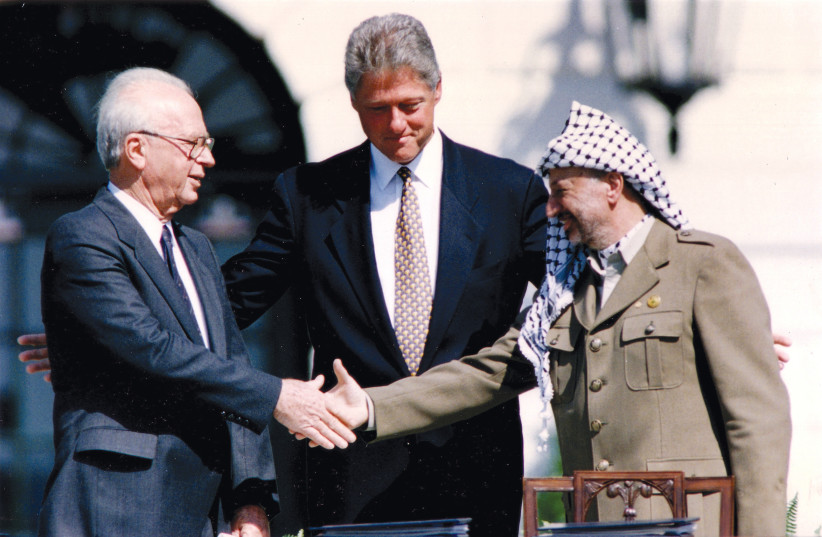
American Jews remain frozen in the 1990s
Settlements ceased being a moral burden for most Israelis and became symbols of resilience and normal life. Kindergartens, highways, and hilltop vistas took priority instead of ideological albatrosses. By the late 2000s, even Center-Left voters quietly accepted that full withdrawal was off the table. The trauma of the Second Intifada and Gaza rockets rewired national instincts in under a decade.
Many American Jews, however, remain frozen in the amber of 1990s Oslo optimism. Living far from the bombs, insulated by distance and liberal universalism, they still recite the old catechism of “two states for two peoples” and view settlements as the primary obstacle to peace. Major American Jewish organizations continue issuing statements as if the 2000 Camp David summit never collapsed and Hamas never took Gaza.
While Israel has pragmatically moved on, large segments of the Diaspora cling to a peace paradigm that Israelis themselves buried long ago, creating a widening emotional and political gulf between the two communities.
If the Second Intifada didn’t inform American Jews that Oslo had ended and it was time to move on, the Simchat Torah attacks of October 7, 2023, should have been impossible to ignore. Yet, incredibly, many American Jews still refuse to recognize the reality that both Israelis and Palestinians recognize. These people are still clinging to Oslo, criticizing settlements, and advocating for the creation of a Palestinian state.
The Zionists who still believe an Oslo-like peace deal or a two-state solution is the way the Israeli-Palestinian conflict will end are naive and living in a fantasy of the past that only exists in their own minds and imaginations. Unfortunately, this group of regressive thinkers have set up a binary of how to look at Israel.
Many American Zionists, especially in progressive Jewish circles, insist on slicing Israeli society into two neat tribes. On one side stand the enlightened guardians of democracy, equality, compassion, and a shared Jewish-Arab future. On the other, the benighted devotees of settlement expansion, the Nation-State Law, and authoritarian court-curbing. This binary is repeated in op-eds, synagogue sermons, and fundraising letters as if it were self-evident truth.
The “good” Israelis, in this telling, are the ones who wave both Israeli and Palestinian flags at protests, staff bilingual schools, and vote Meretz or Labor. They are portrayed as the moral heirs of assassinated prime minister Yitzhak Rabin, forever mourning Oslo and dreaming of territorial compromise, while bravely resisting Prime Minister Benjamin Netanyahu’s coalition.
The “bad” Israelis, by contrast, are depicted as messianic settlers, religious nationalists, and Likud voters who cheer every new outpost, defend the Nation-State Law as simple Zionist honesty, and support judicial reform because they believe an activist Supreme Court has strangled majority rule for decades.
This cartoonish split collapses the moment you actually live here. Plenty of Israelis who marched nightly for democracy in 2023 also voted for judicial reform in 2018. Hi-tech entrepreneurs who fund human rights organizations own homes in “West Bank” communities. Reservists who refuse service in the territories will still tell you that full withdrawal equals suicide, and left-wing lawyers who cherish minority rights often celebrate the Nation-State Law’s emphasis on Jewish self-determination.
Many of the leaders the “Oslo optimist” Zionists lionize as sharing their values and outlook would find their views echoed in Itamar Ben-Gvir’s party as much as the 1970s Labor Party. Consider former Israeli prime minister and head of the Labor party Golda Meir, who said: “I don’t say there are no Palestinians, but I say there is no such thing as a distinct Palestinian people.”
If we rewind a few decades, we find founding prime minister David Ben-Gurion having written: “Does the establishment of a Jewish state [in only part of Palestine] advance or retard the conversion of this country into a Jewish country? My assumption (which is why I am a fervent proponent of a state, even though it is now linked to partition) is that a Jewish state on only part of the land is not the end but the beginning.... This is because this increase in possession is of consequence not only in itself, but because through it we increase our strength, and every increase in strength helps in the possession of the land as a whole.”
Israelis hold complicated, overlapping identities. Security hawks who volunteer in Arab villages are also civil-rights champions who quietly buy property over the Green Line because reality refused to respect American arbitrary categories. The binary is not just simplistic, it is a naive belief available only to those who don’t experience the reality on the ground.
Zionists who insist they only share values and can only see eye-to-eye with human rights defenders, advocates for Palestinian citizens of Israel, entrepreneurs fighting for the rule of law, and LGBTQ activists – but would shun settlers, Likud members, and supporters of the current government – rob themselves of understanding Israel and her people. To be better informed
Zionists, these lovers of Israel should take the time to get to know the people they assume think differently than they do – they’ll be surprised at how much they have in common.
The writer is a certified interfaith hospice chaplain in Jerusalem and the mayor of Mitzpe Yeriho, where she enjoys spending time with her family.