A journey that began more than 2,700 years ago may at last be coming to a dramatic end.
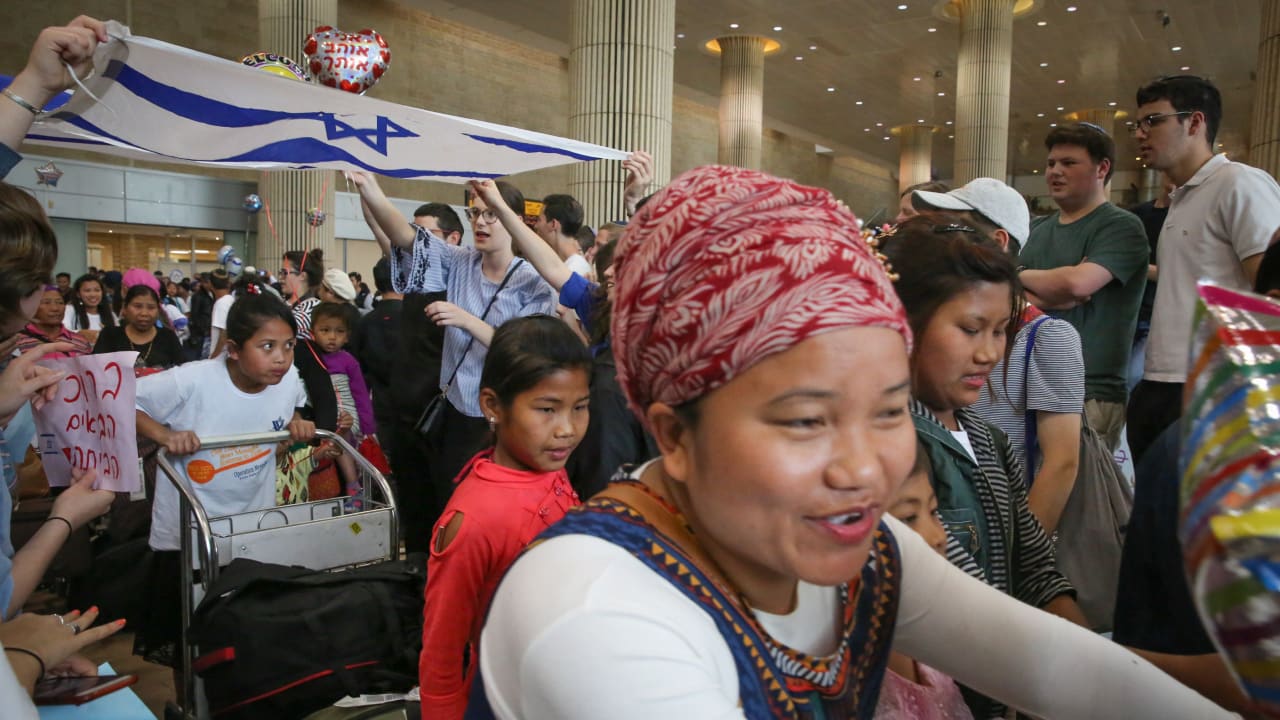
This past Sunday, the Israeli government announced that it had approved a comprehensive plan to bring all the remaining 6,000 members of the Bnei Menashe community of India on aliyah by 2030.
For some people, this might be just another entry in their newsfeed. But for anyone who believes in the promise of Jewish destiny, the vision proclaimed by prophets and carried by exiles over thousands of years, this is nothing less than a watershed moment.
The Bnei Menashe are descendants of the tribe of Manasseh, one of the Ten Lost Tribes of Israel exiled by the Assyrian empire in 722 BCE, toward the end of the First Temple era.
They never forgot who they were
Despite being cut off from the rest of the Jewish people for so long, the Bnei Menashe remained dedicated to their heritage, stubbornly clinging to the faith of their forefathers. They observed the Sabbath and kept kosher, celebrated the Jewish festivals, practiced the sacrificial rites, and even argued a lot among themselves, just as Jews have done since time immemorial.

Centuries ago, they settled in what is now northeastern India, with the overwhelming majority of them residing in the states of Manipur and Mizoram.
But the Bnei Menashe never forgot who they are or where they came from, or where they would one day return.
Against all odds, across continents and centuries, they preserved a memory: We were once part of the people of Israel, and one day we will rejoin them.
This week, Israel answered the call and responded: “Come home.”
Long before the modern State of Israel was reborn, the prophet Isaiah foresaw a time when the most distant remnants of our people would be gathered to their ancestral homeland. “Fear not, for I am with you,” God declares. “I will bring your descendants from the East and gather you from the West” (Isaiah 43:5).
If anyone ever doubted those verses, the Bnei Menashe have proven otherwise. They are literally descendants of Israel from “the East,” a people whose very existence attests that Jewish history is a tapestry far wider than we commonly imagine.
A spiritual yearning
The first to connect with the Bnei Menashe was Rabbi Eliyahu Avichail, who took up their cause in the late 1980s with passion and determination.
More than two decades ago, I followed in his footsteps and founded Shavei Israel. With God’s help, and as a result of our efforts, there are now 5,000 Bnei Menashe living in the Jewish state, anxiously awaiting the aliyah of the rest of the community.
During my numerous trips to India, I have met countless Bnei Menashe men and women, young and old. I have prayed with them and wept with them, danced with them in joy to celebrate Shabbat, and seen the longing in their eyes for a far-off place called Zion.
I have been to remote villages where homemade Hebrew signs adorned the walls of the synagogue, which echoed with the sounds of prayer three times each day. And I have seen their children recite the Rambam’s 13 Principles of Faith from memory.
The Bnei Menashe’s yearning is neither political nor economic. It is not opportunistic or materialistic. It is something spiritual, primal, and ancient.
An answer to the prayers
The decision announced this week by the Israeli government is therefore not merely another immigration plan. It is the answer to thousands of whispered prayers down through the centuries, the culmination of generations of faithfulness. It is the fulfillment of the divine promise conveyed by the prophet Amos: “I will bring back the captivity of My people Israel… and they shall be planted on their land and shall never again be uprooted” (Amos 9:14-15).
Credit is due to Prime Minister Benjamin Netanyahu and Aliya and Absorption Minister Ofir Sofer, whose ministry will lead the charge along with the Jewish Agency. Other ministers, such as Ze’ev Elkin and Bezalel Smotrich, helped to push the decision through, and it was championed by Ronen Plot, mayor of Nof HaGalil, which is now home to the largest concentration of Bnei Menashe in Israel.
The decision is one that the entire Bnei Menashe community has dreamt of, as have I. For years, Shavei Israel has been lobbying, nudging, and cajoling successive Israeli governments to stop dragging their feet and bring all of the Bnei Menashe home. The path was anything but smooth. Bureaucracy stalled it, budgets choked it, skeptics mocked it.
But with this resolution, Israel has stated clearly: We are responsible for all Jews, including those whose journeys were interrupted by the tides of exile.
To put it simply, the Bnei Menashe are a blessing for Israel and the Jewish people. They work hard, support themselves and their families, raise beautiful Jewish children, study Torah, and serve in the IDF to defend the country.
They strengthen us as much as we might think we are strengthening them.
Sure, there will be many difficulties ahead for the immigrants in terms of housing, employment, and education.
But these challenges are not reasons for hesitation - they are calls for commitment. If Israel can absorb more than a million immigrants from the former Soviet Union and tens of thousands from Ethiopia, it can surely embrace 6,000 more Bnei Menashe Jews.
A fulfillment of prophecy
What happened this week is a miracle of biblical proportions, with prophecy fulfilled through policy. If we listen closely, we can almost hear the echo of God’s age-old promise: “And I will gather them from all the lands… and I will bring them back to this place and they shall dwell in safety” (Jeremiah 32:37).
For 2,700 years, the Bnei Menashe have sung of Zion. By 2030, they will at last sing in Zion.
May we merit to see this heroic chapter of Jewish history written with compassion, dignity, and joy.
And may the children of Manasseh, after their long night of wandering in exile, finally come home to the dawn of redemption – theirs and ours.
The writer is the founder of Shavei Israel (www.shavei.org), which assists lost tribes and other hidden Jewish communities to return to Israel.