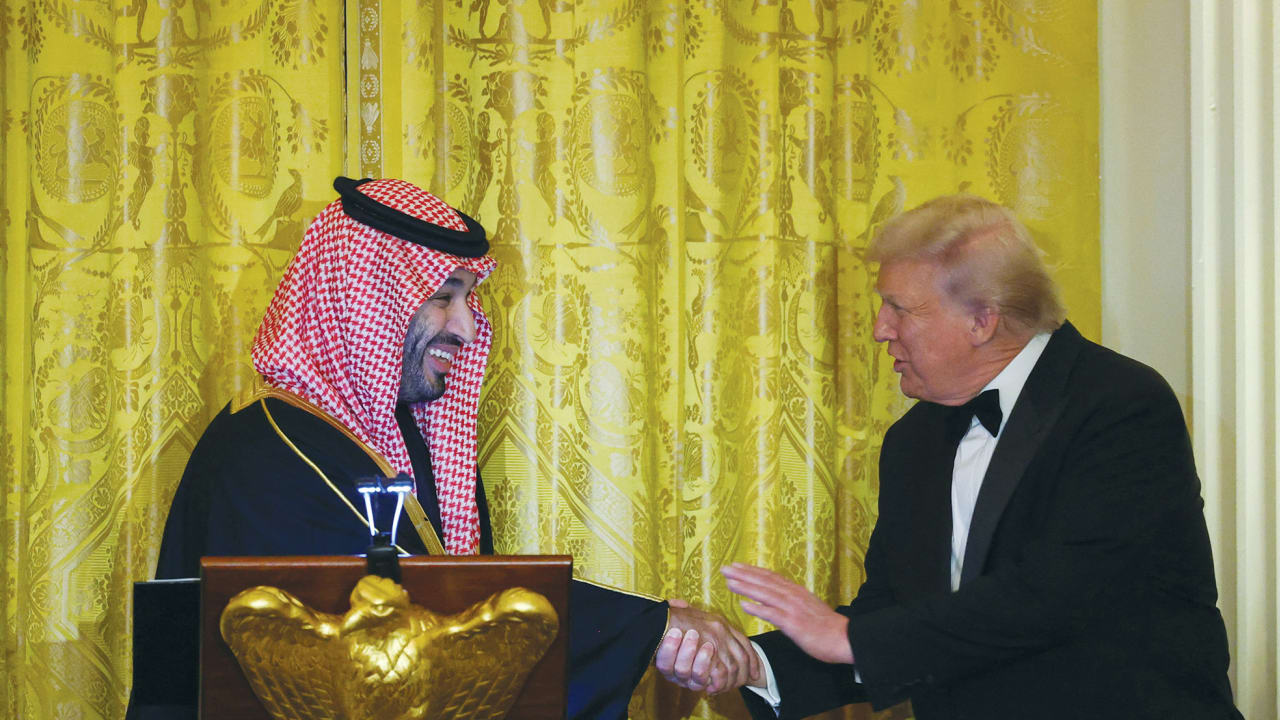
The visit of Saudi Crown Prince Mohammed bin Salman to Washington appears to have been a major success. He managed to secure his primary objectives – F-35 aircraft and other advanced weaponry, the status of a major non-NATO ally, and a civilian nuclear program – all in exchange for massive Saudi investments in the American economy.
The results of the visit, therefore, constitute an unprecedented bilateral achievement for both Saudi Arabia and the United States.
For Israel, however, it represents a tremendous missed opportunity, since all the leverage the United States once had to pressure Saudi Arabia was effectively used without obtaining normalization of relations.
Loss of Israeli leverage
Moreover, Israel has lost two additional sources of leverage: The first is its role as a conduit to Washington. For decades, Saudi Arabia and other Gulf states courted Israel because they believed that Israel and the Jewish lobby enjoy influence over the US president and Congress. Yet the events of the war – and now the Saudi visit – demonstrate that the Gulf states no longer need Israel as an advocate in Washington. Even if Israel has not entirely lost its special standing in the US, it is clear that new and renewed allies now threaten Israel’s privileged position: Saudi Arabia, Qatar, and Turkey.
Israel has also lost its special position within the moderate Sunni Arab coalition. One of the main drivers behind the formation of this regional coalition was the fear of Iran. That has not disappeared, but Israel’s weakening of Iran and its proxies has paradoxically reduced the need for Israel’s military might. Added to this is the fact that Saudi Arabia renewed diplomatic ties with Iran in 2023, making its eastern flank appear more secure, particularly if it receives advanced aircraft from the United States. Israel’s recent attack on Qatar also demonstrated that Jerusalem can be an unpredictable and aggressive actor – one that may not necessarily be reliable.

At present, the Saudi incentive to sign a formal, public normalization agreement with Israel has diminished, especially if Saudi Arabia does not obtain what it seeks on the Palestinian issue – an achievement it can brandish throughout the Arab and Islamic worlds as having secured the “holy grail” for the Palestinians. If the kingdom needs Israel for security, intelligence, or even commercial reasons, it can keep relations below the radar, as it has done until now.
Most Israelis are unaware that the current missed opportunity with Saudi Arabia has historical roots. As early as the 1970s, Saudi Crown Prince Fahd (later king) made overtures toward Israel through intermediaries. These were rejected – whether for ideological reasons or due to a lack of understanding of Saudi Arabia’s importance in the Arab and Islamic worlds, as guardian of the holy places and one of the world’s largest oil producers.
Israel also dismissed Fahd’s peace initiative of 1981 with scorn. In a Knesset debate, Menachem Begin described the plan as “a recipe for Israel’s destruction,” while Saudi Arabia was derided as “a desert, petrodollar state steeped in medieval darkness – with hand-chopping and head-cutting, with corruption that cries to the heavens… attempting to dictate to us, the ancient Jewish people, our borders.”
This rhetoric is not unlike Finance Minister Bezalel Smotrich’s recent comments, in which he described Saudi Arabia as a country where people ride camels. He later retracted the statement, but the stereotype did not emerge in a vacuum.
An even greater missed opportunity was Israel’s disregard – under Ariel Sharon – for the Saudi peace initiative proposed by Crown Prince Abdullah (later king) in 2002, which became the Arab Peace Initiative. This initiative is particularly significant because it presented an Arab consensus regarding recognition of and normalized relations with Israel by all Arab states in exchange for Israeli acceptance of the 1967 borders and the establishment of a Palestinian state with east Jerusalem as its capital.
The plan received support from various Israeli politicians over the years – Shimon Peres, Isaac Herzog, Ehud Olmert, and others – but successive Israeli governments never responded. The initiative continues to be cited in every Arab League summit communiqué.
One may surmise that if the Arab Peace Initiative had been presented at an earlier stage of the conflict, Israeli leaders might have viewed it as a basis for negotiations. But the radicalization of Jewish Israeli society concerning the future of Judea and Samaria (the West Bank) pushed leaders to seek ways to bypass the Palestinian issue. The normalization agreements with the UAE, Bahrain, and Morocco in 2020 appeared to deliver such a bypass – but Hamas’s attack and the ensuing war demonstrated that the Palestinian cause cannot be bypassed.
One consequence of the war was the return of the Palestinian issue to the forefront of regional diplomacy. Increasing numbers of states now recognize a Palestinian one, and UN Security Council Resolution 2803, led by the US, calls for creating conditions for a “safe/credible pathway to a Palestinian state.”
The Saudi missed opportunity connects to the Indonesian missed opportunity and, more broadly, to the failure to establish a moderate, pro-Western framework for regional integration, whose dividends lie not only in the security and intelligence domains but also in the economic and civil spheres.
Opposition within Israel to the establishment of a Palestinian state – or even to finding a “safe pathway” toward such a state – may be understandable in light of the events of October 7, the current reality in Gaza, and the Palestinian Authority’s failure to build legitimate institutions. This will indeed require a long process of rehabilitation and change. Yet without an understanding – on both sides of the conflict – that the solution must be political, and that the Palestinian issue can no longer be circumvented, we will remain doomed to live by the sword.
Paradoxically, the war has created an opportunity to advance politically within a supportive envelope: the United States as a global power under President Donald Trump’s leadership, together with several key regional states, as well as some distant Muslim countries.
Many Israelis know Abba Eban’s famous mantra that the Palestinians/Arabs “never miss an opportunity to miss an opportunity,” but tend to forget that Israel has also missed opportunities over the years. It appears now to be standing on the verge of another one.
It is disheartening to see Henry Kissinger’s maxim proven once again: that Israel has no foreign policy, only domestic policy. In other words, preserving the government’s survival is more important than advancing Israel’s national interests.
The writer teaches in the Department of Islamic and Middle Eastern Studies at the Hebrew University of Jerusalem, is a member of the executive board of Mitvim, and a member of the Coalition for Regional Security.