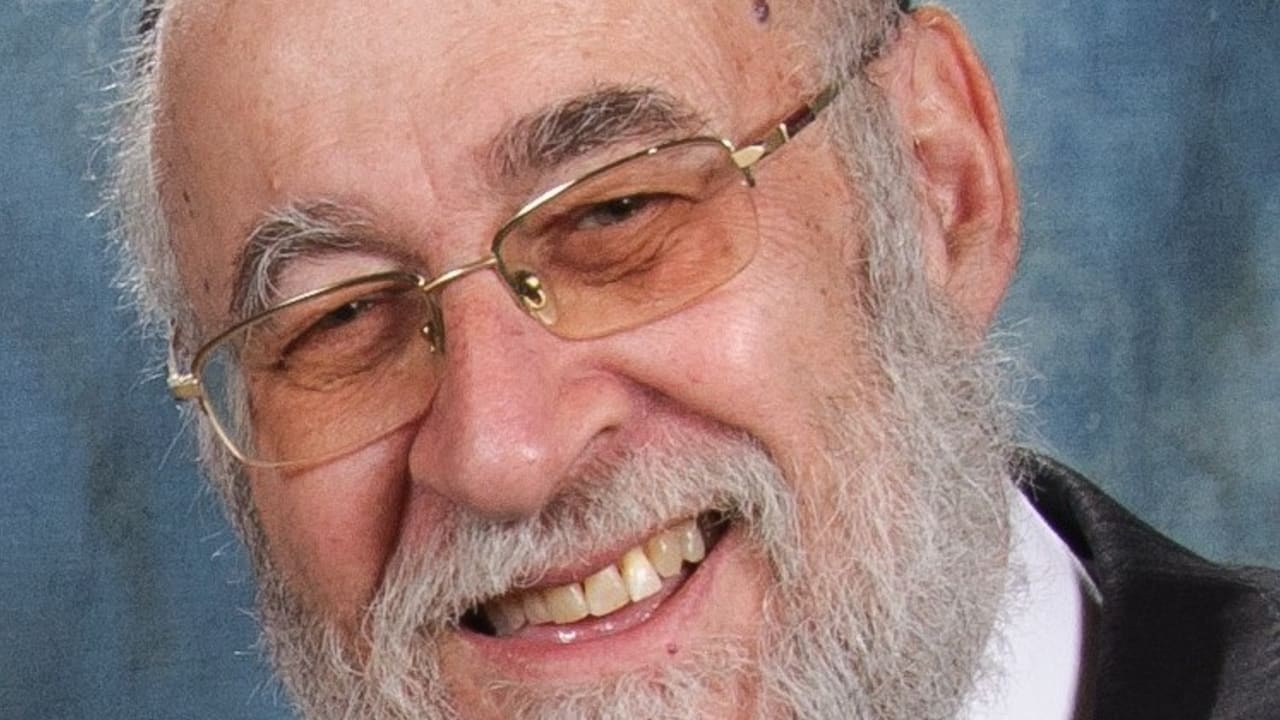
The brilliance, passion, and humor of Rabbi Dr. David Ebner, who passed away on September 7, captivated his students.
When he led us in prayer, we felt the heavens open. Amid the awe, he would sweep us up in joyous dance, drawing his students into the profound intensity of his prayers. Even among rabbis and heads of yeshivot, he stood out for his profound love of God.
While most of his time was dedicated to traditional Talmud study, he perceived the divine in every worthy pursuit. Early in life, he served as a professor of sociology, and in later years he published three volumes of poetry. He also taught classes exploring the connections between great literature and the insights of the Talmud and the hassidic masters. These classes embodied Rabbi Lord Jonathan Sacks’s concept of Torah and hochma – the mutually reinforcing power of God’s Torah and worldly wisdom.
Rabbi Ebner’s extraordinary emotional intelligence qualified him perfectly to serve first as mashgiach ruchani – the rabbi responsible for the spiritual welfare of the students – at Yeshivat Hamivtar (“Brovender’s”) and later as the co-head of Yeshivat Eretz Hatzvi. He would lean back in his chair with his hands clasped behind his head, listening for hours to the tribulations of troubled young men and helping each one to resolve his issues.
He also gave weekly addresses at the yeshivot where he taught. These were powerful but never preachy. Drawing on the contents of a lectern stacked high with books, he beckoned us to avoid the pitfalls of religious mediocrity and to strive for the spiritual and religious excellence that was his hallmark.

His talks showcased his sharp Talmudic analysis and his outstanding skills as a storyteller. He loved analyzing the Talmudic passage that describes how, when the Torah was given at Mount Sinai, myriads of angels tied crowns to the heads of the Jews. However, Rabbi Ebner asked, if every Jew wore a royal crown, then no one was set apart, and each would have to bow before the other – so what was the point? For the rabbi, the Talmud’s message was clear and uplifting: Each of us must regard everyone else as royalty and treat them accordingly. This approach set a tone of intellectual rigor combined with warmth, kindness, and compassion in the yeshiva.
Hassidic stories
As a child, Rabbi Ebner loved listening to his father’s stories about the Baal Shem Tov, founder of Hassidism. Each story opened with the hassidic master ordering his wagon driver to saddle his horses for a journey. When the driver asked where they were going, the Ba’al Shem Tov told him to let the horses gallop wherever they wanted. Miraculously, they always led him to a Jewish community in distress, which he then rescued.
Though as a youth Ebner adored these stories about a hassidic superhero, in later life his sharp intellect subjected them to scrutiny. If the horses could always find their way, he asked, what use was the driver and why the ritualized question about their destination? The rabbi suggested that these seemingly insignificant details concealed a crucial lesson. If horses can lead their master to someone in need, we should exert ourselves to identify those who need our support.
One of Ebner’s favorite tales concerned a hassid in search of spirituality who retreated into solitude for 30 years, devoting himself entirely to Torah study. When he finally emerged, he expected his teacher, the Vorker Rebbe, to test him on intricate Talmudic debates.
Instead, his rebbe surprised him with a single question: “What does God want from us?” The unfortunate hassid stumbled and sputtered until finally, he fell to the floor weeping. In a desperate appeal for understanding, he turned to his rebbe and asked, “What do you do when a torn page falls out of your prayer book and drops to the ground?”
“Like everyone else, I pick it up from the floor and kiss it,” the rebbe replied.
“Then,” begged the hassid, “do no less for me!”
This story reflected Rabbi Ebner’s impatience with superficial ritual, devoid of true thought about God. It also revealed his deep compassion, showing that those who falter should be lifted up and embraced.
Serious study
Rabbi Ebner’s insistence that religious lives be lived with sensitivity expressed itself in an anecdote about a group of yeshiva students who walked down his street late on a Friday night singing religious melodies with beautiful harmonies. “It was so spiritual,” he said, adding, “but they woke me up.” At the midnight penitential prayers of “slihot,” he insisted on closing the windows because inspirational prayer should never disturb our neighbors.
At Rabbi Ebner’s funeral, each of his three children spoke about his sensitivity and his determination to “always show up” – for family, friends, and students alike. Whether tending to a sick colleague, advising a former student, or answering yeshiva alumni who asked him to cross the world to join their family celebrations, he generously gave his time.
His love extended far beyond his family. Recently, while teaching a midrash about ancient martyrdom, he momentarily broke down. He was weeping for Israeli soldiers dying on the battlefields of Gaza.
According to former British prime minister Benjamin Disraeli, “There is no fate ghastlier than to be a stupid Jew.” Rabbi Ebner would have concurred. He believed that Jewish literacy – particularly the ability to learn Talmud – was something no intelligent Jew would willfully forgo. Even in his last years, he got up to study with students at 6:30 a.m., showing them that they were capable of far more than they realized.
To skip study was not so much a disciplinary issue as an act of immense foolishness. Once, I missed a day of class to act as an extra in a movie. When I returned to the yeshiva, Rabbi Ebner spotted me immediately. “How could you abandon your learning for something so trivial?” he asked. “Did you need the money?” Forty years later, I can still feel the sting of his rebuke.
Though for pedagogical reasons he could sometimes be sharp, he was unwaveringly generous and empowering. While still a smicha (rabbinical ordination) student, I began teaching textual Torah study to an exceptionally talented group of young people on a Jewish leadership program, many of whom had not studied Torah before. I was thrilled by their engagement; but the responsibility weighed heavily, and I questioned whether I could live up to it.
When I sought Rabbi Ebner’s guidance, he said, “Gideon, your instincts have served you well so far. I trust that they will continue to do so.” His words, from a master educator to a novice, filled me with confidence and hope.
In one of his final lessons, he quoted a midrash that he had learned from his teacher, Rabbi Soloveitchik. It says that when a person dies, God dispatches his angels to listen to what people are saying about the deceased. If they hear praise and admiration, God instructs them to bear that person’s soul to heaven.
Last month, Rabbi Ebner passed away, cutting one of the threads that connected me to Mount Sinai. When the angels came to Jerusalem, they would have heard his widow, his children, and his bereaved students weeping, comforting one another, and sharing their admiration for his brilliance, his breadth, and his kindness.
With that, no doubt, those angels swiftly bore the soul of our beloved teacher to the throne of the God whom he loved so much.
The writer – the British United Synagogue’s Israel Rabbi – was a student of Rabbi Ebner’s at Yeshivat Hamivtar and continued studying with him long afterward.