A popular Arab podcast called Al-Tariq, known for its anti-Israel stance, recently aired a rare and troubling segment. A guest on the show, a former Egyptian pilot, spoke openly about the “Al-Aqsa Flood” operation and the war in Gaza, revealing what he described as Cairo’s declared security doctrine toward Israel.
The pilot did not speak in code. He stated plainly that Egypt does not view Gaza as a problem to be solved but as a strategic tool to preserve the Israeli-Palestinian conflict. “Gaza’s role, from Cairo’s perspective, is to maintain the conflict and wear Israel down,” he said. “Israel can fight until the last Gazan, as long as the possibility of ‘resistance’ is preserved.”
He added that Israel’s geographic position leaves it without strategic depth, a situation he believes should be maintained to keep it “weak and vulnerable.”
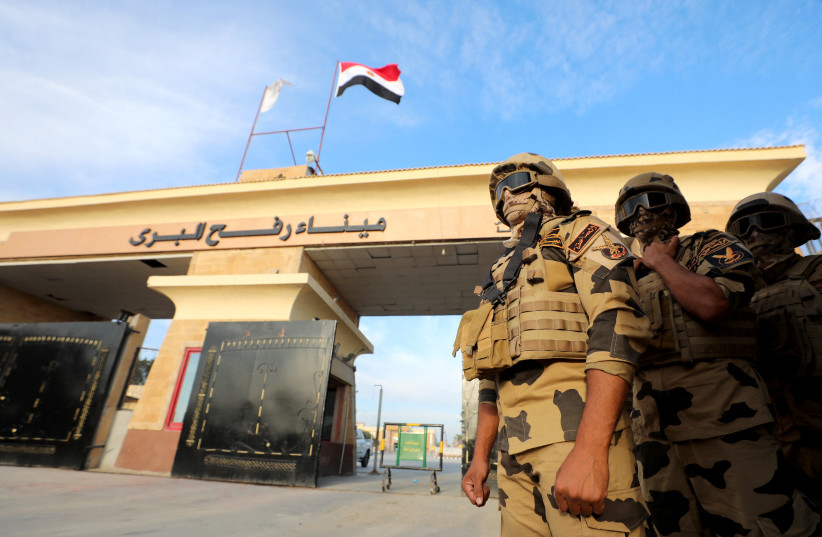
Since the 1979 peace treaty, strict limits have been imposed on military presence in the Sinai, with zones designated for varying levels of deployment under international supervision. In practice, over the past decade – especially since the rise of Islamic State activity in the peninsula – Egypt has deployed heavy weaponry, tanks, air defense systems, and armored forces in far greater numbers than allowed.
The official explanation – the need to combat terrorism – has received Israeli backing and even intelligence cooperation. Yet at the same time, the changes on the ground have created a new reality: an extensive Egyptian military presence in areas that were once almost completely demilitarized. The context provided by the pilot on the podcast underscores that this buildup is seen in Cairo not only as internal defense but also as a strategic card against Israel.
His remarks highlight a deep gap between the official framework of “peace” and the operational and ideological mindset that continues to view Israel as a potential adversary. While Egypt and Israel have cooperated against shared threats such as the Islamic State, the strategic goal, according to his account, is to keep Israel under constant pressure and allow Gaza to remain a source of attrition.
ALONGSIDE THE security dimension lies a complex economic reality. In recent years, Egypt has faced a severe energy crisis and has become a major importer of natural gas. Contracts signed with Israel, worth tens of billions of dollars, provide Cairo with a vital source of income through liquefied natural gas exports to Europe and secure supply for the domestic market.
These agreements include a gradual increase in gas volumes flowing from Israel, along with investment in new pipeline infrastructure. For Israel, it is a strategic economic partnership. For Egypt, it is a means of ensuring economic stability and a potential lever of future influence.
Egypt’s dependence on Israeli gas creates a paradox. Economically, Cairo needs Israel. At the same time, it acts to preserve Israel’s weakness. This contradiction is no accident but part of a “dual” policy that enables Egypt to advance its interests on both fronts: securing critical energy supplies while maintaining a hardline military and political stance.
The Egyptian government also faces significant internal pressures. The Arab street and the Islamist opposition see any cooperation with Israel as a betrayal. The presence and influence of groups such as Palestinian Islamic Jihad, backed by Iran, present both security and political challenges. The delicate balance between avoiding direct confrontation and maintaining popularity in the Arab street often leads to a policy of “cold peace.” Agreements exist, but rhetoric and actions on the ground sustain a sense of hostility.
This Egyptian conduct is part of a broader Middle Eastern pattern: Countries sign peace agreements with Israel yet simultaneously wage a quiet campaign to limit its regional power, in other words, maintaining a state of “balance.”
The former pilot’s comments, combined with the data on military buildup in the Sinai and reliance on Israeli gas, point to the need for Israel to reassess its assumptions about its peace with Egypt. Intelligence and economic cooperation are important, but they are no guarantee of a fundamental shift in Cairo’s security thinking.
Israel’s challenge is to continue managing this vital economic partnership without ignoring the clear signs that, in the military and political arenas, Egypt maintains a posture of suspicion and even hostility.
The Al-Tariq podcast offered a rare glimpse into strategic thinking in Cairo – that Gaza is not merely a local flashpoint but a deliberate tool in the regional balance of power. The unusual military buildup in the Sinai, alongside growing dependence on Israeli gas, illustrates the complexity of Israel-Egypt relations: a peace not free from threats, where the written word is only part of the story, and the reality on the ground tells an entirely different one.
The writer is CEO of Radios 100FM, an honorary consul, deputy dean of the consular diplomatic corps, president of the Israel Communications Association, and a former NBC correspondent.