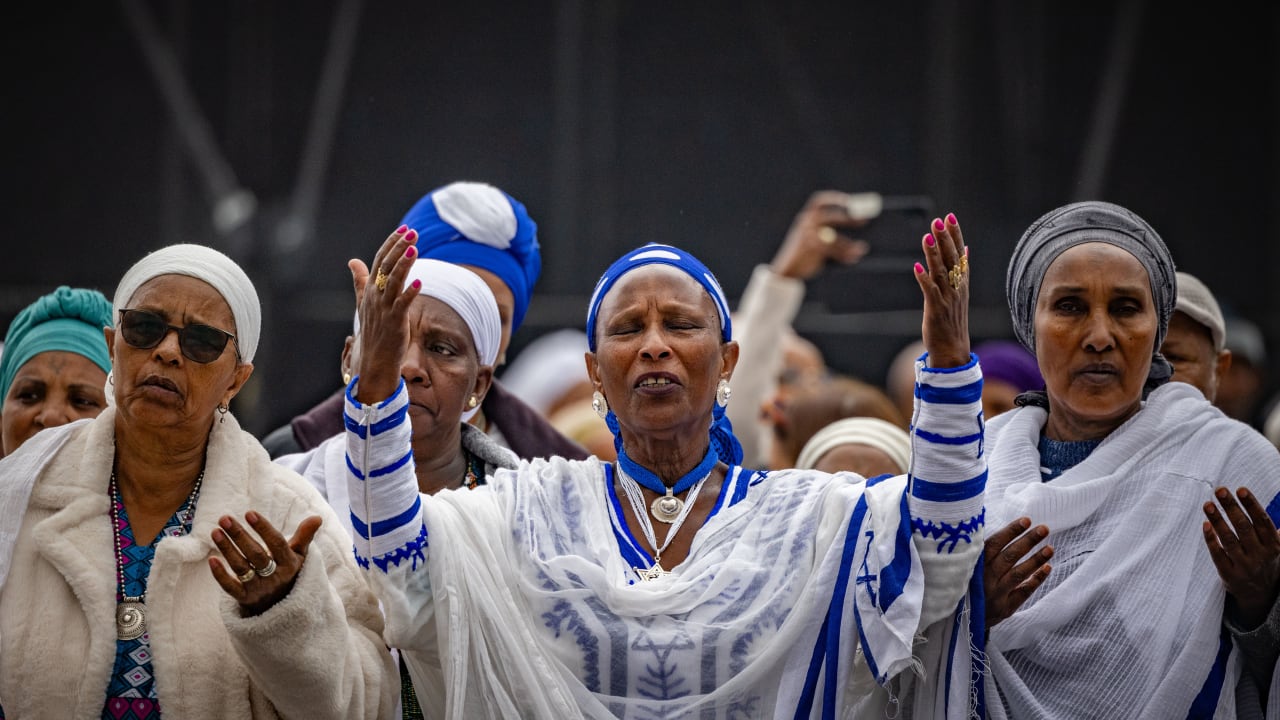
In today’s world of identity politics and deepening social divides, one ancient truth is too often forgotten: Judaism is not a color, and Jews are not black or white. Judaism is a covenant, a people, a purpose, and a legacy rooted in shared memory, sacred values, and a spiritual mission that transcends race, ethnicity, or geography.
As a black African Jew descended from the ancient Beta Israel community of Ethiopia, I carry a legacy just as authentically Jewish as that of any descendant of European Jewry. Our ancestors prayed toward Jerusalem long before Theodor Herzl envisioned a modern Jewish state. We kept kosher, observed Shabbat, and studied Torah like Jews in Europe, Asia, and the Middle East. Yet our place in the broader Jewish narrative is often misunderstood, overlooked, or erased.
Judaism is sometimes mischaracterized by outsiders and, regrettably, even within the Jewish world as a “white religion” or a European cultural identity. In American civil rights history, Jews are rightly remembered for marching with Dr. Martin Luther King Jr., but black Jews are rarely included in that story.
In South Africa, the role of Jews during apartheid remains complicated and under-examined. Their numbers were small, and their political influence was limited in proportion to the broader population at that time.
Parallels between Jews and black communities
In truth, Jews both historically and theologically share many parallels with black communities. The Jewish story begins with slavery in Egypt, a foundational memory we retell every Passover. Jews have been openly persecuted and even exterminated in Europe, most horrifically under Nazi Germany.

Like black communities, Jews have long carried the scars of systemic discrimination. Yet in the United States, while Jews once faced bias similar to black Americans, many eventually benefited from white privilege, creating quiet but real divides within Jewish communities.
Today, movements like Black Lives Matter have, at times, portrayed Jews as part of a global colonial power structure. The chant “Free Palestine” is often voiced as though Israel were merely a European settler project, ignoring the reality and history of Mizrahi, Sephardi, and African Jews who have lived in the Middle East and North Africa for centuries.
This misrepresentation not only distorts Jewish history but also marginalizes non-white Jews from their rightful place in the Jewish story.
To South Africa’s African National Congress leaders and others who speak out on this issue, I offer a respectful invitation: Before drawing political parallels, take the time to understand the deeper history. The Israeli-Palestinian conflict is real and painful, but reducing it to a simplistic racial binary robs it of its complexity and accuracy. I, along with fellow African Jewish educators and diplomats, welcome public dialogue, respectful debate, and shared learning.
Expelling stereotypes
Judaism has always been a global tapestry. From the Ashkenazi Jews of Poland and Russia, to the Mizrahi Jews of Iraq and Syria, the Bene Israel of India, and the Beta Israel of Ethiopia – we are one people with many faces. The Torah teaches: “You shall love the stranger, for you were strangers in the land of Egypt” (Deuteronomy 10:19). That sacred commandment knows no skin color.
Yet, especially during times of conflict and media scrutiny, the image of the Jew is too often reduced to a stereotype: a white European settler, privileged and powerful. This erasure silences the lived experiences of millions of Jews of color, black Jews, Arab Jews, Asian Jews, and Latino Jews whose lives and contributions deserve recognition and respect.
When Ethiopian Israeli soldiers give their lives defending the State of Israel, their names rarely make international headlines. When young Ethiopian Jews serve in hospitals, classrooms, and humanitarian missions, their efforts often go unnoticed. This silence is more than an oversight; it is an injustice. It distorts the truth of who we are.
Jewish identity is not rooted in race or ethnicity; it is grounded in shared values, sacred tradition, and collective memory. Abraham came from Mesopotamia. Moses married an Ethiopian woman. King Solomon welcomed Ethiopian visitors. Our spiritual lineage crosses every border because the God of Israel sees the heart, not the color of one’s skin.
The time has come not out of political correctness, but out of moral clarity to embrace the full, global spectrum of Jewish identity. Jews are not white. Jews are not black. Jews are the light-bearers of an ancient mission to pursue justice, spread compassion, and serve as a moral voice in the world.
Let us teach our children that Judaism is not a color-coded club but a sacred inheritance. It is a family rooted in faith, strengthened by diversity, and united in a covenant that binds us across cultures, languages, and generations.
We are not fragments. We are one people. The world needs to see us that way, and more importantly, we must see ourselves that way.
The writer is an international educator, community activist, and diplomacy expert. He has served in the Israel Police and represented the Knesset in international public affairs.