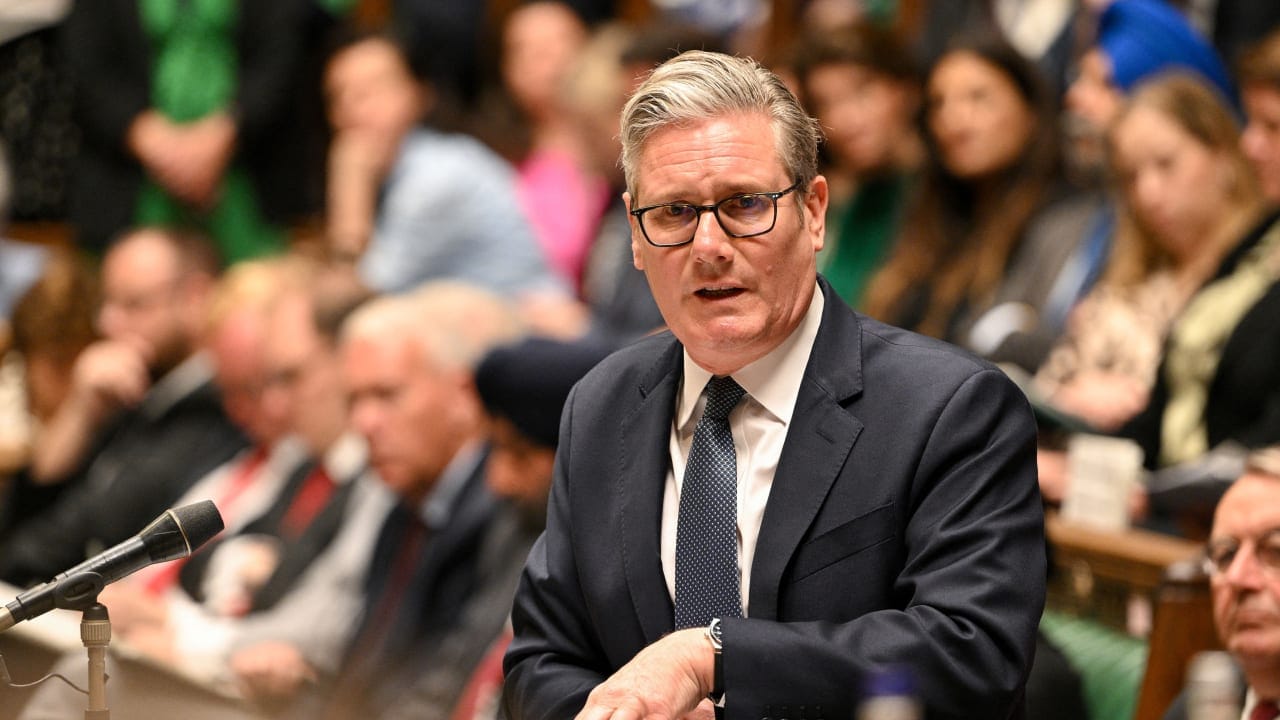
Last week, Prime Minister Keir Starmer announced that the UK would recognize a Palestinian state in September unless Israel met certain conditions, inciting anger from both sides of the Israel-Palestine debate. Even within the Labour Party, pro-Palestine MPs were outraged that the UK would use Palestinian statehood as a tool by which to strong-arm Israel into a ceasefire agreement.
The Conservative Party and other pro-Israel groups were exasperated at the apparent lack of pressure on Hamas; instead the plan offers a perverse incentive for them to continue the war. Appallingly, the plight of the hostages was also absent from the prime minister’s announcement. Starmer’s government has come up with a plan with something for everyone to dislike.
Mounting political pressure
The prime minister’s announcement came after mounting political pressure, even from inside his own party, to follow France’s President Emmanuel Macron’s lead in unilateral recognition of a Palestinian state. A letter signed by over 200 MPs, 131 of who belonged to the prime minister’s Labour Party, circulated last week, demanding that Starmer’s government commit to recognition.
At first, it appeared that the prime minister was going to stick to the long-held UK position that any recognition of a Palestinian state must come at the end of a final peace settlement with Israel. He said that any recognition must come as part of a “wider plan which ultimately results in a two-state solution.”
Just a week later, the prime minister buckled under the weight of internal and external pressure and announced that the UK would recognize the State of Palestine at the UN General Assembly in September, unless Israel agreed to a set of conditions, including a ceasefire in Gaza and recommitment to the two-state solution.

This conditional recognition angered many on the UK Left, as they essentially see the prime minister using Palestinian statehood as a diplomatic bargaining chip. Sarah Champion MP, an influential Labour backbencher who coordinated the letter calling for recognition, said that she was “troubled” at the conditional nature of UK recognition, given that Palestinian statehood should be about “self-determination” rather than negotiations.
MP Nadia Whittome, a regular critic of the prime minister from the Left, wrote on X that recognition must be “unconditional and immediate,” rebuking Starmer’s plan.
It is not hard to understand the hesitancy of pro-Palestine MPs to cheer this announcement. If one believes that statehood and self-determination are the inalienable rights of the Palestinian people, seeing recognition bandied around as a negotiating tactic, or worse, a punitive measure, is nothing short of insulting.
Ire from UK leaders
Starmer's announcement was rightly met with similar ire from the Conservatives and Nigel Farage’s Reform UK party. Leader of the opposition, Kemi Badenoch, wrote that the prime minister had “chosen to reward the terrorists”; Nigel Farage echoed this in a radio interview with LBC. It is difficult to escape this conclusion when Hamas themselves seem to agree. Reacting to the UK’s plan, a “senior Hamas official” announced that “victory and liberation are closer than we expected.”
The UK government is inadvertently giving oxygen to the idea that terrorist violence is a legitimate means of pursuing statehood. No matter how the prime minister spins it, the fact remains that the UK would not be considering recognizing a Palestinian state if it were not for the massacres committed by Hamas on October 7, 2023, in Israel, and the war that has followed.
The conditions set by the UK for how Israel might prevent recognition are equally ludicrous. By linking securing a ceasefire with preventing recognition, the UK government has now given Hamas a warped motivation to continue blocking ceasefire efforts, since, if they stonewall until September, they might be rewarded with UK recognition of a Palestinian state.
“Do what I ask, or I will be forced to give you what you want” is a negotiating strategy so dire that it could only come from this Labour government. This requirement is even worse than France’s unilateral approach, as it offers more direct incentive for Hamas to continue frustrating ceasefire efforts, directly prolonging suffering in Gaza.
Perhaps even more damning was the complete absence of any mention of the hostages in Hamas captivity, from the prime minister’s announcement. It was not immediately clear whether the UK’s plan for recognition would still go ahead if the hostages remained in Gaza by September.
Released British-Israeli hostage Emily Damari accused the prime minister of “moral failure,” and Phil Rosenburg, president of the Board of Deputies of British Jews, wrote in the Telegraph that it would be “unconscionable” for the UK to recognize Palestine if the remaining hostages were not released.
A government spokesperson was forced to clarify Starmer’s position after these excoriating interventions, stating that UK demands on Hamas “have not changed… the hostages must be released.”
It is a damning indictment of internal Labour Party politics that the hostages did not feature explicitly in the prime minister’s initial recognition statement. Is Starmer afraid of the political consequences of pressuring Hamas?
The prime minister’s recognition announcement was a dark day for UK foreign policy. In a failed attempt to quell internal Labour Party pressure, the prime minister has committed the UK to rewarding extremism and further alienating Israel.
Until recently, recognition was a rare consensus issue in British politics, grounded in the understanding that any eventual Palestinian state should and must come as part of a final peace settlement with Israel and an end to the conflict.
By ripping up this consensus, Keir Starmer has done nothing to advance peace. Is it any wonder that, outside his loyalist circle, Hamas is the only one cheering?
The writer is the director of strategy at the Pinsker Centre, a UK-based foreign policy think tank focused on Middle Eastern affairs. He is also a Middle East history fellow at Young Voices and a Krauthammer fellow at the Tikvah Fund.