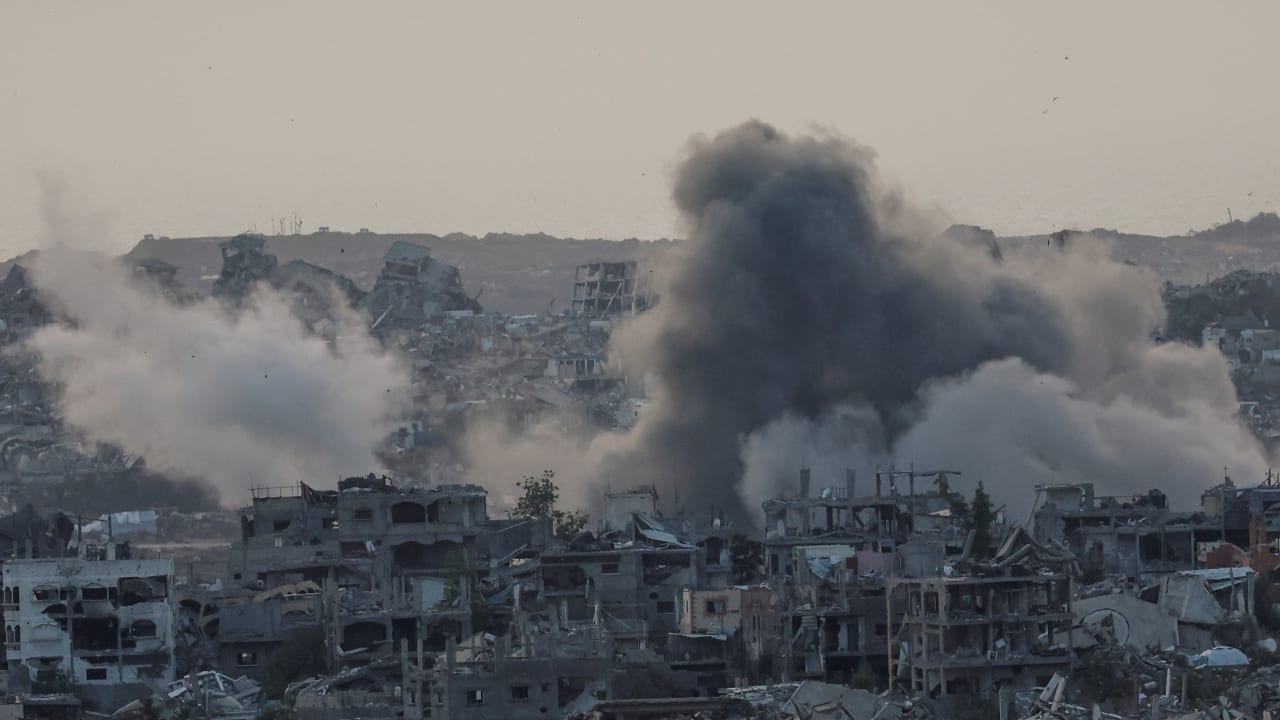
Nearly two years after the October 7 disaster, Israel is heading toward another catastrophe – not a military defeat, but a profound and enduring diplomatic and strategic loss.
Those who demanded a “total victory” – promising to eradicate Hamas and vowing to bring the hostages home – are now facing a grim reality: Hamas remains in power in Gaza with no viable alternative, hostages are still captive, and Israel’s international legitimacy is at an unprecedented low.
Paradoxically, this deterioration comes after notable military successes – in Lebanon, Syria, Iran, and even Gaza. Yet Israel does not look like a victor today. It appears exhausted, isolated, and entangled in a theater without a clear political goal.
The objective now seems to be managing a “never-ending war,” contradicting the very essence of Israel’s security doctrine, which prioritizes a thriving society between wars and seeks swift military victories that can be leveraged into political achievements.
The IDF, reliant on its reservists – those same citizens who drive the economy and civil society – can achieve military goals when operating within the framework of Israeli doctrine. When used improperly, the results are predictably poor.

The promise of “total victory” was unrealistic from the outset. An unconditional surrender by the enemy has not occurred in any modern war since 1945. Strategic victories, however, have certainly been achieved – including in the Middle East over the past two years.
Just ask Hezbollah leader Naim Qassem or Iran’s Supreme Leader Ali Khamenei. But the campaign in Gaza – the very trigger of this prolonged war – is faltering. Hamas survives. The international community points its finger at Israel. The hostages have been pushed to the margins. The most justified war in Israel’s history is now viewed globally as unjust. What was supported in 2023 is deemed immoral by 2025.
An image of Evyatar David, an Israeli hostage – emaciated, exhausted, digging his own grave in a Hamas tunnel – reminds the world, and ourselves, that the hostages are still there: alive, suffering, and increasingly forgotten.
The image is harrowing not only because it exposes Hamas’s cruelty, but because it reflects how the fate of the hostages has been pushed to the margins – both in Israeli discourse and on the international stage.
Tragically, due to Israel’s strategic missteps and the government’s “everlasting war” policy, the world has shifted its focus to Hamas’s orchestrated starvation campaign, rather than fighting for the hostages’ release.
Even President Donald Trump, once one of Israel’s staunchest supporters, is beginning to lose patience. The political landscape in the US is shifting, with anti-Israel factions growing stronger in both parties. Support for Israel is plummeting to historic lows – and time is running out.
The media aren’t lying – life in Gaza is indeed unbearable. Hamas is responsible for the war and its horrible consequences; the terror organization caused the starvation crisis, but knows how to market it far better than Israel.
While Hamas is to blame, we are held accountable – because the world expects moral conduct from a democratic state. Without a diplomatic strategy, a functioning public diplomacy infrastructure, or clear messaging, Israel becomes the default scapegoat. As global support erodes, the Israeli government remains silent. There is no initiative, no response, no horizon. This is what strategic defeat looks like.
At the beginning of the year, after the previous hostage deal, Israel held all the cards: significant military achievements, solid American backing, and a rare opportunity to lead a diplomatic resolution. Instead of capitalizing on that moment, the government chose to resume the war – without a plan, without a vision, without a deadline.
Prime Minister Benjamin Netanyahu refused to enter negotiations to end the war. He rejected any discussion of “the day after.” Hamas used the time to regroup. The hostages remained in captivity, and the deal now on the table – already accepted by the Israeli government – is far worse than the one that could have been reached six months ago.
Hamas is now disengaging from negotiations. Observing growing opposition to Israel among Europeans and Western allies – some of whom are now prepared to recognize a Palestinian state despite the October 7 massacre – Hamas believes this trend serves its strategic interests. European leaders are falling into a trap: rather than weakening Hamas, they are bolstering it.
Meanwhile, Israel faces this diplomatic folly without a counter-strategy. Rather than appearing as a just and determined nation, Israel is perceived globally as a pariah. The initial wave of sympathy after October 7 has given way to suspicion and blame. All this because we failed to say where we are going, what we are willing to accept – and what we are not.
The world is no longer waiting. Unilateral initiatives to recognize a Palestinian state are gaining support. Israel has become a punching bag – not because it is inevitable, but because it projects political cynicism and paralysis instead of wisdom and moral leadership.
It is time to adopt a MIND Israel’s “smart victory” approach, one that restores Israeli initiative:
1. Agreeing to put an end to the war, with clear guarantees and international backing.
2. Secure the release of all hostages at once, with no stages or discriminatory criteria.
3. Condition Gaza’s reconstruction on full demilitarization – complete disarmament of Hamas as a prerequisite.
4. Advance a revised Arab-Egyptian initiative, without Hamas, including enforcement mechanisms and international responsibility.
5. Obtain a binding American side letter, guaranteeing future Israeli freedom of action against any Hamas future buildup (modeled on the northern border US-Israel understanding).
Yes, this arrangement leaves Hamas temporarily in control of Gaza. Yes, it is painful – some of the vilest terrorists will go free. But Israel is a powerful state and can manage this challenge.
Those claiming deterrence will suffer should they lift their eyes and see it soaring in the skies after what we did to Hezbollah and Iran. Those fearing another October 7 don’t understand the extent of Hamas’s damage or how much we’ve learned from the tragedy – even without a formal commission of inquiry. And those worried we won’t be able to resume military operations should look northward: the IDF continues to act against Hezbollah despite a ceasefire, based on an agreement and a US side letter. What we received from the Biden administration will be easier to obtain from Trump.
Only in this way can we create the conditions for a renewed and effective future campaign, aimed at toppling Hamas rule and preventing its military resurgence.
The “ultra-right-wing” government, elected to “defeat terror,” has failed to achieve its own war goals in two separate Gaza campaigns. In practice, it is promoting Palestinian narratives and objectives, pushing Israel toward diplomatic collapse, and driving the world to support a Palestinian state. This trend can be stopped – but only if Israel leads, rather than continues to drift.
Time is up
The choice is clear: either dictate the terms or be trapped by what others impose upon us.
Time is up. The strategic, military, and moral hourglass has run dry.
We can either continue clinging to an illusory “total victory” in Gaza – leading to a diplomatic October 7 and long-term damage – or pivot toward a “smart victory” that puts Israel back on the path to growth, normalization, moral high ground, and strategic resilience.
The writer, a retired major-general and former head of the IDF Military Intelligence Directorate, is the president and founder of MIND Israel.