
“Why was the Second Temple destroyed? …Because gratuitous hatred was rampant in society” (Talmud Tractate Yoma 9b).
Last night we sat on the floor, chanted Eicha, and recalled a Jerusalem that fell not for lack of ramparts but for lack of respect. Our sages taught that the Second Temple was consumed by sinat chinam – baseless hatred among Jews. On this Tisha B’Av, Jewish Israeli society must admit that the disease has returned.
The data are stark. In the Israel Democracy Institute’s March “Israeli Voice Index,” more than three-quarters of Jewish Israelis said they are pessimistic about the country’s social cohesion in the near future. That isn’t healthy disagreement; it is a warning flare.
You don’t need a survey to see the rot. In Tel Aviv last week, a 74-year-old man at a hostages’ rally was knocked to the pavement by a fellow Israeli on a motorcycle – another grim entry in a growing tally of Jew-on-Jew violence at protests. We are no longer arguing only with words.
The toxin runs across our political map. From the far Right, we have seen disgraceful scenes and rhetoric that demean other Jews and intimidate opponents. But Tisha B’Av demands we look in a mirror, not only out a window.
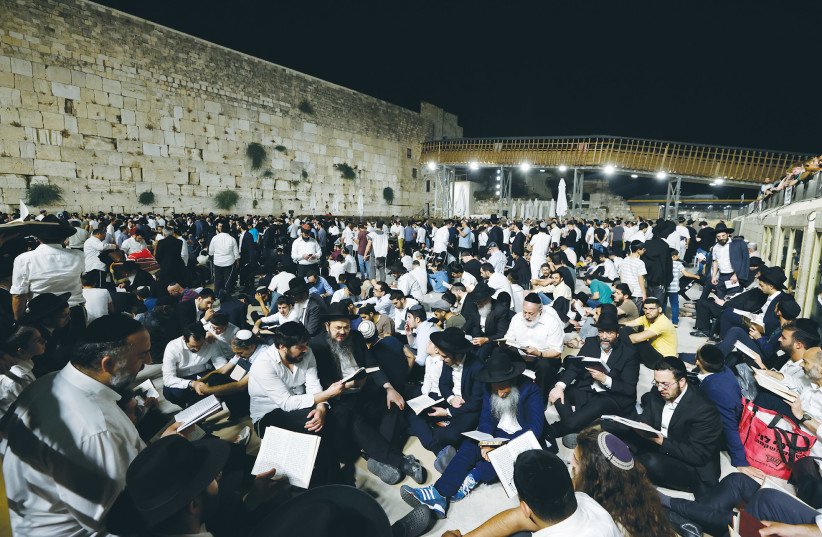
The Israeli Left has also contributed to the violence
The Israeli Left has contributed its own share of contempt. A prominent far-left commentator, Israel Frey, was twice detained this year over posts celebrating the deaths of IDF soldiers and praising attacks on soldiers and settlers – speech that crosses the moral line from dissent into dehumanization. That such sentiments come from a Jew about Jewish soldiers only deepens the wound.
We have also watched liberal activists in Tel Aviv physically block public High Holy Day prayers and hurl insults at worshipers, turning Yom Kippur into yet another arena of culture war. However, one views the legal questions around gender separation in public space, the images from Dizengoff Square – Jews shouting down Jews at the holiest moment of the year – should haunt us on Tisha B’Av.
The Talmud’s account of zealots burning fellow Jews’ food stores during the Roman siege is not a parable about ancient fanatics; it is a parable about us. When ideologues on the Right and Left prefer humiliation to persuasion, and when we excuse cruelty because our side is “more right,” we reenact the same civic arson that once brought down our House.
The Talmud did not blame the Second Temple’s fall on weak defenses or foreign policy. It blamed a mindset: Jews who preferred humiliation to compromise, purity tests to dialogue. Our generation excels at the modern equivalents – viral take-downs, social-media pile-ons, fists thrown at rallies, and celebratory tweets when soldiers die. The parallels should chill us.
The remedy is as old as the diagnosis: ahavat chinam, baseless love. That phrase does not ask us to abandon convictions or blur halachic or democratic redlines. It asks us to recover the Jewish discipline of seeing a divine image in the Jew who votes differently, dresses differently, or prays differently – or not at all. It means speaking about each other as family even in the heat of disagreement; refusing to cheer violence or vandalism when it targets “them”; resisting the dopamine of online derision; and insisting that rallies remain places for passionate words, not flying fists.
Leaders must lower flames, not raise them. Coalition and opposition alike should denounce political violence with the same unanimity they muster against external enemies. Police must protect demonstrations across the spectrum, including those with which they disagree. Educators can turn tomorrow’s lessons into listening circles where secular and religious pupils actually hear one another. Rabbis can model machloket l’shem shamayim – dispute for the sake of Heaven – rather than for the sake of viral clips. And the rest of us can practice the small courtesies that rebuild trust: a greeting across a kippah line, a Shabbat invitation that crosses a political one.
Tisha B’Av ends with the hope that mourning will one day give way to joy. Whether that hope ripens depends less on our enemies than on how we treat our own. If baseless hatred helped topple the last Jewish commonwealth, baseless love can yet fortify this one. The fast will end Sunday night; the real work must begin the morning after. Let us choose to be the generation that learned the lesson in time.