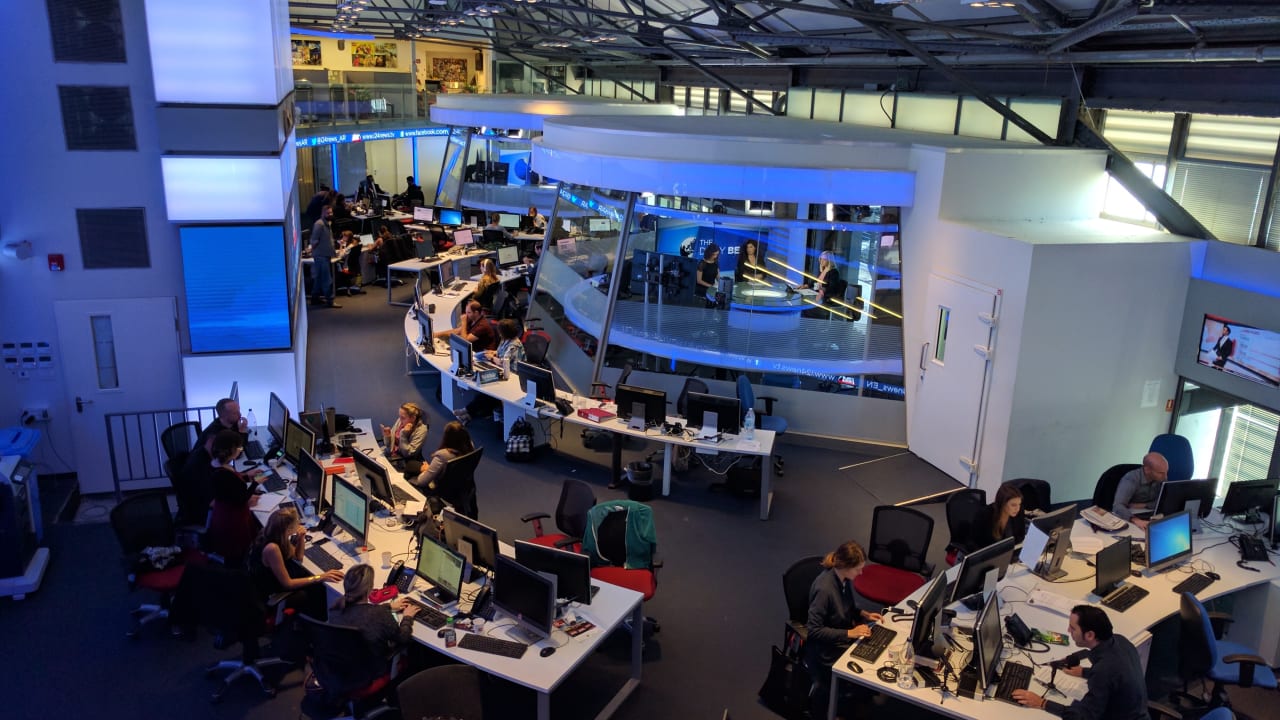
Following the barbaric October 7 attacks, many people turned to i24NEWS for live, up-to-the-minute reporting. From rolling news coverage to well-produced human interest packages, the network was once again brimming with live analysis and news. A little over a year ago, that all changed.
We've seen the dangers of a misinformed public with rumors and lies spreading from the battlefield to the screen and onto college campuses. And for the network that once tried to tell Israel's story to the world, it made the bizarre decision to turn inward and begin setting up a Hebrew channel.
The network's razor-slim budget became even slimmer. Israeli bigwigs were shipped in on what are rumored to be exorbitant salaries, and the English and French channels were sacrificed, and the Arabic channel, never fully staffed, was pared back again. Staff who spoke Hebrew were unwillingly moved to the new venture, the rest quickly ran for the exits, and live programming – what the audience actually tuned in for – was replaced with compilations of interviews, stale reportage, and the occasional live news bulletin, often without any opening headlines.

Despite the financial risks of opening a Hebrew channel in a difficult market, and rumors from former staffers who say it's for the channel to gain political favor, if the network had the cash to keep the English and French channels going, it shouldn't have been a problem.
The events of October 7 scrapped scheduled programming for rolling news and made i24NEWS' existence more known, especially after correspondent Nicole Zedek gave a much-debated live broadcast discussing the number of beheaded babies.
The network, however, has never really understood what its potential audience wanted. Switch on i24 now and you're unlikely to come away more informed of the day's events. In reality, that isn't a new development.
In its first incarnation, the network broadcasted more pre-recorded magazine shows than live news. When I worked there, it transitioned through 3 "grids" (what the network called its schedule).
Around the time I left, it was broadcasting the most live news it ever had. There were regularly two 3 or 5-minute news bulletins every hour. Live shows that were rebroadcast were cleverly timed so the "flashes" (what the network called the news bulletin team) could jump in again and provide the latest headlines 24 hours a day.
It wasn't to last, though. Over time, live overnight news bulletins from Tel Aviv were scrapped. Bulletins mid-program were scrapped, too. Then live programming from New York overnight was halted altogether, which was rumoured to involve legal action from the unceremoniously fired staff. It always came down to cost and the delusional idea that i24 could produce appointment-to-view television. The promos for shows that used to feature heavily in the ad breaks made it abundantly clear this was the plan.
Before the network had gone to air, it was described as Israel's answer to Al Jazeera, but i24NEWS never seemed to understand the question.
Have you ever watched the "BBC News Channel" in the UK before 2023? Or Al Jazeera for a few hours? The programming centers around the news itself (and those networks' biases). You're always likely to get the headlines, more often than not, twice an hour. Rolling news is cleverly interspersed with interviews from prior hours re-aired with an obligatory "earlier we spoke with so and so on such and such." Each hour is filled with headlines, reports, interviews or the occasional 28 to 56-minute recorded program. It's not CNN, but it's a standard rolling news schedule that leaves the viewer somewhat informed.
On i24NEWS now, most of the day, you’ll see the Hebrew channel with an entirely out-of-sync set of translated subtitles. With the Hebrew channel on-air, the English, French, and Arabic channels are produced by fewer staff and with fewer resources than ever.
The remaining English programming, from what I’ve seen, is actually decent and informative, but broadcasting across the languages has been dramatically downsized. Few live shows remain, and live news bulletins have been cut to a minimum.

For the family of staff who ever produced, edited, reported, or presented, it feels like the final chapter of a story we all hoped could go a different way. The hours we tirelessly worked to make sure shows and reports made it to air or online could have made the network a powerhouse.
Instead, we gather around the network's bedside. For some of us, it's not all bad. Numerous people have successfully stepped from i24NEWS to much higher points in their careers in the media industry. CNN, Kan, Reuters, Walla, CBS, The Daily Mail, JNS, The Jerusalem Post, Times of Israel, the BBC, and Keshet, to name a few. I will freely admit I'm eternally grateful for the network and the start it gave me in my career.
It's the audience and would-be future staffers I mourn for. Instead of the network using what's left of its live broadcasts and distributing them thoroughly online, it seems that too has also followed the live broadcasts. More scarcely updated social feeds, and a less informed public.
Whatever fear of potential competition Al Jazeera ever felt when i24NEWS launched has long since dissipated. And now the Hebrew channel will do what exactly? Who is it for? For Hebrew speakers, there's Channel 14, and what's left of News13 is already providing the right with what they want to hear. For the middle ground, there's still Keshet or Kan. For the left, there was "Relevant," but it's not an audience the network seems to want, and it didn't last long either.
When the IBA shut its doors, at least there was i24NEWS left for English speakers. As it slips into a coma, English speakers are back to print, podcasts, and social feeds to stay informed with less of a pro-Hamas slant. So long, i24NEWS. I hope someone takes your reins and brings you back to the path you were once on.
The author is the social media manager at The Jerusalem Post and a former i24NEWS staffer.