
The haredi (ultra-Orthodox) struggle against their conscription into the IDF has been an extraordinary success. Against all odds, the haredi minority has overpowered all three branches of Israel’s government and imposed its will.
In the Knesset, prime ministers – across the political spectrum, not only from the Right – have lowered their heads and forged unholy alliances with the haredim, resulting in laws that legitimize draft evasion.
In the High Court, generations of judges have deployed the unconventional weapon of striking down (non)conscription legislation for violating equality – to no avail. Some judges, in their rulings, have expressed the despair gripping them.
As for the military, part of the executive branch, it has tried its hand at finding solutions – workarounds sometimes bordering on sleight of hand – and also failed the test of reaping results.
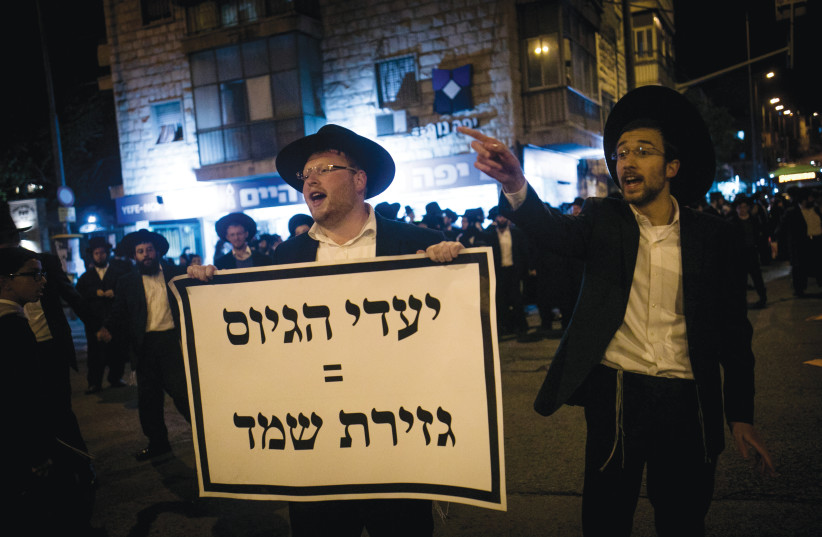
Why is haredi draft so contentious within the ultra-Orthodox?
A combination of three factors explains the anomalous success of this minority. First, for them, this is the single most important issue. Draft exemption has become a theological principle of the highest order at the very center of haredi identity.
Second, although the haredi community is a vibrant marketplace of endless factions and internal disputes, differences are set aside when it comes to IDF enlistment. Almost all – Hasidim, Lithuanians, Sephardim – stand united in their entrenched refusal. It takes various shades: brazen and provocative, or apologetic and evasive. But the chorus sings their refrain in unison: No, and again no.
Third, the haredim have positioned themselves as the swing vote between Israel’s opposing political camps, and everyone is wary of severing the lifeline.
YET, CHANGE is afoot. Until recently, haredi conscription was framed as a legal issue of “equality in sharing the burden.” Thus, the battles played out in the High Court – the authorized interpreter of the right to equality. But the Court and the legal discourse are ill-suited for resolving a socio-political-identity-religious dilemma. If a Knesset majority chooses to capitulate to a minority, why does it require judicial cover? Indeed, despite countless attempts, the Court has failed to save the majority from itself, and the haredim continued to turn their backs on the army.
The protracted struggle has made it clear that haredi non-conscription is not “just” a violation of equality – it undermines national security. The IDF faces a shortage of 12,000 combat soldiers to meet its current personnel structure. Without young ultra-Orthodox Israelis – who constitute 15% of each draft cohort – there is no reservoir of manpower to fill the gap. And this is only the beginning: already today, one in four Jewish children is haredi. If they do not enlist at age 18, how can the IDF fulfill its mission and defend Israel?
The harsh reality currently faced by reservists – my son just received his fourth call-up order, this time for a three-month stint – as well as the tangible threat to the future of the IDF, is shifting the struggle over haredi conscription to the appropriate arena: the marketplace of ideas and politics.
And a transformation is stirring. The very factors that previously enabled the haredim to preserve their exemption – the importance they ascribe to the issue, unity within their communal ranks, and political leverage –are now front and center for the non-haredi public.
The importance of the matter has been internalized, as the tight linkage between haredi enlistment and national security has become impossible to ignore.
Without the haredim, the IDF is not a people’s army, and without a people’s army, we will have difficulty surviving. Even the religious-Zionist public – which, from its perspective, is blessed in having a government willing to dramatically redraw the settlement map in the West Bank – is prepared to bring it down if the haredim are not drafted.
A RARE consensus is emerging among Israelis: a recent JPPI (Jewish People Policy Institute) survey reveals that 89% of non-haredi Jews demand the enlistment of those not studying Torah. Some 54% percent call for at least half the haredim to be drafted, and a third believe that a law must be enacted to draft all haredim. Only 2% of non-haredi Jews support maintaining the exemption. A huge coalition is forming that crosses political and identity groups – unparalleled by any other issue on the national agenda – demanding haredi recruitment. Yuli Edelstein is not a lone dissenter: he is the authentic voice of Israel’s overwhelming majority.
Any political figure who ignores these facts will face fierce public blowback. Whomever is tasked with forming the next coalition will likely require partners to back a significant haredi draft law, one different from all its predecessors. Haredim citing Torah study as grounds for exemption will lose their political sway – the balance has tipped in favor of those demanding their enlistment.
If the haredi leadership acts rationally, it will mitigate its damage and agree to the conscription of those who do not meet the threshold of “Torato Umanuto” (Torah study as vocation), defined as 45 hours of study per week. By conservative estimates, this amounts to at least a third of draft-aged haredi youth. If they continue to dig their heels into their “we will die before we enlist” stance, they will bring down the government. Beyond the next elections, a harsh reality may await them.
The writer is president of JPPI (the Jewish People Policy Institute) and professor emeritus of law at Bar-Ilan University.