
Earlier this week, I was reminded of a joke from my now distant childhood, which at the time was initially perplexing and then commensurately rib tickling. “When is a door not a door?” went the riddle. Answer: “When it is ajar.” The context for that half-century-plus reminiscence was the advent of the ninth rollout of the Jerusalem Biennale of Drawing, which kicked off on November 8 and will run through to February 7.
As usual, the event takes place under the aegis of the Jerusalem Artists’ House, the founder institution, and its veteran director Ruth Zadka. Each edition of the biennale – aka Traces – follows a particular topic. This time, the thematic anchor is Slough and all that it implies. That is normally associated with snakes and the shedding of their skin when it has outlived its corporeal usefulness.
Sadly, and perhaps poignantly, the current festival opened for business just two days after Russian-born artist Sasha Okun passed away at the age of 76. Okun, a celebrated boundary-smashing painter who conceived the idea of the biennale, saw it as a means for reinforcing the elemental art of drawing, which lies at the very root of visual art in its various guises.
Zadka was on board the nuts-and-bolts venture from the start. “Sasha was the founder. Without him, this would never have come into being. This is also a reaction to the terrible development when, in the 1990s, there were cuts in training students in drawing. That’s the basic of the basic [in art]!” she exclaims.
The Jerusalem Artists’ House may be the biennale linchpin, but this is a very much Jerusalem-based event with exhibitions this time around also running at Ticho House, Koresh 14 Gallery, and Jerusalem Print Workshop, with Tali Ben-Nun serving as chief curator.

BACK TO the aforementioned joke. If your idea of drawing is a discipline that spawns a two-dimensional, generally monochrome, bottom line, the Slough spread will make you think again. The four venues are playing host to works by 77 artists. That may sound like a lot, but Ben-Nun and Zadka had their work cut out for them to whittle the proposals to the call for response down to manageable proportions. “We had 784 submissions,” Zadka notes. “Tali selected a sort of bulk and, out of this bulk, she chose the artists who would participate in the main exhibition here, and then a certain number of artists for the other venues so the curators there could decide what suits them.”
The latter is, naturally, a crucial factor in deciding what eventually gets an airing and how it is presented to the art consumer. “The building is important, the architecture, the space, too,” notes Tamar Gispan-Greenberg, the still relatively new director and head curator of the Jerusalem Print Workshop. Gispan-Greenberg took over in May from the facility’s now 91 years young founder and master printer Arik Kilemnik, who opened the workshop over half a century ago.
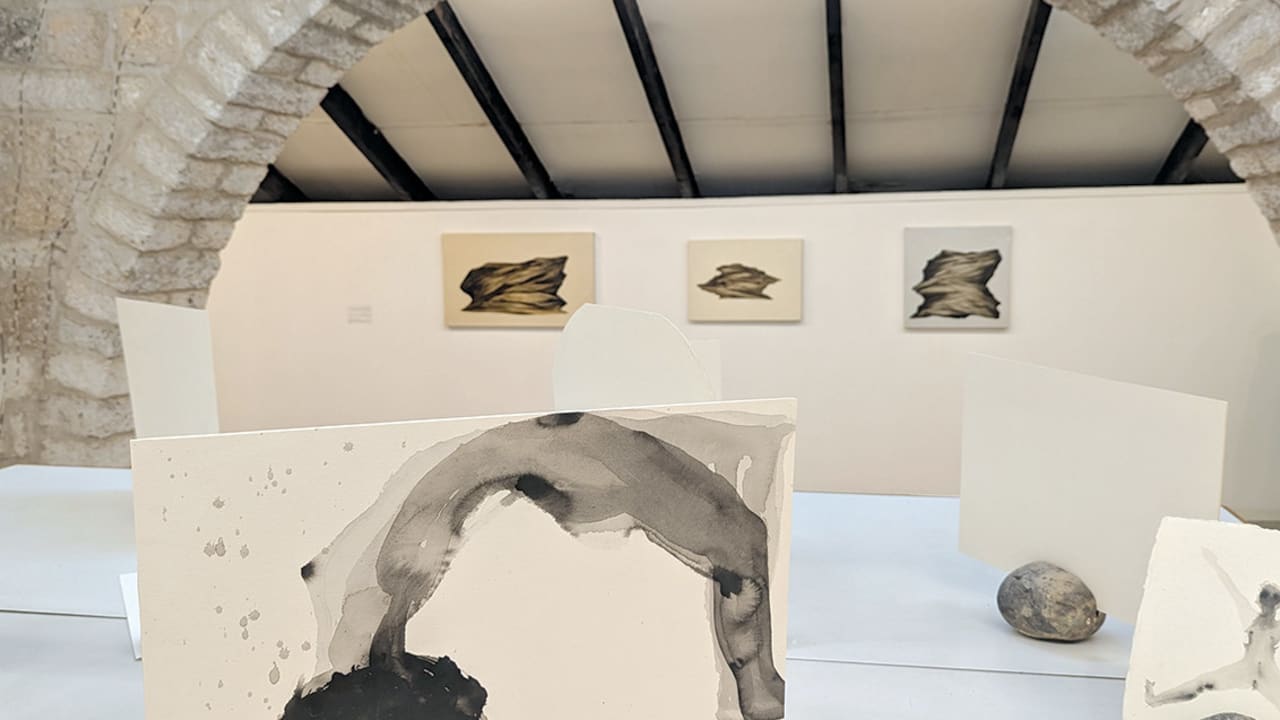
Gispan-Greenberg, who cut her teeth as curator of the New Gallery Artists’ Studios Teddy, is taking her Jerusalem Print Workshop bow as head curator with the biennale. Judging by the drawing-based layout I saw there, she appears to have done a good job of matching the selected works with the venerable building’s display spaces, with its intermittent bare stonework, vaulted ceilings, and areas of abundant natural light.
It was also immediately apparent that Traces IX is following the expansive philosophy of its antecedents and continuing to flex the visual and physical bounds of what could strictly be defined as drawing. There are a handful of sculptural works in there, although it must be said that the thematic core of the biennale does lend itself to generous interpretive maneuvering.
Yael Ruhman’s green burlap fabric creation, for example, Habeas Corpus, seems to just hang there, minding its own business in a corner of the Workshop’s top-floor exhibition space. There is, however, a sense of the statuesque about it; and its form, with ostensibly unplanned pleats going this way and that, is reminiscent of classical Greek and Roman sculpture. That makes for a fetching oxymoronic material feel, as the clearly hollow figure nonetheless makes its presence felt in no uncertain terms and underscores the slough element.
The same can be said for Rachel Frumkin’s striking Hook paper cutout, distended from the vaulted ceiling on the bottom level of the building. You can’t miss it. It is big and red and meets you head-on as you peer into the side room, offering a warm – heartwarming – counterpoint to the pristine white walls and ceiling around it.
“I come from painting,” says Frumkin as she arrives armed with a photographer and hefty gear to snap some professional shots of her outsized creation. “I felt I needed something else, beyond painting,” she explains. “Taking something two-dimensional, like paper, and cutting into it gave me that third dimension.”

Gispan-Greenberg notes, “It also feeds off the architecture here.” It does indeed, and it brings an eye-catching structural addendum to the presentational fray.
THE WORKSHOP building is very much a major player in the Slough offering there. The facility’s daytime job gets a well-deserved nod in the layout too, with a display cabinet providing a close-up look at some of the accouterments of the printmaking process, such as metal etching and woodcut plates and screens that were put to beneficial practical use by Jerusalem Print Workshop employees over the years.
That also echoes the malleable Traces IX leitmotif of the Slough, which is offloaded as soon as it outlives its usefulness but still maintains a palpable physical and spiritual presence. Tamar Roded Shabtay takes the animate-inanimate concept a step further with her epexegetically named Gathering the Pieces That Remain installation, which fuses drawings that exude a sense of dynamism with organic matter she collected from the environs of her desert abode.
There are subtleties that require some effort to discern in there, too. Yonatan Zofy certainly went all the way with the nuance mindset. His delightfully named pencil Drawing the Paper to Sleep is a gossamer affair that almost imperceptibly marries the physical substratum and the artist’s endeavor.
Form and casing pop up all over the biennale show at all its various venues. That includes the Koresh 14 Gallery, tucked away in an apartment block that has seen better days, hidden away in the less glitzy part of downtown Jerusalem. Just how far you can stretch and present the idea of drawing takes another notch leap when you catch sight of Ron Asulin’s Pickpocket assemblage spread across a wall and, indeed, around one corner and, as you gradually note, through the door to a small utility room tucked away to one side. The visual parameters certainly lend themselves to the drawing discipline, as do the black-and-white tones; and you don’t even question Asulin’s thinking and apparent gall at assuming that a textile arrangement could possibly fit the genre bill.
Ben-Nun and the in-situ curators have clearly gone for philosophical and aesthetic broke across the biennale board. There are also cross-location bridges with, for example, Doaa Bsis’s Charcoal Chalk, at Koresh 14, resonating in I Stroked Gaza by Kineret Haya Max at the Jerusalem Artists’ House, which is classified as a “live action and wall drawing.” The latter comprises the detritus, the urban grime, of a performative work by Haya Max presented at last week’s official biennale curtain raiser.
“She walked up and down Gaza Street – that infers Gaza the place and Gaza the street – and accumulated dirt along the way,” Zadka explains. That neatly encapsulates the art-life reciprocity equilibrium while referencing the flotsam and jetsam of life central to the Slough theme.
“There is the image of something that incorporates both life and death, the remnant which, on the one hand, is the cover of the book, and has to be shed as part of a cyclical process,” says Ben-Nun. “That could be because the body has to grow and needs more room, or there is the need to replace dead or wounded skin. On the other hand, this dead entity contains the memory of the body from which it has separated, and there is a sense of the time and events and trauma that have elapsed.”
YOU DON’T need to have an Einsteinesque IQ to get the Oct. 7 transition hook here. “This live-dead synergy moved me very much,” Ben-Nun continues. “And there is the fragile shell element which connects, for me, with the situation we are all in – this shield we had which was cracked open.”
The scene was set for the chief curator, and she ran with it every which way into all kinds of genres, styles, textures, and physical dimensions. “There were all these images that moved me, thinking about creatures that can regrow limbs, others that shed their slough in order to grow, and some that die within the slough due to adverse conditions.
“When you think about a slough, that naturally leads you in a zoological direction; but there is so much more to that, on all sorts of levels.” Traces IX patently conveys that, and the dozens of works on display on the Jerusalem Artists’ House’s three floors dip into numerous emotions, levels of consciousness, walks of life – and death – and cultural spheres.
When the Jerusalem Biennale of Drawing started out back in 2001, paper was largely considered to be the bedrock of the discipline. The demarcation lines of the medium have, in the interim, been stretched in every possible which way. The physical-ephemeral interface exhibited in Yonatan Zofy’s diptych at the Jerusalem Print Workshop is reprised in a brace of works by Hilla Toony Navok in which she employs felt-tipped pens in sweeping arches. As she works, the consumer product ink gradually depletes, thereby producing graduated bands of color that run the gamut from full-blown blue or brown to the almost invisible. It makes for attractive, entertaining, and thought-provoking viewing.
The opposite wall of the side hall is largely taken up by a compelling trio of drawings by Yitzhak Golombek as an ode to his late father. The polychromic sketches are infused with the sense of a life well lived, a slice or two of humor, and the artist’s feelings for his dad.
Hands are a recurring subtext to the biennale rollout. They feature powerfully in a septet of prints by Dana Lev Levnat that worked off photographs of the departed on tombstones, on the ground floor of the Jerusalem Artists’ House, and in elongated form in Revital Lessick’s St. Bartholomew’s arrangement at Koresh 14. Michaela Mor’s evocative Untitled (Red Alert), an ode to her sister who was murdered at the Supernova gathering on Oct. 7, shows her sibling’s hands held high in a supplicatory or self-embracing pose, while the figure in Nirvana Dabbah’s impressively intricate and elaborate pencil drawing at the Print Workshop keeps her outer layer of attire – her slough? – firmly in place with her hands.
You can clearly take drawing down all kinds of highways and byways, on physical and philosophical levels, but, as Ben-Nun sagely observes, at the end of the day it is a fundamental practice that lies at the root of manifold artistic pursuits.
“It is a very primal and raw activity. It is the first thing the hands undertake in a search, a search for what? It is not clear where it is all going to lead.” The Slough door is definitely ajar.
For more information: www.art.org.il

Biennale bites
Most of us find a couple of hours visiting any museum or other repository of art exhausting. At that juncture, we either head for the in-house coffee shop or leave the premises and make our way to the nearest café for some culinary sustenance and emotional respite. However, that shouldn’t be a problem to find as you do the rounds at the Biennale circuit, with the charming HaMarakiah veteran soup-based eatery on Koresh Street, always a fun place to hang out, and the famed Kadosh café just around the corner on Shlomzion Hamalka Street, with great food and a delightfully convivial ambiance.
If you’re feeling peckish after visiting the Jerusalem Print Workshop, topnotch hummus and falafel can be had down the road at the feted Ikermawi establishment, while Café Bastet near the Jaffa Street end of Heleni Hamalka Street is a spot favored by the vegetarian crowd. And you are really spoiled for choice in the environs of the Jerusalem Artists’ House, with the nearby Bezalel Street pedestrian strip awash with food stops. In addition, a couple of hops farther up the road, the popular Nocturno restaurant has most of what any heart and belly could possibly desire after an hour or two of digesting a slew of compelling drawing-based creations. Bon appetit!