
Mohammad Bagher Ghalibaf, Iran’s parliament speaker, has a problem on his hands. On Tuesday, he posted a link to a New York Times article titled “airstrikes on Iran missile sites may shed light on justification for dams.” Ghalibaf and other officials are likely concerned that another round of conflict could destroy Iran’s dams. This is due in part to the article’s suggestion that Iran built its dams to assist its underground bunkers and missile cities.
Ghalibaf, who is a key regime official and one of the survivors of the last rounds of strikes earlier this year, pointed to this article as an example of the US and Israel preparing to attack civilian infrastructure.
“Cool. New rule: Any dam, port, or power plant near a US or Israeli base is dual-use. We’ll apply your logic consistently and even-handedly,” he wrote.
The New York Times article was written by Sanam Mahoozi and Erika Solomon. Mahoozi noted that, together with Solomon, they had “investigated a question: Why does Iran keep expanding dams and water-transfer projects amid a water crisis? Experts point to an intriguing overlap with military sites. Could some water projects have served to support Iran’s military buildup? No conclusive evidence – but questions worth asking.”
Commentators have recently been focusing on the dam controversy. Esfandyar Batmanghelidj, founder and CEO of the Bourse & Bazaar Foundation, noted that he was perplexed by the dam story. “Fewer than 50 of Iran’s 500+ large dams have turbines installed to generate electricity,” he said. “This is an easy fact to check. The notion that Iran built hundreds of dams to provide electricity for military facilities does not hold up.”
He argues that “the reason there are so many dams in Iran is because there are vested interests, including IRGC construction companies, that use infrastructure budgets to generate rents. Lots of other countries have more dams than they need for this exact reason. China has constructed thousands of ‘unnecessary’ dams, yet we don’t jump to the conclusion that these are military facilities in disguise.”
He also noted that dams are easy targets. “This is a classic case of a third variable problem. To the extent that there is a pattern of missile strikes near dams, it is because dams are built in mountainous areas and military sites are located in mountainous areas.”
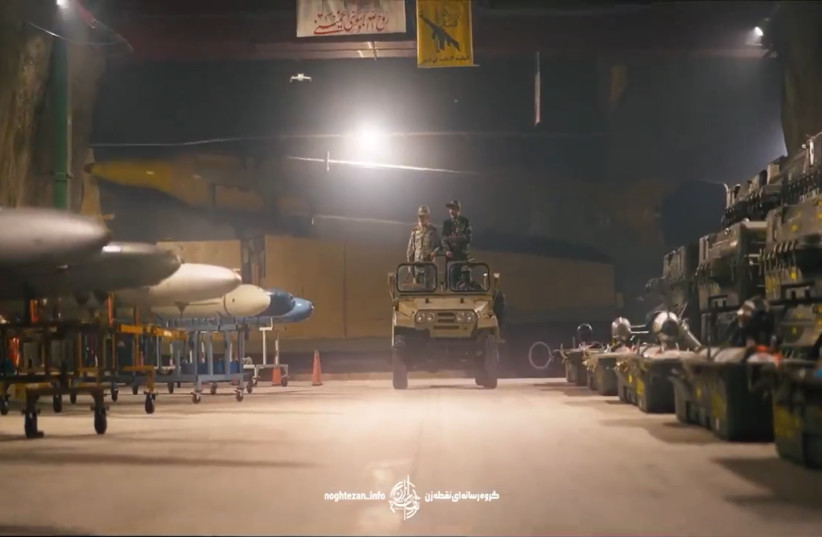
Iran's underground missile strategy raises questions over dams' military role
Middle East national security and intelligence expert Danny (Dennis) Citrinowicz also spoke about the dams. “Tehran has invested heavily in underground facilities, redundancy, decentralization, and potentially independent water and electricity supplies to keep its missile operations functioning even when civilian infrastructure is disrupted,” he said.
On X/Twitter, he added: “While the direct connection between Iran’s dam projects and its underground missile facilities has not been conclusively established, such an approach would be entirely consistent with Iran’s strategic thinking.”
Mohammad Ali Shabani, editor at Amwaj media, said, “Some would say this framing amounts to manufacturing consent for the bombing of dams and other civilian water infrastructure in Iran.”
Nima Shokri, a professor and chair of Geo-Hydroinformatics at the Hamburg University of Technology, noted on X: “I want to clarify my position regarding the recent New York Times article on dam construction in Iran: the proximity of dams to military targets does not establish why those dams were built, nor does it justify attacks on them.”
Experts caution against linking Iran's dams to military facilities without evidence
Sina Toossi, a senior non-resident fellow at the Center for International Policy, also reacted on X, noting, “The connection remains speculative. The investigation does not establish that particular dams were constructed for military purposes. Many Iranian dams provide essential civilian water, irrigation, and electricity services.”
It remains to be seen if Iran’s dams are targeted.