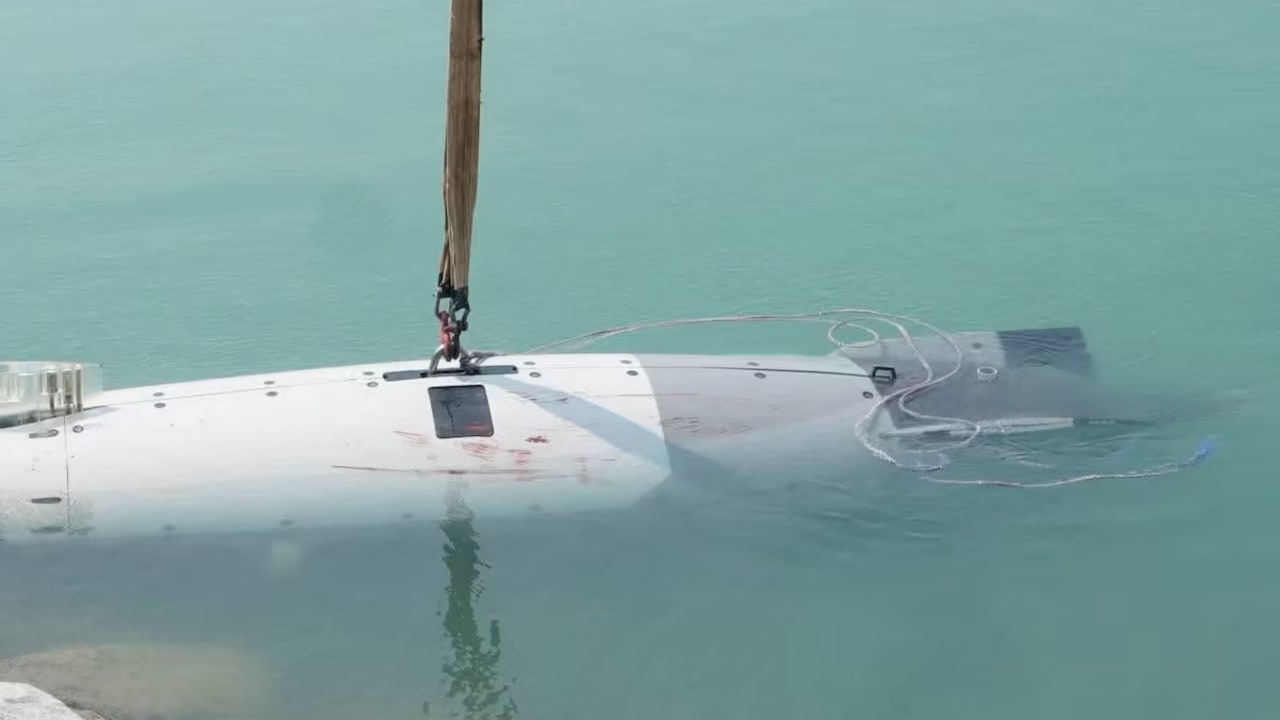
Iran's Islamic Revolutionary Guards Corps said on Tuesday it had captured a US uncrewed submarine at the entrance to the Strait of Hormuz, offering a rare glimpse into how underwater drones are being used in military operations.
Iranian state media said the vessel was a Dive-LD, a large autonomous underwater vehicle built by California defense firm Anduril. The 19-foot (5.8-meter) submersible can carry out missions including mine countermeasures, seabed mapping, intelligence gathering, and the inspection of underwater infrastructure such as cables and pipelines, the company has said.
"We trapped one of the most modern, intelligent, and unmanned submarines of the terrorist American army at the entrance to the Strait of Hormuz. This submersible is equipped with the latest technologies," the IRGC Navy said in a statement carried by Iranian state media.
In response, a Pentagon spokesperson said an underwater drone had "malfunctioned more than a day ago."
"It was surveying regional waters in support of ongoing operations. The defective drone was an older model that neither collected sensitive data nor carried any classified sonar or radar equipment," the spokesperson said.

Reuters could not independently verify Iran's claims and the Pentagon did not address them in its statement.
Anduril confirmed the loss of one of its vessels, but downplayed the significance of the incident.
"Dive-LD is an attritable autonomous system, meaning it is designed from the outset to operate in dangerous environments where loss of the vehicle is an expected possibility," a company spokesperson said.
US military investing in unmanned naval systems
The US military is investing heavily in unmanned naval systems, including underwater and surface vessels, as it seeks cheaper ways to monitor vast areas of ocean, gather intelligence and track adversary ships and submarines without putting sailors at risk.
According to Anduril's website, Dive-LD can operate for up to 10 days without returning to base and is designed to dive to depths of up to 6,000 meters (19,700 feet). Dive-LD units cost about $2.5 million each, US military news site DefenseScoop reported in 2024.
Iran could reverse-engineer captured US drone
Analysts say Iran is unlikely to gain a decisive military advantage from the captured drone, but the episode nonetheless represents a propaganda victory for Tehran and an awkward setback for Washington's efforts to project technological superiority.
"Of course Iran will take every opportunity as a propaganda win," said Farzin Nadimi, a senior fellow at the Washington Institute for Near East Policy. "It can help the (Islamic Revolutionary Guard Corps) make better versions of their own designs."
Iran will almost certainly try to pry open the drone's hardware, but the drone's software carries built-in defenses, said Bryan Clark, a senior fellow and director of the Center for Defense Concepts and Technology at the Hudson Institute. Iranian engineers "could definitely reverse-engineer the mechanical systems," he said, pointing to Tehran's track record with captured American aircraft.