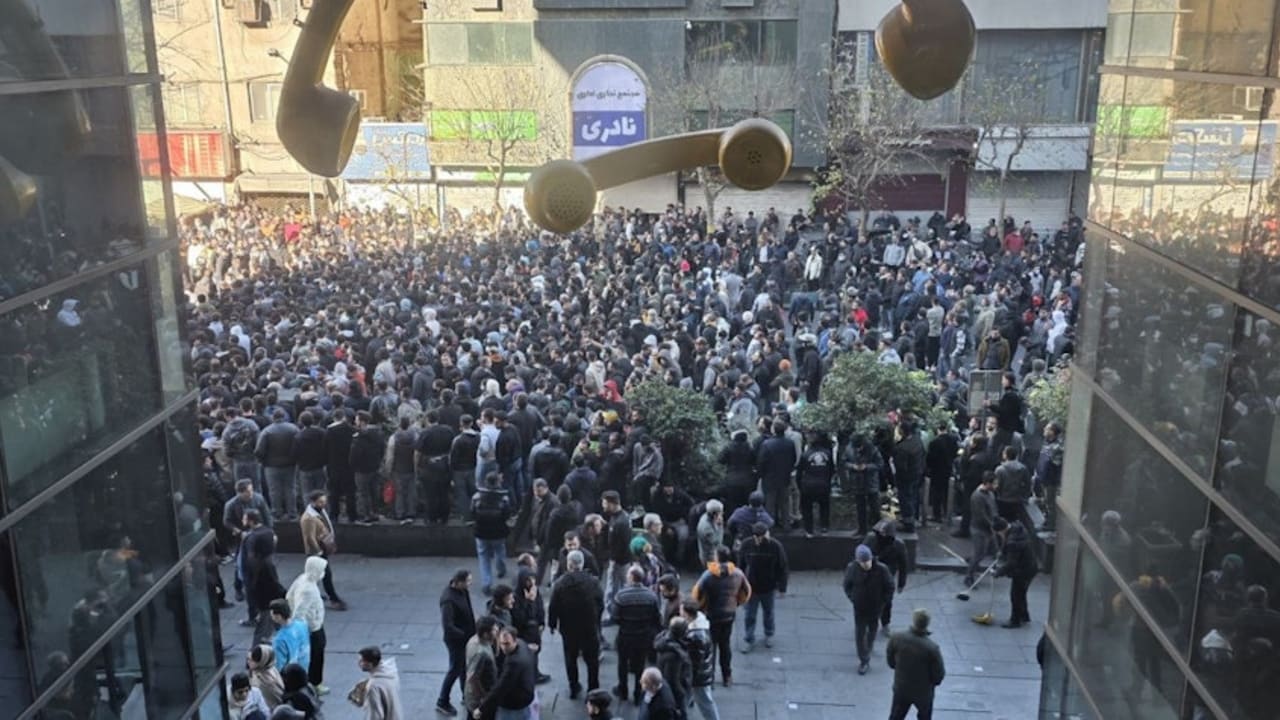
The protests in Iran officially proved deadly on Wednesday night, in violence that carried through to Thursday, after Tehran confirmed the death of a member of the paramilitary Basij militia.
The Hengaw human rights group also reported that authorities killed protester Dariush Ansari Bakhtiariwand with live fire during a protest in Isfahan province on Wednesday night. Regime authorities have yet to comment on the death.
At least two people were also killed in the Lordegan on Thursday, Iranian media confirmed after Hengaw reported that authorities opened fire on the crowds demonstrating.
The Basij is a volunteer paramilitary force fiercely loyal to Supreme Leader Ayatollah Ali Khamenei and affiliated with the Islamic Revolutionary Guards Corps, which said in a statement that 13 of the militia members had been injured.
Blurry footage obtained by the dissident newspaper site Iran International allegedly shows regime forces throwing tear gas into crowds at a market in Tehran. The violent dispersal method has been recorded across several provinces since protests broke out against the collapsing value of the rial.
Iran detains protesters while maintaining image of diplomacy
While Iran’s leadership has maintained a reasonable tone in public statements, activists and journalists have been detained and released with little communication. Universities, central hubs of protest activity, have been targeted by authorities, with some reports indicating that students involved in the activities were taken by men in plain clothes.
Iranian president Masoud Pezeshkian, who benefited from having a reputation as a reformist during his presidential run, affirmed on Thursday, "The problem of people's livelihoods in the country is visible, and the main culprits are us, managers and officials; we must play our part in solving these problems by correcting our behavior," Tasnim reported. This came after he claimed on Monday that he “instructed the Minister of Interior to hear their (the protesters') legitimate demands.”
Government spokesperson Fatemeh Mohajerani also promised on Thursday that the regime would hold a direct dialogue with representatives of trade unions and merchants to address issues relating to inflation.
Despite the public promises, reports indicate that an unknown number of people were taken by authorities.
At least seven people were detained after they rallied in Kermanshah, the IRGC-affiliated Tasnim news agency confirmed on Thursday, and accused of being "affiliated with hostile and opposition groups abroad." Since the 12 Day War in June, Iran has been accused of silencing dissent by carrying out executions against those it accuses of foreign collusion, manufacturing evidence, and using torture to collect confessions from victims.
Kazem Nazari, the Public and Revolutionary Prosecutor of Kohdasht County, also confirmed that 20 protesters were arrested, accusing those detained of causing “disorder by chanting destructive slogans and committing sabotage, including throwing stones at law enforcement officers."
The human rights group Hengaw said demonstrators had been detained on Wednesday in the western provinces of Kermanshah, Khuzestan, and Hamedan. Meanwhile, footage shared by BBC Persian saw a young man dragged away by a group in plain clothes from Shahid Beheshti University, where student groups had earlier been recorded chanting anti-regime slogans.
Telegram channels associated with student groups also reported that Tehran University student council member Sarira Karimi was arrested by regime forces, along with two other students and later released at 4 a.m. on Thursday.
"Security officers have temporarily detained these three students at the private home of the Karimi family and have confiscated their identification cards and documents. The students have also been informed that they will be summoned to provide explanations in the coming days via an anonymous call," according to the Amir Kabir student newsletter.
The same newsletter reported that Hassan Mousavi, a Sociology student at Shahid Beheshti University, was arrested at his home in Tehran's Heravi neighborhood and that nothing had been heard about his whereabouts or conditions since. Two other student activists from Tehran University were also reportedly arrested.
More concretely, the political editor of Iran’s Etemad newspaper, Mehdi Biek, was held for more than 24 hours by the regime, without information being provided to his family, and released on Tuesday. It remains unclear why authorities detained Biek, who was covering the protests, though this is not the first time that Tehran arrested him.
“The question is, why are some institutions concerned about domestic journalists reporting on the protests for the rights of people whose backs are bent under the burden of high prices?” Biek’s wife wrote on X.
Iran looks to create a distraction from its failing economy
Officials told Maariv journalist Avi Ashkenazi that they were preparing for Iran to potentially launch an attack on Israel, particularly as the regime’s hold over the Iranian people is challenged.
“The Iranian government has set its own priorities: first, to reestablish an offensive posture against Israel before dealing with Iran’s economic distress, water shortages, and welfare problems,” a senior military source told Maariv.
Ashkenazi wrote, “Although Tehran lacks the ability and desire to enter another war with Israel now, it may feel cornered.”
This comes as Tehran has spent the last several days pointing blame at “enemy inducements.”
Islamic Revolutionary Guard Corps (IRGC) Brig.-Gen. Ali Akbar Pourjamshidian, the security and law-enforcement deputy to the interior minister, was quoted in state-affiliated media as saying, “In my opinion, a large part of the currency problems and fluctuations is affected by the psychological atmosphere of the market. The enemy is desperately seeking to take advantage of the created atmosphere. People should be aware of this issue and not be influenced by the enemy’s insinuations. The market should continue its work peacefully, and people should not worry.”
The IRGC also attributed the dissent to “cognitive warfare, psychological operations, and narrative creation.”
“Despair, instilling fear, and encouraging surrender to the enemy in the current circumstances are clear examples of seditious behavior,” it said.
The protests are the largest seen across Iran since the regime murdered 22-year-old Kurdish woman Mahsa Amini in custody after she was detained for wearing a head covering incorrectly.
Reuters and Jerusalem Post Staff contributed to this report.