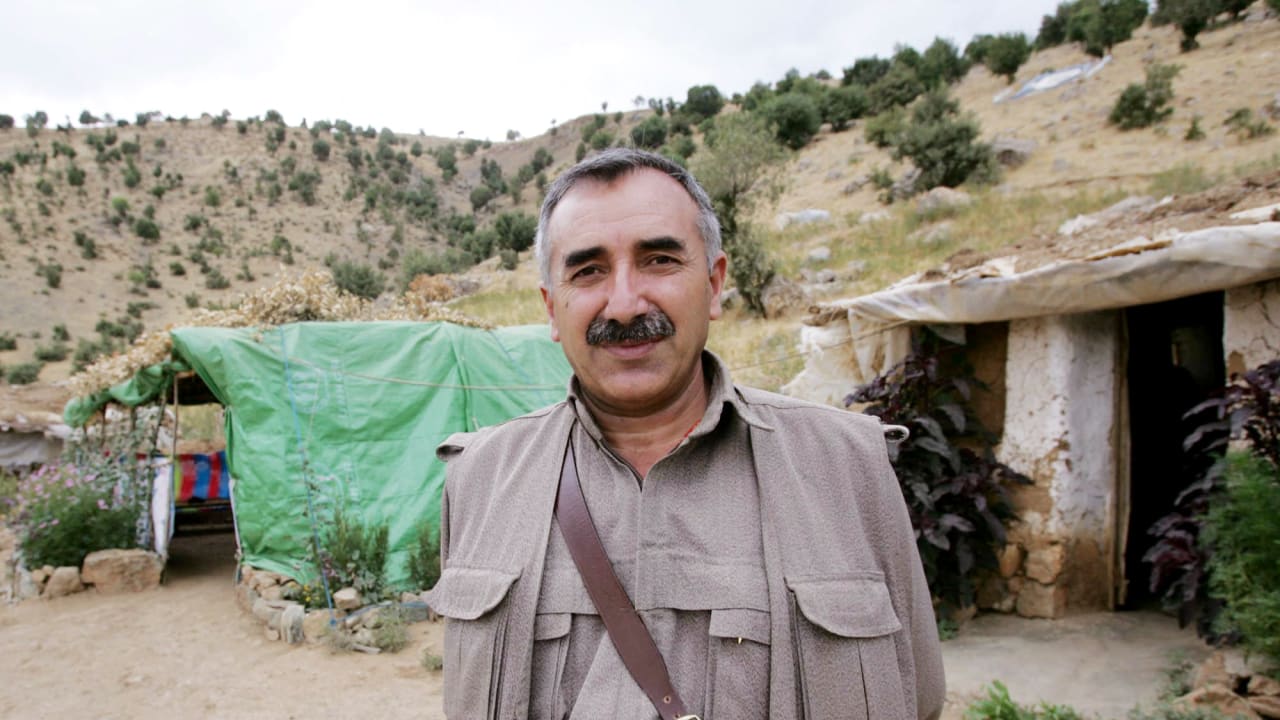
The Middle East is at a crossroads. It is also in the midst of a “Third World War,” Kurdistan Workers’ Party’s (PKK) Murat Karayilan said in an interview published on October 12. “This war is in essence a global war. A Third World War; however, these make it into a regional war. War between Shias and Sunnis. War between Iran and the Arab Gulf States. This comes from a supremacist plan and mentality. A supremacist mentality, regarding how to design the region, how to control it, and how to govern it. It is such a plan,” he told Kamal Chomani from The Amargi news outlet. This is an important interview that puts a spotlight on Kurdish issues and the region. It comes at a unique time as the PKK is moving toward disarmament.
Kamal Chomani, a PhD student at the University of Leipzig in Germany, published an important and exclusive interview with Murat Karayilan, who co-founded the PKK and who is its key leader today.
Chomani notes in the introduction to his interview, posted on X, that “I spent 10 days in the PKK headquarters and caves before finally reaching Murat Karayilan, for this exclusive interview with The Amargi.” He noted, “We begin with the wars reshaping the Middle East and then break down the peace process, in which Mr. Karayilan clearly calls on the Turkish state to end policies of denial and annihilation, and on Kurds to abandon rebellion and work toward establishing a democratic state.” He also noted that the PKK leader has not spoken to an external media outlet for 12 years.
The interview comes at a crucial time in the region when many are at a crossroads, including the Kurds. The PKK, since its founding in 1978, has been one of the key Kurdish movements in the region. The other major Kurdish movement is primarily linked to parties and groups associated with the Kurdistan Democratic Party. The PKK’s main role has been in Turkey, where there was a long conflict with the Turkish government costing thousands of lives. The most recent round of that war restarted in 2015. The PKK also has had branches and influence in Syria, Iran, and Iraq among Kurds. In Syria, the main group was the People’s Defense Units (YPG), and in Iran it is the Kurdish Free Life Party (PJAK).
As the PKK and the Turkish government have appeared to move toward a peace deal that will see the PKK dissolved and disarmed in Turkey, and in other areas, there are a lot of questions about what comes next. The interview may provide a window into this and appears to show how the PKK wants to get its message out today. The party is often opaque and complex to analyze because of the devotion of its members, many of whom join when they are young.

PKK leader discusses regional changes and the movement's future strategy
In the hour-long interview, which is on YouTube and also translated to English from Kurdish by The Amargi, the PKK leader discusses the current changes in the region. Although this part of the interview is actually the shortest part, it is also the most interesting for our purposes. The PKK's internal ideology and choices, and how it views Turkey today or its concepts of democratic confederalism, may be important, but it is the pragmatic choices made by the PKK these days that matter the most.
Karayilan discusses the recent changes in the region. He is asked about how the wars caused by the Hamas October 7 attack have changed the region, and also how changes in Syria, Libya, Iraq, and other places are shaping the region. The interview took place after US forces left Iraq on September 30. It also took place more than eight months after the US left Syria and after the US-backed Syrian Democratic Forces agreed to a deal to integrate with the Syrian government. The Syrian Democratic Forces’ (SDF) largest armed component was the YPG, which is linked to the PKK.
PKK leader says global powers are competing for dominance in the Middle East
“The Third World War emerged over time. It differs from the First and Second World Wars in its methods. It’s not a single event; it emerged over time, spread, and continues to this day. It’s a global war among capitalist forces competing for hegemony. It’s between forces that seek global dominance. You’ve mentioned the Middle East, but there is also the Ukraine-Russia conflict, and Ukraine is supported by NATO states,” the PKK leader says. “The Third World War continues with various methods. The primary objective is to establish dominance in the Middle East. The global capitalist actors led by the US are afraid of China.”
The ideology and worldview that Karayilan mentions views the current conflict as a global war that is between “capitalist forces” fighting for dominance. This is not just between NATO backing Ukraine and the Russian invasion. This is also about the Middle East. He mentions AI and also new technology and the struggle for control of rare earth elements necessary for solar panels and chips. As such, he suggests that one goal of the US and the West is to weaken Russia and block China’s ambitions.
“They’re trying to build a line from Egypt to Kazakhstan to stop China’s advance. This is not openly stated, but it is the core objective. Energy sources are very important to capitalist forces. Then there are rare earth minerals used to produce chips and solar panels. Then there is uranium, as an important energy source,” he says. The conflict has spread, not just to Iran but also to the Gulf and Yemen.
The PKK leader stresses that today war is not a solution. War does not serve the interests of the people. He argues that his movement presents a third way of supporting democracy. He stresses this in discussing Turkey today and the region. He also stresses how US allies, such as Greece, Turkey, and Israel, do not all agree on strategy, or may even be against each other. Greece and Israel today are closely aligned.
“Tensions exist between the US and NATO partners – they are not all united. So, Iran, on one side, wants to represent the Shia line, but then you’ve got Turkey and Israel as two other sides. There are also conflicts between them. It is true that two days ago the US Secretary of State Marco Rubio stated that they do not allow contradictions between their allies to escalate into war. He was referring to the conflict between Greece and Turkey.”
PKK disarmament raises questions over Turkey's political future
The challenge for the PKK today is that while it has this regional outlook, it continues to stress the need for greater democracy in Turkey. It wants its leader Abdullah Ocalan, who has been in prison for decades, released. The PKK calls Ocalan “Apo,” and Karayilan speaks about how he must administer disarmament. This creates challenges ahead. So far, Ankara has appeared flexible; however, there are questions about what happens next. Will the ruling party use the deal with the PKK to divide the opposition or get votes from Kurds? The Justice and Development Party (AKP) has received Kurdish votes in the past, and it is important for them if they want to stay in power after around two decades of rule.
The interview also delved into the details of the current issues in northern Iraq where the PKK has bases. Turkey has sent forces into the Kurdistan Region of northern Iraq because of this. “We pulled our forces out. They were hidden, but we got them out, some using vehicles, some on the roads. So we pulled out our forces. This year they say ‘Metina too.’ They are next door to each other – Zap and Metina. So they tell us you must pull out from Metina too. We say, ‘Why? Why just us taking steps?,’” Karayilan says. “Finally, after a lot of dialogue and internal discussions, we took the decision to also pull out of Metina. Two days ago. Today is October 10. So on the 8th, our final forces pulled out of the tunnels of Metina. Since then, we have had no one in Metina.” What this shows is how the PKK is not just focused on large ideas about its version of democracy and what it sees as a struggle for world order in the region, but also on its bases and operations that continue to be sticking points in peace with Ankara. Chomani’s interview represents a rare glimpse into the PKK’s current views and helps shed light on what may come next in the region.