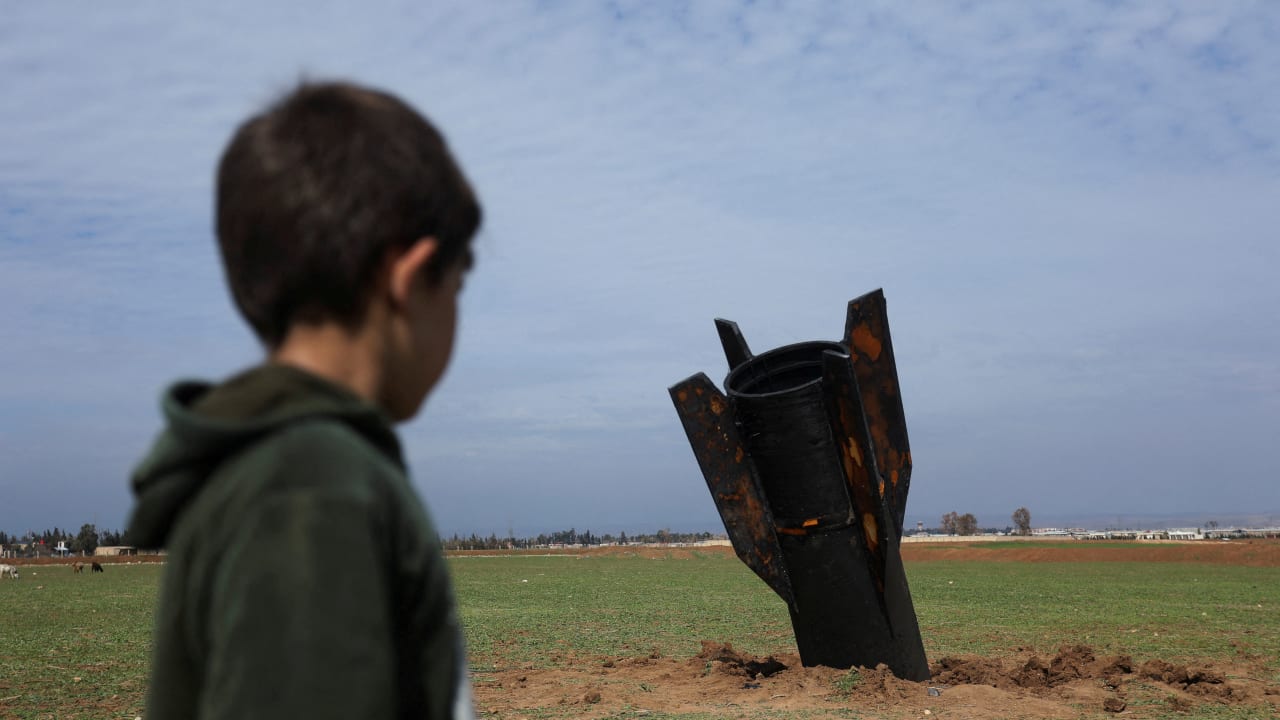
As much of the Middle East has been plunged into chaos and conflict by the war in Iran, Syria stands out as a country seeking to avoid conflict.
Syria has emerged from a decade-long civil war with the fall of the Assad regime in December 2024 and is now led by a new government with Ahmed al-Sharaa as president.
On Friday, Sharaa sent congratulatory cables marking Eid al-Fitr to several leaders of Arab and Islamic countries. SANA state media said the cables were sent as “part of strengthening bilateral relations and exchanging congratulations on religious occasions.”
He reached out to a long list of leaders, including Saudi Arabia, Qatar, Iraq, Oman, Algeria, the Palestinian Authority, Yemen, Mauritania, Azerbaijan, Pakistan, Afghanistan, Malaysia, Tanzania, Bahrain, Kuwait, Indonesia, Jordan, the United Arab Emirates, Morocco, Somalia, Egypt, Tunisia, Turkey, Nigeria, and Uzbekistan. He also addressed a message to the Kurdistan Region of northern Iraq.
“The messages underscored Syria’s commitment to strengthening ties with these countries, and conveyed hopes for continued cooperation and solidarity across the region,” SANA noted.

Sharaa understands the challenges in the region. In southern Syria, the Iranian missiles launched at Israel can sometimes be seen from the ground as they pass over.
In addition, Israel is waging a war with Hezbollah in Lebanon. There are tensions between Syria and Hezbollah. The terrorist group backed the Assad regime and tried to occupy parts of Syria during the civil war.
Sharaa has sought to put Syria on a path towards peace and prosperity. He was quick to reach out to US President Donald Trump last year; he accomplished this via support from Saudi Arabia and Turkey, two countries with close ties to the White House.
He has been able to have sanctions against Syria lifted, allowing it to attract investment. Sharaa positions Syria as a country seeking peace, not conflict, in a region where conflict appears to be growing.
Speaking from the People’s Palace in Damascus, Sharaa said on Friday that “Syria’s economy is rebounding sharply after years of decline, citing a budget surplus and projecting GDP will return to pre-war levels as reconstruction and wage increases accelerate,” SANA reported.
“Everyone knows that... the GDP in 2010 was $60 billion, then things deteriorated, and after liberation, statistics indicated that it had decreased significantly,” he noted. “In 2025, we achieved a growth rate of approximately 30 to 35 percent, with GDP reaching around $32b. and spending reaching $3.5b. For the first time in Syria, there was a budget surplus,” he said.
The Syrian state is increasing its budget as GDP grows rapidly. “Sharaa stressed that the state has priorities, including ending the issue of camps and enabling people to return to their villages and towns destroyed by the deposed regime,” SANA noted.
To have the growth that Syria is experiencing trickle down, the government is raising public sector salaries by 50%. Sharaa has also enabled tax exemptions for businesses impacted by war.
“Exemptions vary depending on the extent of damage. Commercial businesses will receive tax relief for one year, ranging from 50% for damage between 25% and 50%, to full exemption for damage exceeding 75%,” SANA noted.
Syria remains in transitional state
However, there are challenges. Syria recently completed a series of transitions in eastern Syria where areas formerly run by the Syrian Democratic Forces were integrated into state-run areas.
The Interior Ministry in Damascus has sent forces to work with the SDF to secure areas. There are still difficult areas where a full resolution of control has not been smooth, such as in the Kurdish city of Kobani in northern Syria.
The road ahead is complex. In addition, in southern Syria, the Druze area of Sweida is not under government control. Israel has vowed to back the Druze. However, Damascus accuses Sweida of trying to smuggle weapons.
Levant24 in Syria noted on Friday that the Interior Ministry “said security forces in Sweida thwarted an attempt to smuggle weapons and ammunition for use in hostile acts on the Busra al Sham and Baka road, after detecting infiltration near checkpoints and suspicious vehicle movements.”

The report added that “it said a clash followed after gunmen opened fire, resulting in two killed, two wounded and two arrested, with weapons seized.”
IDF strikes military targets in Syria
On Friday, the IDF carried out airstrikes targeting infrastructure and military sites belonging to the Syrian government in southern Syria, saying the strikes were in response to attacks on the Druze.
The IDF calls the government in Syria a “regime,” just like it did to Bashar al-Assad’s government, which was a partner of Iran and Hezbollah. In theory, the new government in Damascus and Israel share regional views regarding Iran and Hezbollah.
However, the US is now focused on the conflict with Iran and Hezbollah, which puts Syria in a complex spot. It borders Iraq and Lebanon, where conflict is unfolding, and Iranian-backed militias in Iraq have threatened Damascus and have carried out hundreds of attacks on US forces and on the Kurdistan Region.
Meanwhile, the Syrian Foreign Ministry has condemned the Israeli airstrikes as a “brutal Israeli attack.” Syria says it “considers it a flagrant violation of the principles of international law and the UN Charter, and a blatant attack on Syria’s sovereignty and territorial integrity.”
Saudi Arabia also condemned the strikes. “The kingdom reiterates its firm rejection of this blatant aggression and Israel’s violation of the 1974 Disengagement Agreement,” the Saudi Foreign Ministry said, and called on the international community to intervene and end “Israel’s violations of international laws and norms.”
Syria to prioritize avoiding international conflict
For Syria, the key is avoiding being dragged into the conflicts in the region. It has support in this endeavor from Riyadh and Ankara.
US Ambassador to Turkey Tom Barrack, who is also the envoy to Syria and plays an increasing role in Iraq, will be key for Damascus to reach its goals.
This past week, he noted, “Many thanks to Erbil and Baghdad for their work to reach an agreement at this critical time to resume energy exports and improve prosperity for the region. Your courage, steadfast cooperation, and commitment to the diplomatic path have been truly invaluable. The United States remains fully committed to supporting these important efforts in this time of crisis.”
The next day, he wrote on X/Twitter, “I was honored to chair the March 18 UNSC meeting on Syria, on the 15th anniversary of the launch of a revolution inside Syria. We remember the courage of those who first marched peacefully in 2011, calling for dignity, reform, and freedom on Syria’s Revolution Day. Their voices helped open the door to a new chapter for Syria. The United States honors the resilience of all Syrian people as they work toward a stable, unified, and prosperous future.”