
Iranian-backed militias in Iraq are in the spotlight as there appears to be growing momentum seeking to disarm them and place their weapons in the hands of the state. This is part of a broader trend in the region that seeks to end the reign of Iranian-backed proxies, terrorists, and militias that have wreaked havoc in Gaza, Lebanon, Yemen, and Iraq. The only major success so far has been in Syria, when the fall of the Assad regime forced Iranian-backed militias to flee the country. In Gaza, Hamas is weakened, but continues to control around half the enclave.
Reports in Iraq suggest that some Iranian-backed militias are ready to comply with an order to place their weapons under state control. However, two powerful militias have openly refused. At the same time, rumors are swirling in Baghdad that if the militias do not disarm, those militias could face airstrikes. The Iraqi National Intelligence Service issued a statement late Saturday night clarifying what media outlets had reported about “Iraq about to be subjected to military strikes.” But the intelligence agency said it was categorically denying this.
Numerous members of the newly elected Iraqi parliament have affiliations with the Iranian-backed Shi’ite militias. These militias are often categorized as the Popular Mobilization Forces or Hashd al-Shaabi. This is supposed to be an official Iraqi parliamentary force.
Much like Iran’s Islamic Revolutionary Guard Corps, it often seeks to supplant the state and act independently. The militias in Iraq include dozens of groups. Some are stronger than others. The Badr Organization, for instance, has numerous large militia affiliates; it also has a strong role in Iraq’s Interior Ministry. However, it is not sanctioned by the US.
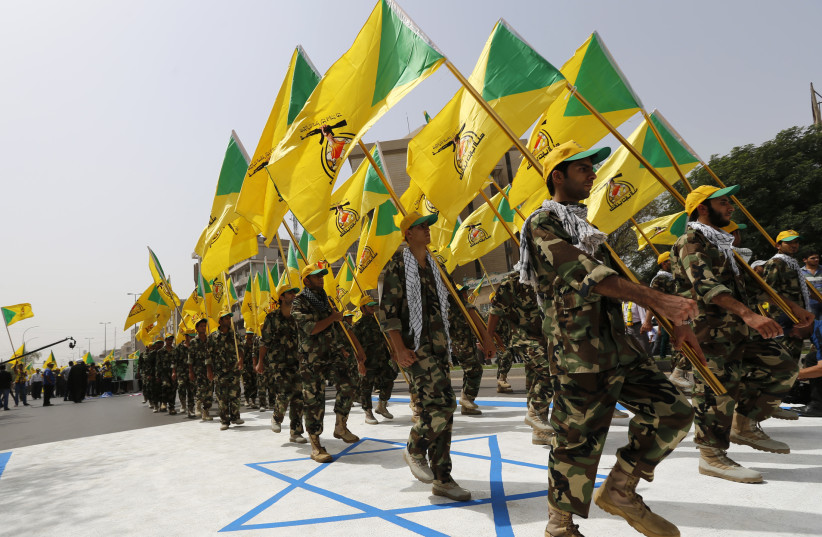
Other militia groups, such as Kataib Hezbollah, Asaib Ahl al-Haq, and Harakat Hezbollah al-Nujaba, are sanctioned by the US. As such, some of these militias are seen as terrorist groups. Many have engaged in terrorism and human rights abuses over the years. Some of them have also targeted American forces and the Kurdistan Region of Iraq.
One report at Al-Sumaria TV says that some of the militias may agree to place their weapons under state control. This comes after a judicial order to do so. Asaib Ahl al-Haq, the Kataib Imam Ali militia, and Harakat Ansar Allah Awfiya appear to be willing to comply.
Iraq’s judiciary and militias test the state’s sovereignty
However, there is controversy about Iraq’s judiciary and whether it will do the right thing. US Congress member Joe Wilson wrote on social media on December 21, “today, the corrupt president of the Iraqi Supreme Judicial Council publicly thanked armed factions for their stated intention to disarm. This language does not reflect the conduct of a state institution nor that of a neutral judiciary. Instead, it clearly shows a communication channel and an ongoing relationship between the judiciary leadership and militia factions. An independent judiciary does not thank armed groups for following its advice nor assess their political or military actions. Such conduct is completely outside its constitutional role.”
According to Shafaq News in Iraq, “a source within the [Shi’ite] coordination framework revealed on Saturday evening that the political forces involved in the framework have requested some international mediating parties to provide actual guarantees that armed factions will not be targeted during the steps to dissolve and integrate them into security institutions.”
The report added, “the political forces within the coordination framework have asked some international parties (mediators) to provide real guarantees in exchange for dissolving the armed factions and disarming or confining their weapons to the state. The guarantees are that they will not be attacked or targeted, and that the matter of dissolution and integration will be left without a specific time frame, because the movement will be internal.”
It also appears that other parties want to encourage Baghdad to continue with its policy of reigning in its militias. “An informed government source revealed on Sunday that the US President’s envoy, Mark Savaya, will soon visit Baghdad at the head of a delegation from the US administration to discuss a number of issues related to the nature of the relationship between Washington and Baghdad in the next stage, as well as to discuss solutions to the crises,” Shafaq said.
What do we know about the current crisis in Baghdad? Rudaw Kurdish media reported that a report by Asharq Al-Awsat had said a “friendly” country had warned Baghdad that strikes could occur if the militias don’t comply with demands to put their weapons under state control. “Potential targets could include government institutions linked to Shiite factions and the Popular Mobilization Forces (PMF), military figures, drone and missile depots, and training camps. It also claimed Israel had received a ‘green light’ from the United States to act inside Iraq.”
Kataib Hezbollah is the main militia now threatening to cause trouble. Al-Ain media in the UAE notes that its refusal to put weapons under state control “restricts Iraq’s sovereignty.” The report stated, “Kataib Hezbollah, one of the most prominent armed factions linked to the Iranian axis in Iraq, has renewed its explicit rejection of the principle of disarmament or confining weapons to the state.”
The Al-Ain report notes that Kataib Hezbollah, which is among the closest militias to the Iranian IRGC, wants to see “foreign forces” leave Iraq before it disarms. The Kataib Hezbollah brigades consider their weapons “not their property,” but rather a “trust” that cannot be relinquished.
Al-Ain said, “The brigades linked any potential understanding with the Iraqi government to the withdrawal of all foreign forces, including the international coalition and NATO forces, in addition to the Turkish forces, thereby exceeding the powers of the Iraqi state in managing its military and security relations, and enshrining the logic of ‘armed veto’ over sovereign decisions.”
The group also included vague threats related to what they called “dangers to the people and holy sites” in an attempt to justify their continued possession of weapons.
Al-Ain notes that this is the same policy as Hezbollah and Hamas. “These positions are seen as part of a broader strategy by armed forces linked to Iran, based on retaining weapons as a tool of political and security influence, and using them to pressure national governments, rather than integrating into state processes and building institutions.”
The report concludes: “the insistence of Kataib Hezbollah on imposing its conditions, and its prior rejection of any path to disarmament, undermines the Iraqi government’s efforts to restore its monopoly on force, weakens the chances of stability, and keeps the country hostage to regional equations that transcend the national interest.”