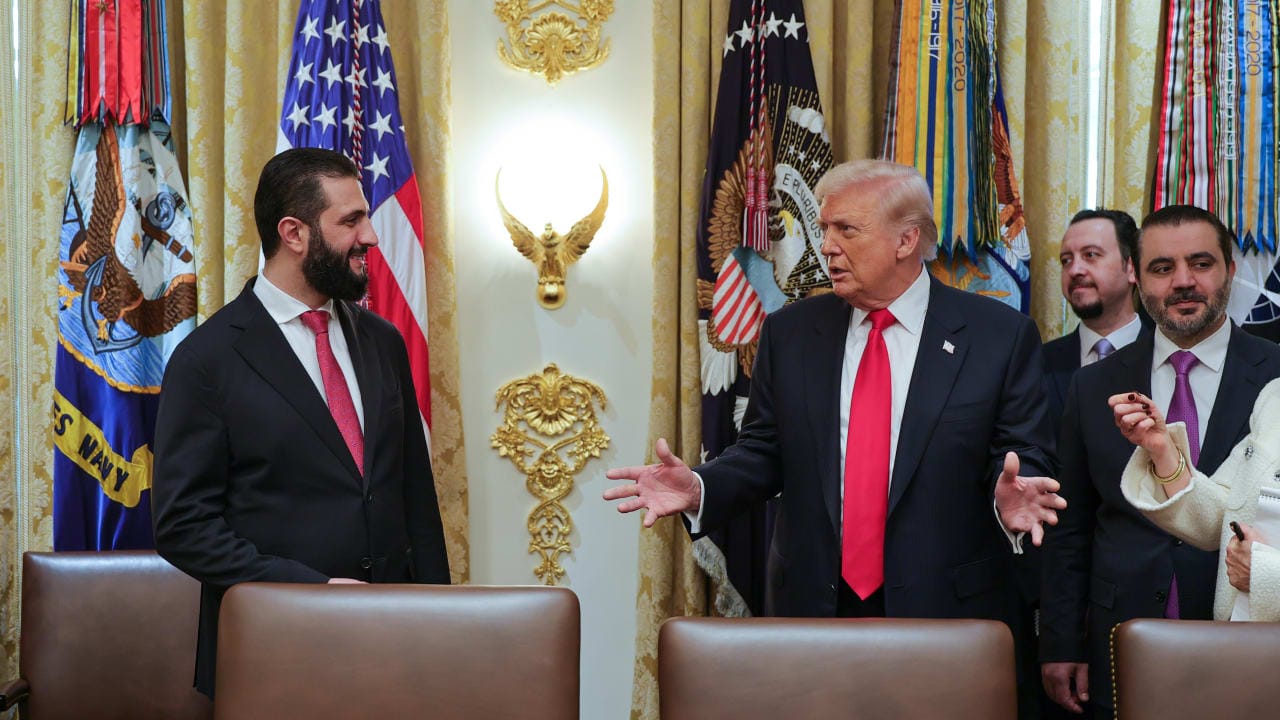
The US House of Representatives voted on December 10 to pass the $900 billion National Defense Authorization Act, or NDAA. This is an important move that will fund defense programs and also has wide-reaching ramifications for other issues. It includes a repeal of the Caesar Act, a series of sanctions on Syria that were imposed by the US against the Assad regime in 2019.
US President Donald Trump and his team have been pressing to remove the sanctions to give Syria a chance to thrive. Not everyone agrees, as some have criticized the current government in Damascus. Others want to give Damascus a chance to change, but believe it’s important that sanctions could be reimposed.
For Syrians, this is a time to cheer. Celebrations have already been ongoing in Syria due to the anniversary of the fall of the Assad regime.
In many cities, such as Homs, Hama, Aleppo, and Damascus, there has been a week-long celebration. This is unique for Syria, after people suffered under more than a decade of war.
Reuters noted that “a set of tough US sanctions imposed on Syria under its former leader Bashar al-Assad could be lifted within weeks, after their repeal was included in a sweeping defense policy bill unveiled during the weekend and due for votes in Congress within days.”

Caesar Act sanctions on Syria set for repeal by NDAA
The vote in the House was 312-112. ABC noted that “the legislation – which sets lawmakers’ defense priorities and authorizes spending levels for the Defense Department and national security programs – cleared the lower chamber in a bipartisan vote with 312 voting in favor and 112 in opposition.”
Syrian state media, SANA added that “the US House of Representatives voted Wednesday by a majority to repeal the sanctions imposed on Syria under the ‘Caesar Act,’ which was enacted in December 2019 to penalize the former regime for war crimes committed against the Syrian people during the years of the uprising.”
The report at SANA added that the new repeal is comprehensive and unconditional. The report credits “extensive diplomatic efforts by the Syrian government, supported by the Syrian community and active Syrian-American organizations in Washington, as well as by allied and friendly countries that had worked to lift the sanctions.” Syrians see this as a major win in Washington.
It came about through Saudi Arabia helping to get Trump to meet with Syrian President Ahmed al-Shara’a earlier this year. The two leaders then met again last month. There are voices that appear to have opposed the end of the sanctions in Israel, where some officials have been increasingly vocal in opposing Syria’s new government.
One government minister said war is inevitable with Syria, and others have bashed Shara’a as a “jihadist” and “terrorist.” It isn’t clear why Israel is a major outlier regarding Syria. The Assad regime backed Hezbollah and was a close ally of Iran. Shara’a helped remove Iranian-backed militias from Syria, and his government has shown openness to Israel. However, Syria is angry that Israel has taken over a buffer zone along the Golan border and has carried out airstrikes in Syria and raids into Syrian villages.
SANA quoted Abdul Hafeez Sharaf, a member of the Syrian American Council, as saying, “After passing the House, the bill now returns to the Senate because there are amendments to the budget unrelated to Syria and concerning other matters. Therefore, there may be another Senate vote on the budget as a whole, not specifically on Syria. The repeal will then proceed automatically and reach the US President’s desk for final signature.”
Arab News reported that “Syria faces serious challenges in the aftermath of the fall of the Assad regime a year ago, including rebuilding its economy, lifting refugees and civilians out of poverty, and preventing a resurgence of Daesh terrorism.” At a recent event at the Middle East Institute in Washington, DC, on Wednesday, there was an important discussion about what comes next in Syria.
Arab News noted that the event was “moderated by the institute’s vice president for policy, Kenneth Pollack, the participants included retired ambassadors Robert Ford and Barbara Leaf, and Charles Lister, a resident fellow at the institute.”
It also noted that “the other discussion focused on the continuing economic hardships in Syria that could fuel terrorism, including a resurgence of Daesh. Moderator Elizabeth Hagedorn, of Washington-based Middle East news website Al-Monitor, was joined by Mohammed Alaa Ghanem of the Syrian American Council, Celine Kasem of Syria Now, and Jay Salkini from the US-Syria Business Council.”
The report at Arab News went on to note what some of the participants said. “Ford said a key aspect of the process as Syria moves forward will be the removal of all sanctions imposed by the US against the Assad regime under the 2019 Caesar Act, an effort that is now underway in Congress.” The challenges for Damascus continue.
One key issue is making sure there are no more large clashes or conflicts in Syria, such as the ones that have broken out with the Druze. The Druze in Sweida has sought to create its own autonomous region. Demonstrators this week called for self-determination, essentially charting a course towards independence.
Israel has said it will back the Druze. In eastern Syria, the Syrian Democratic Forces, a mostly Kurdish-led group, are also wondering what comes next. The end of sanctions can benefit them as well. However, there are questions about how they may integrate their region with the government in Damascus. A March agreement was supposed to pave the way for integration. So far, it has not happened.
“If they can work with the Syrian government and with more and more important regional actors as the United States retrenches – like Israel, Turkiye, Saudi Arabia, the United Arab Emirates, Qatar, and Egypt; it’s a long list – it will become more important,” Ford said, Arab News noted.
There are positive signs on other fronts. US Central Command is now working with the Syrian authorities. This comes after Syria sought to join the US-led global coalition against ISIS. Admiral Brad Cooper, commander of the US Central Command, sent a pre-taped message to the MEI event.
He spoke about cooperation. “Just to give an example, in the month of October, US forces advised, assisted, and enabled Syrian partners during more than 20 operations against (Daesh), diminishing the terrorists’ attacks and export of violence around the world…We’re also degrading their ability to regenerate.”
Poverty is a challenge in Syria. Jay Salkini, of the US-Syria Business Council, noted that there was a lot of unemployment. “Let me give you statistics on the wages: A factory worker today, his salary is $100-$300 a month. A farmer makes $75-$200 a month in salary. A manager (or) a private in the military makes $250 a month,” he noted, according to Arab News.
The report also said the average income is only $200-$300 a month. “Many displaced people are unable to return to their former homes, the panelists said, because they were destroyed during the war and there is no accessible construction industry to rebuild them.”