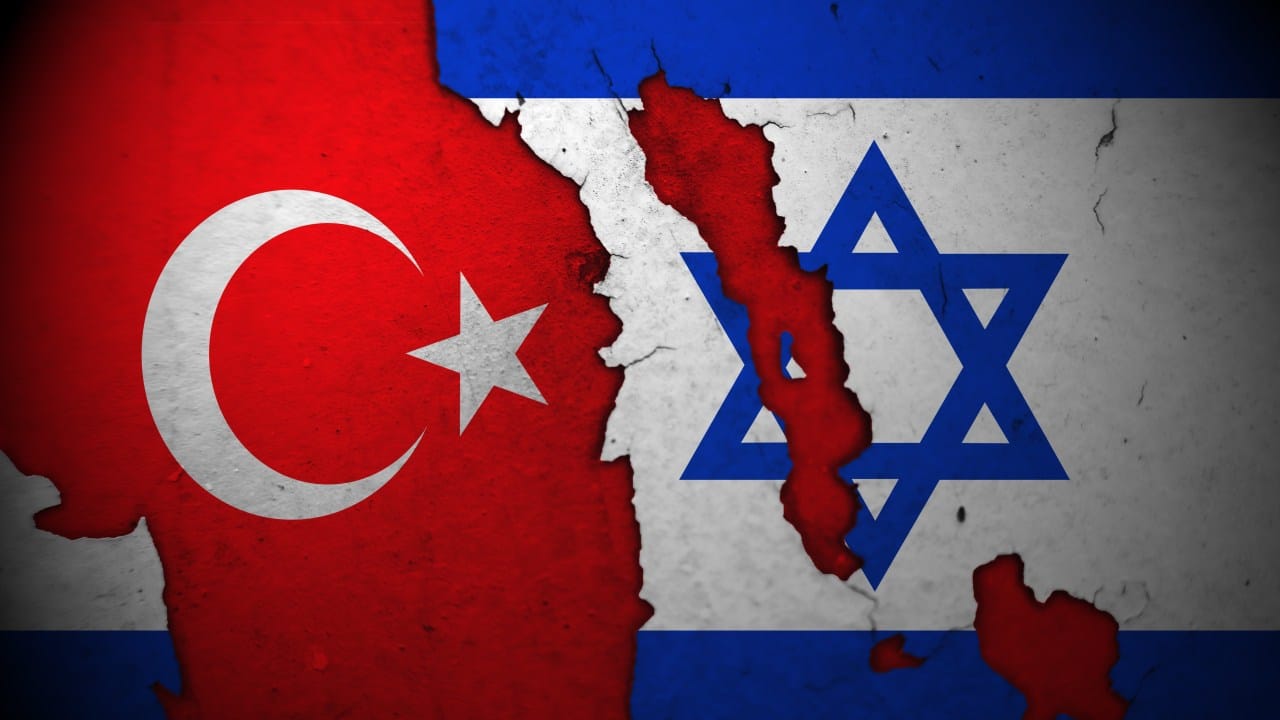
Turkish President Recep Tayyip Erdogan said Sunday after the G20 summit in South Africa that Ankara is still “evaluating” how it might participate in the planned International Stabilization Force in Gaza.
Only in the Middle East could the same leader who shelters Hamas, and compares Israel to the Nazis, and its prime minister to Hitler, suggest with a straight face that his country might help stabilize Gaza.
The dissonance between the role Erdogan sees for Turkey in Gaza and the one Israel will be willing to let him fill is glaring.
This became evident at Sunday’s cabinet meeting when Diaspora Affairs Minister Amichai Chikli called on the prime minister to shut down Turkey’s consulates in Jerusalem and Tel Aviv and outlaw TIKA, the Turkish Cooperation and Coordination Agency, which Israel has long viewed as a vehicle for political subversion and a conduit to Hamas under the cover of development aid and cultural cooperation.
“The rhetoric and actions of the dictator in Ankara,” Chikli wrote, “are those of the leader of an enemy state.” And no self-respecting nation, he argued, would allow Turkish emissaries to operate freely on its soil while Ankara embraces Hamas and campaigns internationally for Israel’s delegitimization. This was not a rhetorical outburst. It reflected a steadily growing current inside Israel that believes Jerusalem must draw firm red lines with Turkey.

What Chikli’s statement shows is that the question is not only whether Turkey should have a role in Gaza, but whether its representatives - including TIKA - should be allowed to operate freely in Jerusalem and Judea and Samaria. At the same time, Ankara houses those trying to murder Jews.
It is easy to forget that just over a year before October 7, Israel and Turkey were cautiously restoring ties. Ambassadors were exchanged. Prime Minister Benjamin Netanyahu met with Erdogan on the sidelines of the UN General Assembly. There was talk, never realistic, but still talk of resetting the relationship.
Then came the Hamas massacre. As political correspondent Amit Segal wrote in Israel Hayom earlier this month, Israel’s embassy in Ankara has been “closed and gathering dust” since that day, and the consulate in Istanbul opens only intermittently, staffed by two diplomats who travel under personal risk. Meanwhile, Turkey maintains around fifty diplomats inside Israel - 30 in Tel Aviv and 20 in Jerusalem - and their mission, Segal emphasized, is not to strengthen ties but to undermine Israel from within.
He pointed out that when Hamas leader Ismail Haniyeh was assassinated in Tehran fifteen months ago, the Turkish embassy in Tel Aviv lowered its flag to half-mast. Few gestures more clearly conveyed where Ankara’s sympathies lie, and Israel’s blind spots.
Israel's blind spots in its approach to Turkey
Those blind spots in Israel’s approach to Turkey are rapidly disappearing, and what is starting to seep into the national conversation is that Turkey is no longer simply a hostile state, but an adversarial one.
Another layer of this story also deserves attention: the Turkish embargo that wasn’t. In April 2024, with great fanfare, Turkey announced a full suspension of trade with Israel, marketed domestically as a principled response to Israel’s “genocide” in Gaza. Erdogan compared Israel to Nazi Germany. Turkish officials spoke of economic punishment.
The facts tell a different story. A Bank of Israel analysis in March found that the embargo’s impact on Israel’s economy was minimal to nonexistent. Israeli importers quickly found substitutes, even in sectors like cement, where Turkey had been dominant, and prices did not rise.
Meanwhile, Turkish exporters quietly kept doing business. Between January and May 2025, Turkey exported $393.7 million worth of goods to Israel. Although bilateral trade between the countries fell by more than half in 2004 compared to the previous year, UN Comtrade data shows that Turkey was still Israel’s fifth-largest source of imports in 2024, with $2.86 billion in goods. Turkish companies simply rerouted shipments through third countries or via Palestinian intermediaries.
The point is not that Israel suffered, as it didn’t, but that Erdogan wages a political and rhetorical campaign against Israel while his own economy continues to benefit from Israeli consumers. The embargo farce exposes Turkey’s duplicity: saying one thing, doing another, all while continuing to shelter Hamas.
President Donald Trump’s announcement Sunday that he plans to designate the Muslim Brotherhood as a Foreign Terrorist Organization now adds an additional twist to the relationship with Turkey, since Erdogan’s ruling AKP Party - and Erdogan himself - is deeply rooted in Muslim Brotherhood ideology.
If Washington follows through, Jerusalem may well mirror the designation. Netanyahu said as much Sunday night, commending Trump’s announcement and saying that Israel has “outlawed parts of the organization and will continue to do so.”
And the consequences of doing so would be far more than just symbolic. Once the Brotherhood becomes an FTO, any organization linked to its networks or financing channels becomes exposed. This could provide the rationale for curtailing TIKA’s activities in Israel.
TIKA is not merely a development arm of the Turkish government. Israeli officials and analysts have long cited it as a conduit for money, personnel, and influence into Hamas-linked operations in Gaza and east Jerusalem. If Hamas - already a designated terrorist organization - is treated in US law as the Palestinian arm of an FTO, then any entity documented as transferring funds, resources, or personnel to it becomes sanctionable overnight.
A Muslim Brotherhood designation would not just be a political statement; it would structurally undermine Turkey’s ability to operate in Gaza, Jerusalem, or anywhere in Israel.
Turkey today is arguably Hamas’s most permissive foreign base of operations. It hosts senior leaders, grants citizenship to operatives, and allows command-and-control activity, financial laundering networks, recruitment pipelines, attack planning, and cyber operations targeting Israelis and Jews. A country that shelters Hamas should not be allowed to operate freely inside Israel, let alone inside Gaza. Israeli public opinion is shifting accordingly.
Ankara’s challenge for Israel is not only ideological or operational; it is strategic. Ankara is militarily stronger, more assertive, and increasingly willing to confront Israel rhetorically and diplomatically -- it has systematically blocked Israeli cooperation with NATO since October 2023.
Turkey’s growing presence in post-Assad Syria, its navy in the Eastern Mediterranean, its involvement in Palestinian politics, and its push for a role in Gaza all reflect a widening arc of ambition. Erdogan sees himself as the future leader of the Muslim world - a vision in which Israel is an obstacle that must be contained.
Israel, meanwhile, sees Turkey trying to carve out influence inside Jerusalem and in the West Bank through TIKA and related bodies. That is why voices like Chikli’s are multiplying. And that is why Israel’s opposition to any Turkish role in a Gaza stabilization force is not a diplomatic preference - it is a necessity.
In a region where ambiguity is often the default option, this is one case where clarity is a necessity. A country that provides sanctuary to Hamas should not be given sanctuary inside Israel - not through cultural institutes, not through “humanitarian” agencies, not through diplomatic missions far larger than Israel’s own presence in Turkey, and certainly not through troops in Gaza.
If Turkey wants operational access to Israel, it should first remove Hamas’s operational access to Turkey. Until then, the line should be unmistakable: Israel cannot afford to allow Turkish influence into Gaza - or into Jerusalem or Judea and Samaria - while Ankara works tirelessly to weaken and delegitimize Israel, and as it champions, hosts, and enables Israel’s most murderous enemy.