
‘I try to blend science and Kabbalah together,” says Eduard Shyfrin, the well-reputed author, scientist, and musician. In recent years, Shyfrin has received acclaim for his work in this area, as evidenced by his first book, From Infinity to Man: The Fundamental Ideas of Kabbalah Within the Framework of Information Theory and Quantum Physics, published in 2019.
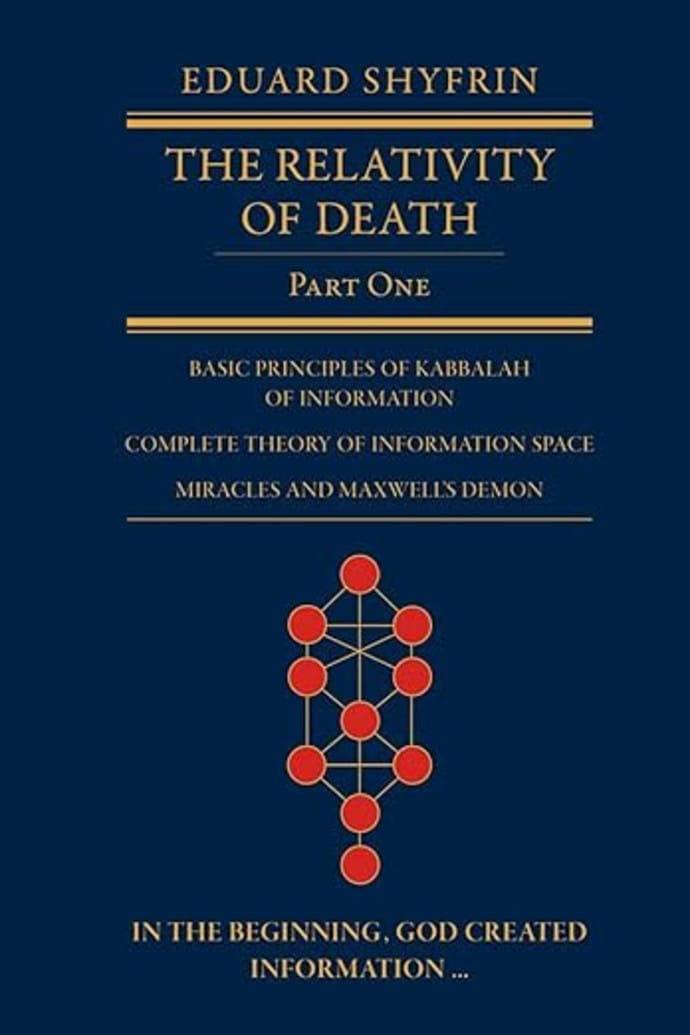
Shyfrin recently issued his second book on the subject, The Relativity of Death: Part One: Basic Principles of Kabbalah of Information, Complete Theory of Information Space, Miracles and Maxwell’s Demon, in which he expands on the ideas introduced in his earlier work.
He describes Creation as a multidimensional information space, populated by humanity and angels, and composed of concepts and forces expressed through letters and numbers. Building on this framework, he develops a comprehensive system of information laws and principles of Creation, offering a unified theory of the Kabbalah of Information with explanations and discoveries never before articulated.
Recently, this writer discussed some of the book’s main concepts in a Zoom discussion with Shyfrin.
How does this book further develop your ideas on the Kabbalah of Information?
In 2019, I published my first book, From Infinity to Man, a collection of insights and ideas, in which I put forward the main thesis that ‘In the beginning, He (Ein Sof) created information and nothing else.’ The Relativity of Death is the first attempt in history to formulate the Kabbalah of Information as a systemic theory based on principles and laws. The main new development is the depiction of Creation as an information space, comprised of concepts and force.
The book’s title references ‘the relativity of death.’ What do you mean by that, and how should it change the way we think about mortality?
One of the basic principles of the Kabbalah of Information states that every phenomenon in Creation, including life and death, is relative to the zone of information space in which it occurs. The Kabbalah of Information considers death as a collapse of the complex system of the soul and the body. The notion of death cannot be attributed to simple systems, to the soul, or to electrons.
The principle of the Kabbalah of Information is ‘no soulless bodies, no bodiless souls.’ In every zone of the information space, we will still be a complex system of soul and body. Death is relative to the zone of information space where we are now. It is a transition to another zone of information space. The Ari, Rabbi Isaac Luria, the 16th-century Jewish mystic in Safed, expressed this idea many times.
In any zone of information space, we will have a soul and a certain kind of body. The difference is that in our world, the body is composed of components of the environment, such as electrons and protons, enabling it to exchange information with the environment. In another zone of information space, the body will be made of the components of that zone. But the principle is that there are no bodiless souls. We will exist with a soul and a body, whatever the body is composed of.
You have stated that modern science cannot explain the true nature of reality. What, in your view, is its biggest blind spot?
The root of all problems of modern science is the so-called ‘problem of initial state.’ Science knows nothing about the origin of the universe.
One of the central ideas of your latest book is that reality is fundamentally ‘information.’ What does that mean in simple terms for someone without a scientific background?
For people without a scientific background, I offer a simple conclusion. People will always exist in the Information Space of Creation.
Information is irreducible, and we will always exist in a certain form of the body and soul. In addition, King Solomon wrote in Ecclesiastes [7:2] that ‘a good name is more precious than fragrant oil.’ In the Kabbalah of Information, it means that the record of a person’s deeds – whether good or bad – will always accompany them in all the zones of the Information Space of Creation.
How does your concept of ‘information’ differ from the way it’s understood in physics or computer science?
Information, according to the Kabbalah of Information, is considered a building block of Creation. In physics and computer science, it is part of the general notion of information. As 20th-century American theoretical physicist John Archibald Wheeler said, ‘It from bit.’ Everything is made of information and is fundamental to the universe.
You place humanity at the center of Creation. Why do you believe the universe exists for human beings?
One of the pillars of our faith is the thesis that man is the ultimate purpose of Creation. According to the Kabbalah, the first world that emanated after the tzimtzum [contraction of God’s infinite light] was Adam kadmon [primordial Adam]. The Kabbalah of Information considers Adam kadmon an information concept of man that defines the information structure of Creation as a whole.
This idea has parallels in science. For example, the Weak Anthropic Principle, proposed by Australian theoretical physicist Brandon Carter, says that the universe is fine-tuned for life. The Strong Anthropic Principle, postulated by American astronomer and physicist Robert Dicke, says that the universe was intended to produce life. The Participatory Anthropic Principle, proposed by Wheeler, holds that observers are necessary to give the universe meaning.
What kind of reader did you have in mind when writing this book – scientists, believers, or skeptics?
People often ask, ‘What’s more important – faith or knowledge?’ I consider this question incorrect; it’s like asking, ‘Which leg is more important – left or right?’ The answer is both. My book is intended for people who want to combine belief with knowledge.
If readers take away just one idea from your book, what would you want it to be?
The main idea of the book is that information is irreducible. Information is irreducible because even the absence of information is information.
What books have you planned for the future?
With God’s help, I plan on publishing Parts 2, 3, and 4 of The Relativity of Death. I don’t like writing long books because most people will not read them. They are scared off by thick books.
Shyfrin concluded our interview by citing one of the first books he read – Maimonides’ Guide for the Perplexed, in his own quest to learn more about Judaism. “That book was addressed to people 800 years ago who had knowledge but couldn’t synthesize Judaism with their knowledge. That is what Maimonides did. For me, he is a role model. In the process of acquiring new knowledge, we should always integrate it with our faith because there will always be people who are perplexed by this combination. That is the purpose of my book.”
This article was written in cooperation with Eduard Shyfrin.