
The earliest chapters of Jewish history unfold as intimate family stories. Avraham nurtured a household of faith, a small circle that spread knowledge of God to all who were willing to hear. As a family charged with a historical mission, it required refinement, and his eldest son, Yishmael, was sifted away.
Isaac’s home underwent a similar winnowing, with Jacob chosen to carry the future while Esav stepped to the margins of the unfolding story.
By the third generation, the winnowing has run its course, and the dynamics shift. No longer is the circle of believers confined to a handful of individuals. A larger family begins to take shape – one that will eventually number seventy souls as they descend into Egypt. This small nuclear family has become a clan.
In this expanded setting, leadership naturally becomes an issue. A small family of three or four does not require formal structure; its intimacy allows decisions to emerge through instinct and emotional familiarity. But as the group grows, coordination becomes more complex, tensions sharpen, and a more defined form of leadership becomes necessary.
As the family grows into a larger community, several models of leadership begin to appear.
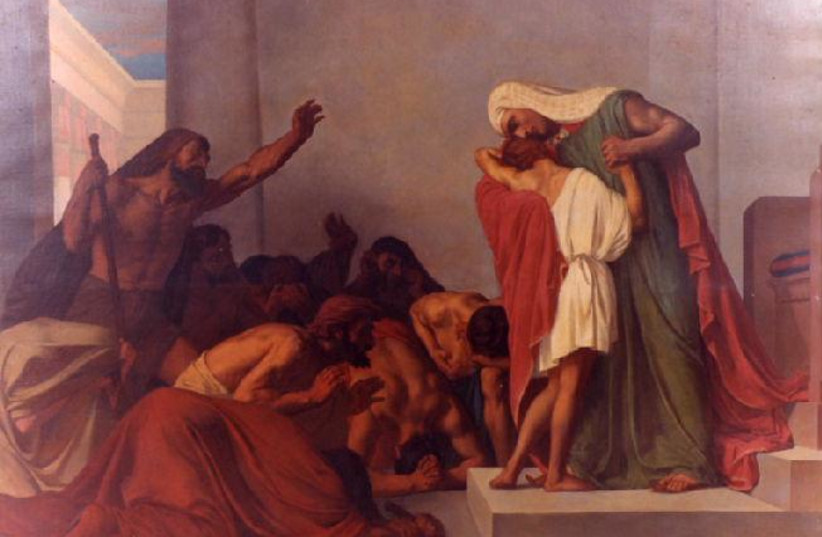
Power of a role model in moments that matter
Jacob’s eleventh son, Joseph, has been kidnapped and sold into slavery in Egypt. As far as he knows, he will never return to his family again. Alone, vulnerable, and seemingly without a future, he suddenly finds himself facing the seductive advances of his master’s wife. Her offer is more than temptation – it is his imagined path to freedom, influence, and greatness.
Joseph has always believed he possessed talent. He dreamed of leading his family and was convinced he was destined for prominence. Now, in this moment, it appears that everything he had once envisioned could be within reach.
His morals and integrity are challenged. How does he resist an offer that appears to deliver everything he once hoped for – hopes his brothers had ridiculed?
The Midrash teaches that in that charged moment, the image of his father appeared in the window. Gazing at Jacob – recalling the moral discipline he had absorbed in his father’s home – Joseph found the strength to turn away from temptation.
Whether this vision was a supernatural revelation or a psychological projection of his father is almost beside the point. In either case, the image – real or imagined – anchored him. His father’s presence and the standards he carried with him gave Joseph the strength to hold firm in a moment that could have led him astray.
People move people; ideas alone rarely do. When we face difficult tests, we draw strength not from abstractions but from the flesh-and-blood figures who shaped us.
My rebbe, Harav Aharon Lichtenstein, once offered a simple but transformative piece of advice: When confronting a moral or religious challenge, do not retreat into theoretical categories of right and wrong. In the calm of contemplation, our moral compass is clear. But under pressure, when desire or fear distorts judgment, our clarity becomes muddled.
In those charged moments, we need role models whose shoes we can step into. The real question becomes: How would someone I admire – a person of unquestioned moral integrity – behave in this situation? Their imagined presence makes the choice more compelling, and it becomes harder to justify a lapse in judgment.
As Rabbi Lichtenstein spoke, everyone in the room recognized that he was the ideal model of the integrity he was urging upon us. More than once in my own life, when facing a moral or religious crossroads, I have asked myself how he would respond if he were standing where I stand.
Politicians aren’t always fantastic role models for moral behavior; they should not be confused with true leaders. They are elected to make decisions on behalf of the electorate they serve – that is their role. Too often, we mistake this function for genuine leadership.
Real leaders are those who become role models – people whose lives we instinctively look to when shaping our own behavior. And for that role to be meaningful, it must be authentic. Genuine leaders do not perform morality in public, crafting gestures for applause. Such displays feel artificial and hollow. True leadership flows from quiet strength and consistent integrity, from lives whose authenticity commands respect more powerfully than any speech or position ever could.
Learning to lead by enabling others
But Joseph’s education in leadership was not yet complete.
Initially, he dreamed of ascending to prominence. He placed himself at the center of the family, imagining his influence radiating outward to his brothers. He possessed charisma and sought to shape their lives. His intentions were sincere; he believed he had been chosen to elevate them through his talents.
Fast-forward many years, and Joseph is languishing in an Egyptian prison. Two fellow inmates approach him, each troubled by a dream of his own. Joseph enters their dreams and interprets them. Tragically, only one dreamer will survive and return to freedom.
At this stage, Joseph discovers a deeper truth: Leadership is not about imposing one’s own vision but about enabling others. It is not about placing yourself at the center of the story but about helping others interpret and advance their own dreams.
Two years later, Joseph is summoned from his prison cell and asked to climb into yet another person’s dreams – this time into the mind and imagination of the king of Egypt. As he successfully interprets Pharaoh’s dreams, he finally attains the impact he once sought.
In his youth, Joseph believed that leadership flowed from charisma and the ability to shape others. He now discovers that leadership has far less to do with influencing people and far more to do with enabling their hopes and aspirations. To accomplish this, a leader must sometimes quiet his own dreams. Joseph never dreams again; his imagination and his heart become fully devoted to advancing the dreams of others.
Leadership means assuming responsibility
If Joseph learns that leadership means enabling others, his older brother Judah learns that leadership means assuming responsibility.
Originally, it was Judah who proposed selling Joseph to Egypt, a choice that condemned the family to years of shame and fracture. He believed that leadership rests in authority and decisive action.
Hard decisions are certainly part of leadership; however, decisions made without accepting responsibility are a shallow form of it. Anyone can seize authority and impose his will on others – especially once he has already accumulated influence.
Years later, Judah discovers real leadership. His brother Shimon has been imprisoned in Egypt, and Jacob refuses to allow Benjamin to travel there. The family stands on the verge of starvation, yet the patriarch cannot bring himself to part with his youngest son.
At that moment, Judah steps forward and guarantees Benjamin’s safe return. If his younger brother does not come home, Judah will bear the consequences for the rest of his life. This personal guarantee finally persuades Jacob to send Benjamin.
Judah has now learned that leadership is not merely making decisions – it is accepting responsibility for those decisions and standing behind them with personal accountability.
He soon reaches the moment when he must stand behind the promise he made. The brothers are detained, and Joseph – disguised as a harsh Egyptian official – threatens to imprison Benjamin. Judah steps forward and confronts the second-most powerful man in Egypt – not knowing that it’s the brother he sold into slavery many years earlier – to secure Benjamin’s release. In that moment, he proves himself a leader, accepting responsibility and acting upon it.
Our world is filled with loud imitations of leadership and a marketplace of self-promoting leadership workshops. Being featured in headlines doesn’t make someone a leader, nor does projecting influence. Genuine leadership is quieter: modeling principled behavior, enabling others in the pursuit of their dreams, and accepting responsibility for the choices you make. These are the essential traits of authentic leadership.
The writer, a rabbi at Yeshivat Har Etzion (Gush), was ordained by YU and has an MA in English literature. His books include To Be Holy but Human: Reflections Upon My Rebbe, HaRav Yehuda Amital. mtaraginbooks.com.