

The Torah portion of Ha’azinu is unlike any other. It is not simply a speech but rather a song – Moses’ final ode to the people of Israel before his death. Poetic and searing, its verses capture both the heights of God’s faithfulness and the depths of Israel’s sins.
The Haftorah that accompanies Ha’azinu, taken from II Samuel 22, is also a song: King David’s hymn of gratitude after being saved from his enemies. Two of Israel’s greatest leaders – Moses and David – each compose an anthem of sorts, testifying to God’s justice, His protection, and His ultimate redemption of our people.
In David’s words, we hear echoes of our own story: “The waves of death encompassed me... In my distress I called upon the Lord… and He heard my voice” (II Samuel 22:5-7). It is a cry that could have been written for the Jewish people in our own day, especially in the wake of the barbaric Hamas assault on Oct. 7, 2023. On that dark day, the nation was assaulted by ruthless enemies who seek nothing less than our annihilation.
Like David hemmed in by foes, Israel found itself surrounded by fire and blood. Yet just as in the Haftorah, the cry of our people ascended heavenward, and God stirred His mighty hand on our behalf to do battle with our foes.
This connection between ancient text and present reality grows even sharper when we place Ha’azinu and its Haftorah alongside the festival of Sukkot (Tabernacles), which begins next week.
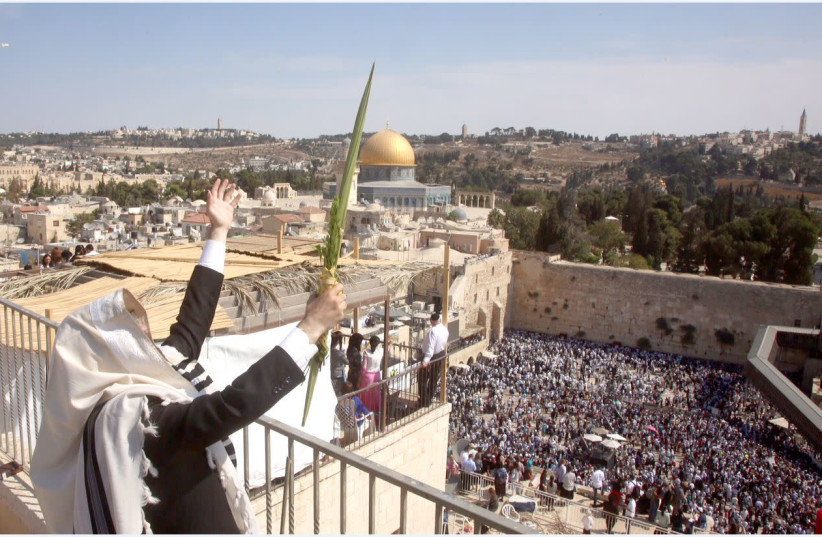
Sukkot and the link between past and present
Sukkot is called z’man simhateynu, the season of our joy, but it is also a commemoration of fragility. We leave the solid walls of our homes to dwell in booths covered with branches, utterly dependent upon Divine providence. The Sukkah is both a shelter and a statement: that our true security comes not from concrete and steel, but from the God of Israel Who has preserved us through the ages.
How poignant, then, that Oct. 7 coincides with the start of Sukkot this year. On that terrible day, Israel was reminded in the harshest way that Jewish life is still fragile, still vulnerable to sudden attack. Yet at the same time, Sukkot affirms that even in that vulnerability lies our strength. The sukkah becomes not a symbol of weakness but of faith, the very faith that has carried us through exile, persecution, and war.
On Oct. 7, terrorists sought to tear down the Sukkah of Israel, to rip apart the fragile covering of our national existence. They murdered, they burned, they desecrated. But the Jewish people, though shaken, did not collapse. We rebuilt, we returned to our communities, and we resolved never again to be caught unprepared.
In Ha’azinu, Moses also reminds us of the Divine covenant that transcends tragedy: “Remember the days of old, consider the years of many generations. Ask your father, and he will tell you; your elders, and they will inform you” (Deuteronomy 32:7). The memory of Jewish history – the persecutions we endured, the salvations we experienced – teaches us that despair is never the last word. Even when all seems lost, the sukkah of David is raised once more.
As we celebrate Sukkot this year, amid the shadows of Oct. 7, let us draw strength from the songs of Moses and David. Their words remind us that God has not abandoned His people, nor will He ever. The sukkah may sway in the storm, but it will not topple; Israel may be besieged, but it will not be broken.
For just as David sang after his deliverance, so too shall we: “You have girded me with strength for the battle… You have made my enemies turn their backs to me” (II Samuel 22:40-41). That is the promise of Ha’azinu, the hope of Sukkot, and the faith that sustains us after Oct. 7: that the God of Israel neither slumbers nor sleeps, and that His people, though tested, will endure forever. ■