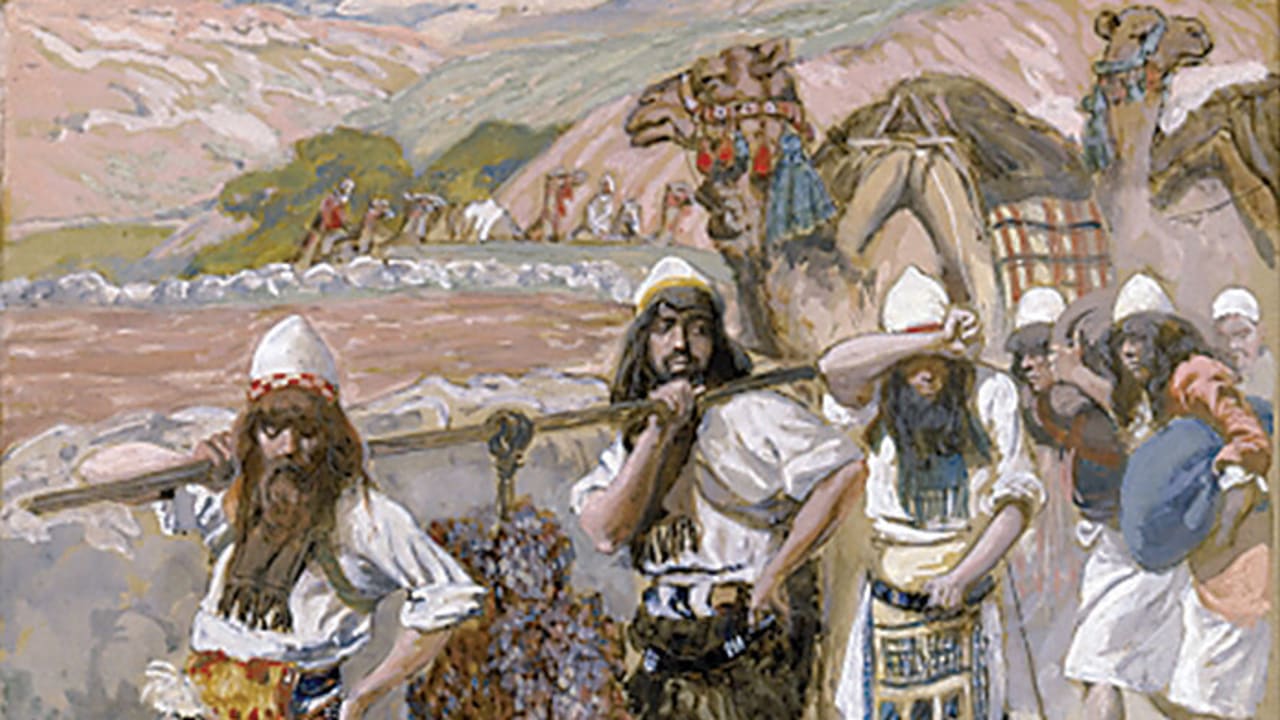
In the Torah portion “Shelach,” we read about the 12 spies who were sent to scout the Land of Israel.
Before they set out, Moses gave them guidance in a single Hebrew word, meaning “and you shall strengthen yourselves” (Numbers 13).
Don’t be afraid of anything.
Believe that the land is promised to you.
Believe in yourselves, and be strong.
Why the spies failed in their message
In reality, however, the spies did not carry out their mission in this spirit. For some reason, they insisted on measuring themselves against the height of the four giants (exceptionally tall men who lived in Hebron), and they became overwhelmed with fear.
Later, they picked huge fruits and brought them back to the desert in a detailed logistical effort described in the Torah portion, to show the people that the nature of the land was unusual and extreme.
In a tone of despair, they told the people: “And there we saw the Nephilim, the sons of Anak from the Nephilim; and we were in our own eyes as grasshoppers, and so we were in their eyes” (Numbers 13:33).
The Torah recounts the argument that erupted between the 10 pessimistic spies and Joshua and Caleb, the two optimistic ones.
Joshua and Caleb said: “We shall surely ascend and conquer it, for we can surely do it.” The other spies said: “We cannot go up against the people, for they are stronger than we.”
What was their argument about? Was it a debate about reality – about who was stronger? Certainly not.
This was a people who had just come out of Egypt, who saw the sea split before them, who had received the Torah from heaven. They were given manna from above to eat, every day except on Shabbat. This was a generation that did not experience the concealment of God but, on the contrary, saw God revealed in the most tangible way.
They knew that God is “the One who can do anything and holds all power.”
But what they lacked was faith in themselves. Faith that they would always be worthy of that goodness.
The 10 spies saw the huge size of the fruit and the extraordinary strength of the natives – because that is what they chose to see. From this, they concluded that the land was supernatural, and only the best and strongest could survive there.
The theory the spies developed was: We’ve grown used to the highest level of closeness to God. Therefore, if we make a mistake, we’ll be punished instantly.
Because a nation so close to God is required to be responsible and serious 24/7, and that’s hard – impossible even.
WHEN THEY returned to the desert, they mournfully described the frequent funeral processions they had seen in the land, interpreting it to mean: “A land that devours its inhabitants.” In other words: This is a land where only the perfect survive. So it’s better for us to return to Egypt.
In contrast, Caleb and Joshua replied: “God is with us, we are strong, we will ascend to the land, and it will be wonderful – we just need to believe in ourselves and our abilities. If the Lord desires us, He will bring us to this land and give it to us... Do not fear the people of the land, for they are our bread... and the Lord is with us.”
Rabbi Tzadok of Lublin, a thinker, scholar, and one of the leading rabbis of Poland, wrote in his book Tzidkat Hatzadik: “Just as a person must believe in God, so too must he believe in himself.”
WHAT DOES it mean to “believe in oneself”?
It means that a person who knows he is God’s emissary to spread light and goodness in the world believes in his own ability and capacity – and knows there’s no reason he should fail. Because if God didn’t believe in him, He wouldn’t have sent him as His messenger.
A person who believes he is not some redundant creature chasing survival and fleeting pleasures but rather a “divine spark from above” whom God placed in this world because He believes in his potential to spread good and light up worlds – such a person is vital, joyful, and driven. He becomes a beacon for his family and community.
The spies didn’t believe in themselves.
They didn’t believe in the uniqueness of the Jewish people.
And the tragedy was that they managed to sway the entire nation – and we paid dearly for it.
Today, as Israel faces great challenges, the message of “Believe in yourselves” is more relevant than ever.
We are not grasshoppers. We are a strong, ancient people with a mission. If God believes in us, we must believe in ourselves.
With faith, unity, and courage, we will prevail! ■
The writer is the rabbi of the Western Wall and holy sites.