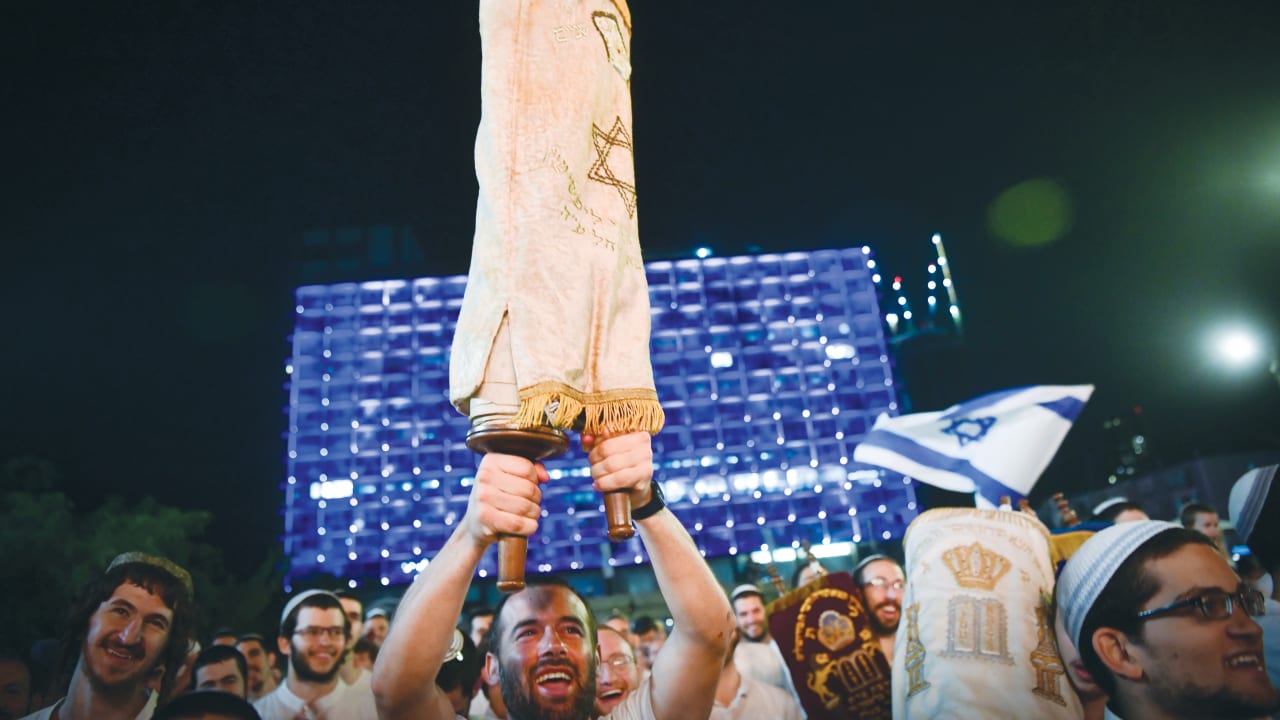
A month ago, I was asked to write about what it’s like to be an American Jew two years after October 7 – “maybe something uplifting for Simchat Torah?” Because the political landscape here and abroad changes by the hour, I waited. Now, with the holiday at hand, I begin.
There are subjects I’ll mention only briefly and leave aside. I won’t linger on how being a very public Jew has made it harder to find work. I won’t detail how many acquaintances – even some friends – have been surprised, or even chilled, by my unwavering support of Israel in its seven-front existential war.
Nor will I re-argue history – the Balfour agreement, the Peel Commission, the Mandate recommendations, or the simple fact of Jewish indigeneity in the Land of Israel. All of that matters, but this is not the place for a legal brief.
What I want to share instead is the sense of purpose and pride I feel in belonging to the 15-to-20-million-strong tribe called the Jewish People.
Whether one “believes” in the divinity of the Torah is irrelevant. What cannot be disputed is that, unlike any other people alive and intact today, we celebrate having been entrusted with a universally recognized document that has done – and continues to do – many things. The Torah serves as the foundation of moral consciousness, the precedent for systems of justice, and it unequivocally binds the Jewish people to Israel, our ancestral Homeland.
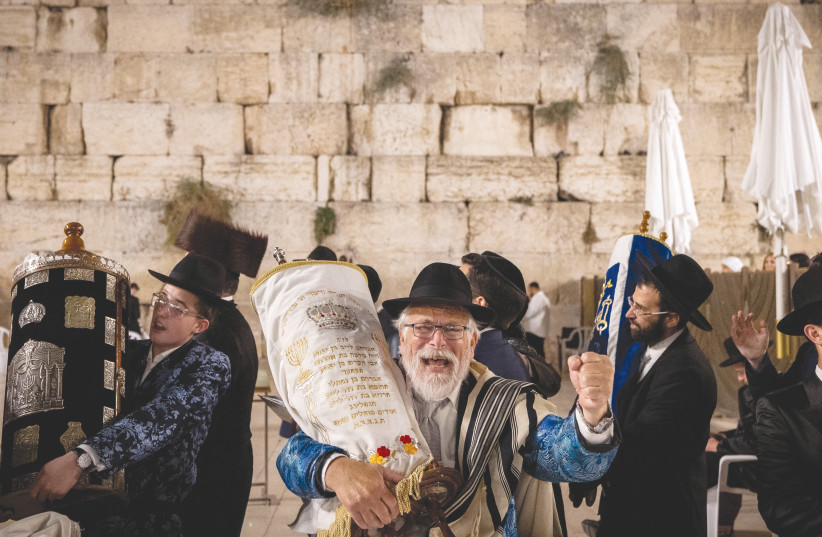
How is it that the same Torah we will rejoice with, exactly two years past the worst bloodletting of Jews since the Holocaust, could have been so prescient when it said the Jewish people will forever remain alone: “For from the top of the rocks I see him, and from the hills I behold him; behold, it is a people that shall dwell alone and shall not be reckoned among the nations” (Numbers 23:9).
More pointedly, how is it that after 3,300 years there still exists a Jewish people – a unique nation who, after exile, Inquisition, countless pogroms, the Holocaust, and now another unspeakably brutal assault, do indeed still dwell alone among the nations? Is it a matter of culture, politics, mere chance? Or is there something miraculous at play?
Yes, I know. It’s 2025. We are modern people, people who believe we’ve outgrown such notions. There must be a reasonable, rational explanation for the existence of this stubborn tribe who, clinging to their Torah, still exist and still dwell alone. And yet I have never heard one that is the least bit convincing.
Peoplehood and chosenness
Several weeks after 10/7, I was given the chance to watch the full 47-minute film of Hamas’s pogrom. It remains the worst thing I have witnessed in my six decades. My children urged me not to watch, but I felt a duty to do so. Yes, the sights – and even more, the sounds – have, in some ways, caused lasting harm.
But they also confirmed what I had until then only strongly suspected: that this Peoplehood – our Peoplehood – is unlike any other. For millennia, though we are just two-tenths of one percent of humanity, “in every generation they rise to destroy us” (Passover Haggadah). Why does such a tiny people so vex the world? To many, Jewish success can never be innocent. It must be manipulation, conspiracy, trickery. That is how our survival has been explained for centuries.
I see it differently, and here is where the “uplift” comes in. Here in America, where few grasp what it means to be Jewish – to belong to a family, a tribe, a vast kinship – one might feel pressure to hide: to downplay a 3,300-year-old heritage, to soften opinions about Israel, to tuck away something essential.
For me, the effect has been the opposite. These days have deepened my certainty that our Peoplehood, which includes our chosenness, is sacred.
What does chosenness mean – then and now? Not superiority – it was never that. It is a vocation to holiness, justice, and universal blessing – to be a covenantal people who model a life of Torah and compassion so that “all the nations of the earth may be uplifted.” It is duty, not self-importance, that feels ennobling to me, especially now.
Light on Simchat Torah
To be charged with purpose is perhaps the greatest gift. And the question is how, on this Simchat Torah, even with souls scarred by the events of two years past, can we manifest the command to be “a light among the nations,” and dance with the Torah with both our heads and our spirits held high?
In my view, it does not begin with grand gestures. It begins in the everyday: showing our spouses, children, and parents the love and respect they deserve; extending that love to fellow Jews; greeting colleagues with cheerfulness and offering help when needed; casting our votes for those who will carry our values into society; turning our minds away from the incessant fear and hate that drip from our screens; and bringing timelessness back into lives made mercurial by an unceasing obeisance to the god of mundane pursuits.
For Jews, that timelessness means Shabbat and holiday observance, regular prayer, keeping kashrut – and cultivating the fleeting but real awareness that the world, though broken, is not without a Creative Force that guides, instructs, and recreates at every moment.
This is not “religious” in the narrow sense, and certainly not political, though others have politicized it. It is a forward step into something that subverts the notion that the media or the latest pundit has the answers we seek.
Dancing on Simchat Torah
I am a musician. I work with intangibles, abstractions – things that are not things at all, but formless ideas that, more than anything we commonly find, resemble the spiritual. This has not made me a saint (God knows), nor special. But it has given me, and many artists I know – Jewish and not – a clue to the inexpressible enormity of the world. Our job is to awaken that sense within ourselves and, through art, bring it to life for others, enlarging their sense of the world.
It’s understandable that some will ask: How will we dance with the Torah this year? How will we rejoice? How will we hoist the banner of God? We will do it the way we have done everything throughout our long and storied history.
We will rise from our beds, leave our homes, join together with our communities, hold fast to the Torah, open our mouths to sing, clap our hands – and even though we cannot forget our struggles, both in Israel and in the galut (Diaspora), we will dance. If we dance with tears in our eyes, so be it. We will dance because we must. And in this way, just as holding a match to kindling creates fire, we will create joy. We must all endeavor to create joy.
This, I think, is the message of Simchat Torah: to hold firmly in one’s imagination the joyful possibility of a year made truly new; to bring heart, mind, and body to the search for something higher than the rote and negative assumptions pumped into us daily by a culture incapable of leading us where we need to go – toward the sublime, toward a unified Peoplehood, toward a peaceful and unified world.
May this new year bring us ever closer – in health, in joy, in abundance, with our kidnapped people and soldiers safely home, and with the experience of true and lasting peace.
The writer is a Grammy- and Emmy-nominated rock and roll performer, songwriter, film composer, visual artist, and award-winning author. He has been profiled in ‘Time Magazine’, ‘Rolling Stone’, ‘The Wall Street Journal’, Tablet, and NPR. His newest book is ‘Suspended By No String: A Songwriter’s Refections On Faith, Aliveness, and Wonder’ (Regalo Press/Simon and Schuster). Follow him at peterhimmelman.substack.com