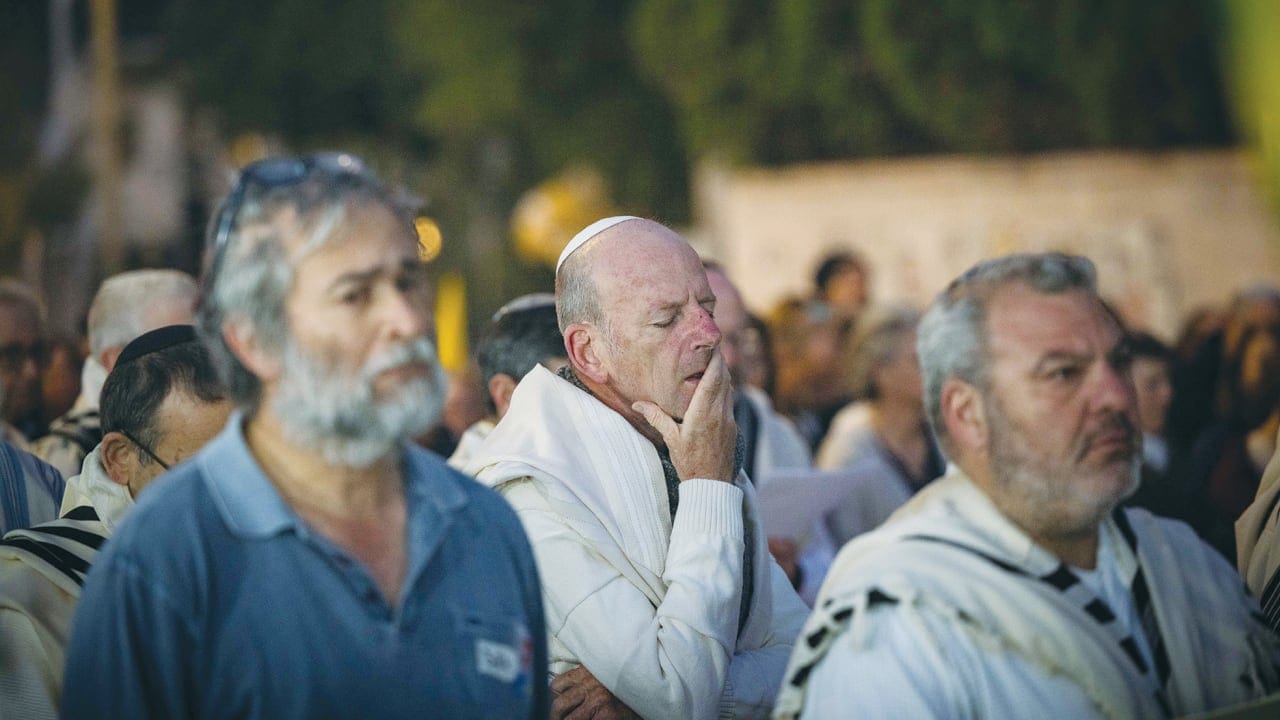
How will it be possible to celebrate Simchat Torah this year after what happened on this holiday two years ago, on October 7, 2023?
The Torah and the rabbis command us to be happy and rejoice on this special day, a day that is supposed to be joyous and celebratory, at the end of the fall holiday season.
However, I wonder if we will ever be fully happy on this Jewish holiday, since so many Jewish citizens were massacred and kidnapped by Hamas, Islamic Jihad, and other terror groups from Gaza in the South, on that infamous day. We have been struggling to get all the hostages home, end the war, and restore sanity to Israel for the past two years.
Simchat Torah is a holiday meant to celebrate our love and appreciation of the Torah, the Five Books of Moses, the foundational text of Judaism, and the rest of the Hebrew Bible. But the Hebrew Bible is a complicated and diverse set of books, with many conflicting stories and messages. Also, in Jewish tradition, when we talk about Torah, we include the rabbinic interpretations, which have made Judaism what it is today over many centuries.
Which messages of Torah are we meant to celebrate and honor as our legacy on this holiday?
Here are the messages that reverberate for me:
- Thirty-six times, the Torah tells us to be kind to the stranger “for you were strangers in the land of Egypt.” The “stranger” means the minorities within our midst. It is our responsibility as Jews to treat the minorities in the Jewish state fairly. If not, we are rejecting one of the core tenets of Judaism.
- “Love your neighbor as yourself” (Leviticus 19:18). This is a fundamental moral principle in Judaism (and in other religions). In the rabbinic tradition, Rabbi Hillel famously summarized the core principle of “Love your neighbor as yourself” by stating, “What is hateful to you, do not do to your neighbor; this is the whole Torah and the rest is just commentary.”
Who are our neighbors today? Not only all the citizens of Israel, but everyone in our region. If we were true to our Jewish values, and we cared about our neighbors like we should care about ourselves, then we would not treat them the way we do today most of the time.
- “Depart from evil, and do good; seek peace, and pursue it” (Psalms 34:14). It is not enough to refrain from war, but we need to seek peace by actively trying to bring it about. Unfortunately, we have been ignoring this principle for a long time. Even after this long war in Gaza ends, the sooner the better, we Jews need to still look for a way to live in peace with our neighbors, within our country, and within our region.
Fighting wars forever is not the Jewish way of living. Rather, pursuing peace actively, assertively, and attentively is the way we Jews ought to be living, especially in a Jewish state.
- “Therefore, choose life, that you and your descendants may live” (Deuteronomy 30:19). Judaism is a religion that consecrates life, not death and martyrdom. We don’t have a cult of death. We rejected that a long time ago in biblical times and afterward. Pursuing a path of constant death and destruction in an endless war is not the Jewish way. We need to choose life – for ourselves, for our minorities, and for all people in our region and in our world.
- “And it shall come to pass at the end of days, that the mountain of the Lord’s house shall be established as the top of the mountains, and shall be exalted above the hills; and all nations shall flow unto it.
“And many peoples shall go and say: ‘Come ye, and let us go up to the mountain of the Lord, to the house of the God of Jacob; and He will teach us of His ways, and we will walk in His paths.’
“For out of Zion shall go forth the law, and the word of the Lord from Jerusalem. And He shall judge between the nations, and shall decide for many peoples; and they shall beat their swords into plowshares, and their spears into pruning hooks; nation shall not lift up sword against nation, neither shall they learn war any more” (Isaiah 2:4).
What are God’s ways, according to Isaiah? They are not the ways of war but the ways of peace. The messianic goal is peace, according to Judaism, not Armageddon. And therefore, we say the following words when we return the Torah to the ark in our synagogues: “It is a tree of life for those who hold fast to it, and all its supporters are happy. Her ways are ways of pleasantness, and all her paths are peace” (Proverbs 3:18-19).
THESE, AND many other similar passages, are the words of Torah that we need to be mindful of on this Simchat Torah. If these are the teachings that we commemorate on this holiday, then it will be worth celebrating it. These teachings of Torah will certainly lead us on a better path than the one we are on today.
Nevertheless, we cannot be fully joyous on this holiday. Too much sorrow has befallen us and our neighbors during the past two years. Too much killing and suffering have taken place.
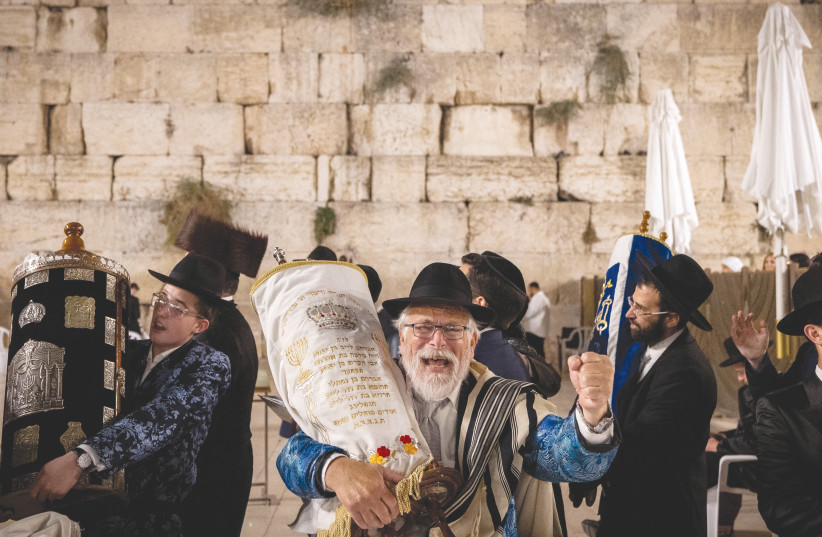
Like at a Jewish wedding, when we break the glass to remember our history’s past tragedies, we will not be able to dance with the Torah ever again without being aware of the tragedies that befell us on this day two years ago.
Yet, life must go on, and we must try to rejoice on this holiday and on every Shabbat. We need to always remember that Torah should catalyze us to be moral human beings, even if we live in very difficult and dangerous times.
The writer is a rabbi-educator, author blogger, lecturer, adjunct professor, and interreligious peacebuilder who has lived in Jerusalem for 46 years