
Far from being a distant memory, October 7 has been an extended shiva experience. Mourning has become our mode of being, as we struggle to glimpse a new horizon.
In Gali Ravitz’s poem “Horizon,” written in the aftermath of the October 7 Hamas terrorist attacks, she observes: “This is a period in which it is hard to speak of horizon/ It seems that there is not anything ‘on the horizon.’”
In so many ways, Ravitz distills perfectly what our lives have been like in Israel over the past two challenging and heartbreaking years. We struggle to maintain a sense of normalcy and to affirm life in all its vigor. Yet, after more than 700 days of loss and pleading for the release of our hostages, we know well that our reality is qualitatively different.
A wedding begins with an acknowledgment of the absence of those we love; a graduation ceremony opens by placing the hostages foremost in our minds; and empty seats have been a symbol around our festival tables.
Nowhere is this notion more profound than in our celebration of Simchat Torah. A festival once imbued with an unbounded sense of joy has become a painful reminder of the most tragic day in the modern history of the State of Israel.
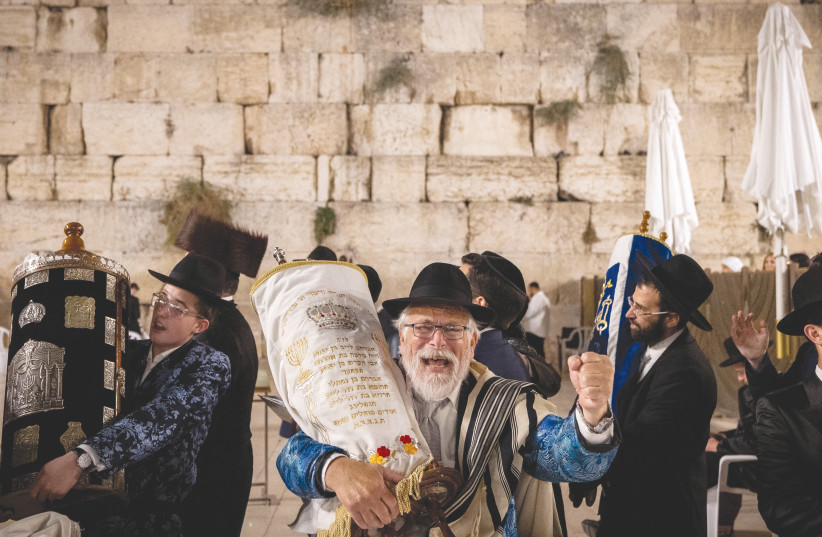
How are we to reframe observance of this day?
The Babylonian Talmud (Yoma 21b) shares the following, conveyed by Rabbi Isaac bar Avdimi. He teaches that, in his day, the eve of Simchat Torah was a time of uncertainty.
“On the night following the seventh day of Sukkot, all gazed upon the smoke rising from the pile of wood on the altar. If the smoke inclined toward the north, poor people rejoiced, and the prosperous ones were dejected, because the rains of the coming year were going to be excessive, and fruits would be left to rot.
“If the smoke inclined toward the south, poor people were dejected and the prosperous ones rejoiced, because the rains of the coming year were going to be scanty, and the fruit would be preserved.
“If the smoke turned to the east, everyone rejoiced; if toward the west, all were dejected.”
THIS VIVID recounting by this ancient Babylonian scholar from the late third-early fourth century captures so much that is resonant in our post-October 7 world today. The smoke continues to rise, and the winds are blowing in unpredictable directions.
Just as in Rabbi Avdimi’s day, the people of Israel are not on the same page. The sense remains that we are split between those who perceive a binary reality: winners and losers, those who benefit and those who sacrifice. Therefore, what should our posture be on the eve of Simchat Torah, amid the news that the hostages may finally be coming home?
When we consider the essence and core rituals of Simchat Torah, it becomes clear that this commemoration is not one of unbridled joy. This is most deeply reflected in the day’s Torah readings. As we conclude the reading of the Torah, we arrive at a tragic point in our history. Moses, the Israelites’ greatest leader, who had the merit of shepherding his people from slavery to freedom, will not enter the Promised Land.
Moses ascends to Mount Nebo, where he views the land that he will not enter. “So Moses the servant of the Lord died there, in the land of Moab, at the command of the Lord. God buried him in the valley of the land of Moab… and the Israelites bewailed Moses in the plains of Moab for 30 days” (Deuteronomy 34:5-8).
On the one hand, we read about Moses’ death and the Israelites’ subsequent mourning over his loss; on the other, we continue onto the Book of Genesis, where we recount the creation of the world and the beginning of life. Indeed, Avraham Yaari, in his book on the roots of Simchat Torah, points out that liturgical poems lamenting the death of Moses were an integral part of the service’s structure.
One piyut from the Geonic period reads: “A great and bitter cry [arose], when the Holy One said to him, ‘Ascend and die on the mountain’… the prayer of Moses tore the heavens, and the Rock answered His people in their time of distress.”
Rabbi David Golinkin, president emeritus of the Schechter Institutes, Inc., writes about the piyut scholar, Menahem Zulay, who recalled that in 1952, his late father used to sit at the Simchat Torah meal in a small town in Eastern Galicia and sang the piyut in a mournful tune.
“Then, when the humble one listened, ‘Rise and ascend to Mount Avarim,’ and when he reached the verse, ‘Woe, woe, he cried, this ascent is a descent!’ his father would burst into tears and continue crying until the end of the piyut.” And so, mourning was part of Simchat Torah.
FROM THIS, we learn that Simchat Torah is about complexity, holding mourning and morning in our hands simultaneously. Simchat Torah was never a festival of polarity. Happiness was never its sole emotion. Between death and creation, there is commemoration; a sacred pause in which we stand and dance together, learning to appreciate the embrace of fragility.
Milton Steinberg, an American Conservative rabbi, author, and theologian (1903-1950), in perhaps his most famous sermon, writes: “Only with God can we hold life, at once infinitely precious, and yet as a thing lightly to be surrendered. Only because of God is it made possible for us to clasp the world, but with relaxed hands; to embrace it, but with open arms.”
May this year’s Simchat Torah be one of seeking balance and embracing complexity; may we learn to stand wholly and fully in the space between death and creation; may we hold each other with open arms; and may the seasonal winds of the land of Israel unite us all in a more hopeful future.
Chag Sameach!
The writer, a rabbi, is the president of the Schechter Institutes, Inc.