
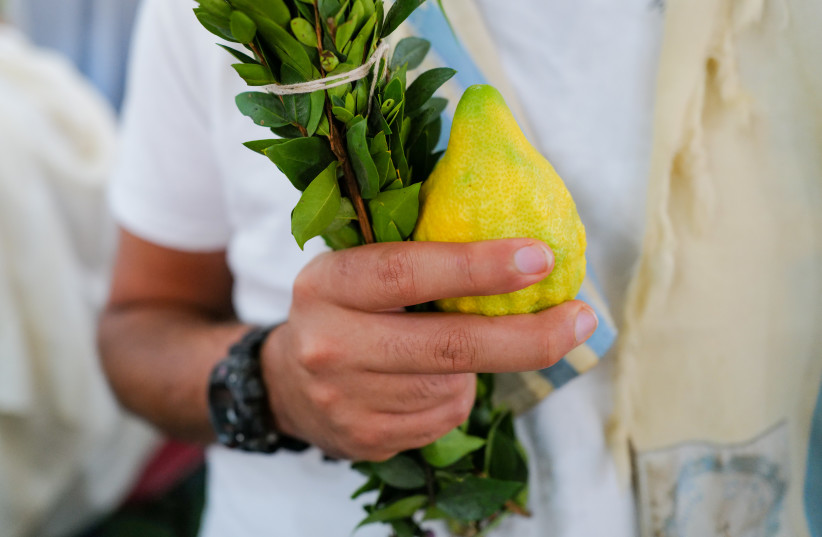
Every fall, as the leaves begin to turn a golden brown and descend to the ground, Jews around the world go in search of one of the more unusual ritual items of the Jewish holidays: a citron, or etrog, to be held in the hand during the prayers of Sukkot.
It is a fruit that must be whole, unblemished, and, crucially, ungrafted. These requirements have given the etrog a history that, at times, can read more like a geopolitical drama than a tale of agriculture. It is a story that includes monopolies, cartels, rabbinic bans, boycotts, and even pogroms.
At the heart of this story lies the Ottoman Empire, whose ports, orchards, and political economy helped turn the etrog into a key component of trans-Mediterranean trade. From the groves of Corfu and Cephalonia to the orchards of Tiberias and Jaffa, the saga of the etrog under Ottoman rule reveals how a fruit became entangled in struggles of faith and trade.
‘Fruit of a goodly tree’
The Book of Leviticus commands Jews to take a “fruit of a goodly tree” (pri etz hadar) during the Feast of Tabernacles, together with lulav (palm) fronds, hadas (myrtle), and arava (willow) branches. Over centuries of interpretation, this “goodly tree” has become universally identified with the citron, a lemon-like fruit native to Asia but cultivated in the Mediterranean since ancient times.
But the etrog is not just any citron. Orthodox Jewish law requires that it be ungrafted – i.e., without any artificial additions by humans. This differentiates it from the many hybrids used in citrus farming. It must also be visually intact, and, especially for Ashkenazim, ideally with its pitom, the little pip that protrudes from one end. According to medieval scholars Rashi (Rabbi Shlomo Yitzchaki) and the Rosh (Rabbi Asher ben Yechiel), the pitom is considered the “head” of the etrog. These criteria made the etrog scarce and precious, as well as an object of devotion, pride, and often extremely expensive in Jewish communities.

In the Ottoman world, those requirements made it into a commodity.
How the etrog found its way to Europe
By the 17th and 18th centuries, Jewish communities across Europe looked to the Mediterranean for their etrogim for Sukkot. Initially, Spain and Liguria in northwest Italy supplied much of the demand, shipped via Genoa and Venice. But as wars, blockades, and shifting trade routes disrupted supply, attention turned farther east to the Ottoman-controlled Adriatic islands of Corfu, Cephalonia, and Zante.
The climate there produced etrogim of a beautiful size and symmetry, important factors when etrog hunting. Packed into straw-lined crates, they were shipped across the Adriatic and channeled through Venice or Trieste.
After Holy Roman Emperor Charles VI declared Trieste a free port in 1719, the Hapsburg city became the major hub through which Central and Eastern Europe, which included Poland, Lithuania, Galicia, and Hungary, received their ritual fruit. By the 19th century, Trieste had superseded Venice as the main entry point through which ritual goods entered Europe’s Jewish heartland.
The journey of the etrog now ran through Ottoman groves, Hapsburg customs houses, and Jewish merchants who bore both commercial risk and religious responsibility.
A ‘Corfu-sing’ situation
For all their beauty, etrogim of the island of Corfu were cast with a shadow of suspicion. Some Jews in Europe began to suspect they had been grafted. Local growers had every incentive to splice the citron onto sturdier orange or lemon rootstock in order to increase yields and durability. For Jews thousands of kilometers away, the answer was unknowable.
Rabbinic authorities were divided. Rabbi Ephraim Margolies, in his book Beit Efraim, praised the Corfu etrog’s authenticity and reliability according to Halacha (Jewish law). Rabbi Daniel of Horodna, however, warned already in the early 19th century that “what appears beautiful to the eye may not be pure to the root.” Later, Rabbi Moshe Sofer, known as the Chatam Sofer, expressed similar concerns. “We must be vigilant,” he wrote in a responsum, “lest we take into our hands something that is in truth a graft, which the Torah forbids us to bless.”
These halachic concerns dovetailed with economic unease. If one island or one group of merchants controlled the market, what would stop them from exploiting their advantage?
By the 1870s, those fears were realized. Greek growers and merchants in Corfu organized to dramatically raise etrog prices, confident that Jews had no alternative. Communities that had long prided themselves on using a perfect etrog suddenly faced ruinous costs.
From Kovno in Lithuania, Rabbi Yitzchak Elchanan Spektor, one of the most authoritative rabbinic voices of his time, intervened. In a widely circulated responsum, he declared: “Better a Jew fulfill the mitzvah with an etrog small in beauty but pure in law, than to be held captive by those who trade in mitzvot as if they were merchandise of vanity.” He issued a ban on Corfu etrogim in 1875 until their kashrut could be clarified and their prices normalized.
Seismic effect
The effect was seismic. Communities from Vilna to Warsaw boycotted Corfu fruit. Jewish newspapers across Europe, such as Ha’Melitz of the Russian Empire and the British Jewish weekly The Jewish Chronicle, published Rabbi Spektor’s responsum in full, positioning it as a stand against rampant commercialism.
Demand shifted to other sources, such as Corsica, North Africa, and, increasingly, Ottoman Palestine. For the first time, rabbinic authority had reshaped a transnational supply chain, and a single responsum from Lithuania reverberated through Mediterranean groves and Hapsburg warehouses alike.
Something darker
If grafting and price wars were not enough, Corfu’s Jewish community soon faced something much darker. In April 1891, the body of a young woman was discovered near the Jewish Quarter.
Rumors spread that Jews had murdered her for ritual purposes, and the accusation spiraled into a classic blood libel. The result was a pogrom in which dozens of Jews were killed, homes and shops looted, and the community thrown into terror. Many Jewish families left the island. Etrog growers were among those accused of fanning the libel, exploiting long-standing resentment and economic rivalry.
The Jewish Chronicle condemned the Greek authorities’ slow response and called on European Jewish communities to boycott Corfu-grown etrogim in protest. Even after the victim was identified as Jewish and the charge collapsed, the damage was done. Jewish buyers across Europe recoiled from the idea of sending money back to Corfu. One contemporary rabbi summed up the mood: “Better a blemish from a leaf than a blemish of blood.”
The fruit of beauty had become a fruit of violence.
The ‘balady’ alternative
At the very moment that Corfu’s reputation was sullied, a new contender was rising – the balady etrog of Ottoman Palestine. Balady, meaning “local” or “native” in Arabic, referred to citron groves cultivated for centuries around Nablus, Nazareth, Tiberias, and Safed. For generations, these fruits had satisfied local demand. In the 19th century, they were ready for export.
Hassidic leader Rabbi Chaim Elozor Wax, head of the Warsaw charity fund Kupat Rabbi Meir Baal HaNess, saw both a religious and a national opportunity. By promoting the “balady etrog,” he could provide a kosher alternative, support Jewish farmers in the Holy Land, and break Corfu’s grip on the market. “The etrog from the Land of Israel,” he wrote, “is not only pure in law but pure in spirit. Whoever takes it into his hand uplifts himself and uplifts our brethren who dwell in the Land.”
Rabbi Wax planted citron orchards near Tiberias, carefully supervised against grafting, and arranged for exports to Europe. His campaign also introduced a modern element on an important tenet of Diaspora Judaism that remains relevant to this day: to buy a balady etrog was not only to fulfill the mitzvah but also to strengthen Jewish life and the economy in the Holy Land.
However, there was a problem. The balady etrog, though pure, was often rougher in appearance. European Jews, accustomed to the sleek Corfu variety, sometimes balked at its knobbly skin and irregular shape.
In the 1840s, Jewish settlers introduced the Greek citron to Jaffa, but suspicions of grafting persisted. The solution, offered in the early 20th century by Rabbi Avraham Isaac Kook, was a compromise. He endorsed growing the Greek/Jaffa strain on balady rootstock under rabbinic supervision, creating a fruit that looked elegant but retained its halachic stricture.
The debate over aesthetic perfection vs native purity mirrored broader Zionist-era questions. Was Jewish revival about returning to roots or about matching the world’s standards? The etrog, once again, carried symbolic weight far beyond its size.
How the trade worked
The Ottoman-era etrog trade was a delicate operation. Fruits were picked in late summer, inspected for blemishes, and packed in crates lined with straw. In Corfu, growers often barred rabbis from inspecting orchards, heightening suspicion. In Ottoman Palestine, by contrast, supervision became a selling point, with certificates of kashrut included in shipments.
From Corfu, crates traveled up the Adriatic to Venice or Trieste, then by river and rail into Central Europe. From Jaffa or Haifa, balady etrogim sailed to European ports, timed to arrive just before Sukkot. The timing was of the utmost importance. A delay in customs, a storm at sea, or a late harvest could leave communities without etrogim – an unthinkable disaster. That vulnerability gave merchants enormous leverage, but it also meant that rabbinic decrees could instantly unsettle the entire supply chain.
Why did Jews pay exorbitant sums for a fruit that would shrivel after a week? The answer lies in prestige and meaning. In many communities, the quality of one’s etrog was a mark of devotion and even social standing. One 1890s report in The Jewish Chronicle noted that etrog prices in some British synagogues reached “a sovereign apiece,” sparking concern that religious observance was becoming a matter of class distinction.
Merchants knew it, and rabbis worried about it. The balady campaign cleverly shifted the value system. Instead of beauty, the emphasis was placed on purity and loyalty to Halacha, to the Land of Israel, and to Jewish economic independence.
By the late 19th and early 20th centuries, the etrog had become a symbol of Jewish identity under Ottoman rule and beyond. The debates around grafting, commerce, and supervision prefigured larger questions of Jewish self-determination.
Could Jews free themselves from exploitative markets? Could agriculture in the Land of Israel become not just subsistence but export, tied directly to Diaspora Jewry’s needs? Could rabbinic authority serve as a counterweight to the ruthless economics of supply and demand?
Every autumn, the fragile yellow fruit became a mirror for those questions. Today, when Jews buy an etrog with a certificate of kashrut from Israel, they are inheriting that legacy. And while the etrog must still be ungrafted, unblemished, and whole, the story of the etrog trade through the centuries is anything but.