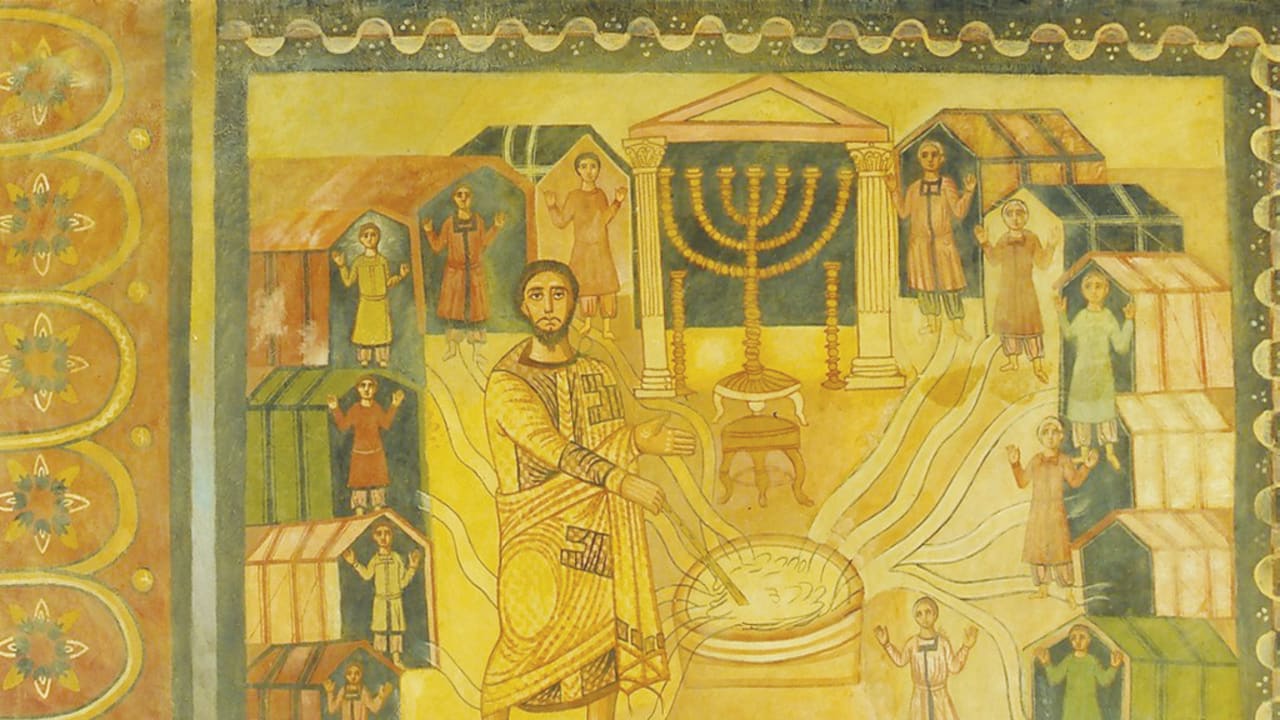
According to hassidic lore, once, just before Kol Nidre, Yitzchak Isaac Taub (1751-1821), who was the sage of Nagykálló (Kalov in Yiddish) in eastern Hungary, called on his assistant, Rabbi Yaacov Fish, to harness his horse and wagon.
The two rushed out to Fish’s fields, where they found a small pool. Immediately, the holy man disrobed and immersed himself, while Fish stood by transfixed. After Neilah, Fish returned to his fields, which he knew intimately. But the pond had disappeared. The sexton asked his master, “Rebbe, as you know, despite our long friendship, I never mix into your affairs. But I beg you to enlighten me about the pool of water that appeared and disappeared so mysteriously in my fields.”
The holy man, who founded the Kaliver hassidic dynasty, smiled: “If [you] Rabbi Yaacov had had the sense, he would have dipped himself the same as I did, for at that moment, Miriam’s Well passed by.”
While ChatGPT offers no date for when this miracle occurred, the apocryphal story is part of the rich lore about Moses’ sister Miriam and the mystical well named in her honor, and is reported by several Hungarian hassidic sources.

What then is the story of Miriam’s Well?
The Hebrew Bible relates that Miriam the Prophetess, today a popular figure among Jewish feminists, was married to Caleb ben Yefuneh. Though she died in the wilderness of Zin, her widower miraculously carried the spring named in his wife’s honor across the Jordan River on 10 Nisan, the anniversary of her death.
Miriam’s demise is described in Numbers 20:1. In the very next verse of the Torah, the Israelites are described as complaining of the lack of water at Kadesh. The text reads, “Miriam died there, and was buried there. And there was no water for the congregation.”
In Jewish tradition, this abrupt transition between Miriam’s death and the lack of water was explained by postulating that a “well of Miriam” appeared after she died. Further elaboration identified the rock that Moses struck to bring forth water in Exodus 17:5-6 with this well.
So powerful was the tradition of Miriam’s Well in Jewish folklore that even after the spring disappeared into Lake Kinneret some three and a half millennia ago, it occasionally miraculously briefly appeared.
For example, in the 6th century CE, Rabbi Tanchuma, who was swimming in Lake Kinneret, accidentally found the well (Midrash Rabba Leviticus 22:4). One thousand years later, the kabbalist Rabbi Isaac Luria showed his disciple Rabbi Chaim Vital its location in the Sea of Galilee “against the walls of the old synagogue.”
The ancient Jewish legend may echo the 14th-century BCE Ugaritic myth known as the Epic of Aqhat, according to a recent article by Israeli archaeologist Michael Freikman of Ariel University and geophysicist Shmuel Marco of Tel Aviv University. The Canaanite story is concerned with the cause of the annual summer drought in the eastern Mediterranean.
Writing in Time and Mind – The Journal of Archaeology, Consciousness and Culture, the two suggest that rather than being a purely fictional story without a historical or geographical context, the legend about a hunter murdered because the goddess Anath was jealous of his magic bow and arrows may have, in fact, have had a human basis.
The two academics believe a huge circle of stones at the bottom of the lake was built as a Canaanite shrine. During severe droughts, it would be exposed as the level of the Sea of Galilee dropped. This usually submerged structure came to be identified by the ancient Hebrews as the spot where, according to the Midrash (Numbers Rabbah 1:1), the mystical peripatetic spring known as Miriam’s Well came to rest.
That legend of Aqhat was uncovered in three incomplete clay tablets discovered in 1928 in the ruins of ancient Ugarit near Latakia in today’s Syria and dating to approximately 1350 BCE. The literary corpus found at the tell, also called Ras Shamra because of the headland there, includes some 1,500 administrative and religious texts.
In the Epic of Aqhat, Anat – the sister and helpmate of the god Baal – plots to kill Aqhat. She invites the young prince to a hunting party where she, disguised as a falcon, carries her henchman, Yatpan, in a sack and drops him on Aqhat. Yatpan then kills the hapless hunter at a place called “the town of Abiluma,” qrt ablm; in Hebrew, Kiryat Abelim. He then snatches his magic bow, which he later carelessly drops and breaks.
Anat laments that due to the murder, crops will soon begin to fail. Indeed, after King Danel’s son is murdered by her assassin, the rains cease in a multi-year drought. Danel calls upon Baal to bring down the mother of some vultures that have been seen feasting nearby on carrion. Dissecting the bird, he finds bone and fat from his son, and buries the remains in a mausoleum he builds on the shores of Lake Kinneret.
That tomb may be the explanation for a mysterious, perfectly circular structure built of basalt boulders up to one meter in width today lying on the lake bed, according to Freikman, an expert in megalithic architecture.
“Two seas are described in the text, and if one is clearly the Mediterranean Sea, the other one can only be the Kinneret,” Freikman said.
“The most important problem is that even today it would be impossible to build this 60,000-ton installation some 12 meters deep in the water,” he said. “However, by measuring the mud surrounding the monument, we know that the installation is at least 4,000 years old, possibly even older.
“We know that around the third millennium BCE, there was a period of terrible drought and desertification in the Middle East, and the Kinneret significantly shrank. Therefore, when the installation was built, the area was probably dry.”
“In the future, we intend to conduct the underwater research, including precise mapping and ultrasound scanning of the monument to determine whether it conceals a chamber inside and possibly excavate it,” he said. ■