The Rambam sharpens the Haggadah’s central obligation past the point most people actually hold themselves to. It is not enough to tell the story of the Exodus, he writes. Each person is required to see themselves as if they personally left Egypt, to feel as though they themselves were enslaved and redeemed. Not to recall it. Not to appreciate it from a respectful distance. To be inside it. It is one of the most extraordinary demands in all of Jewish practice, and after years of sitting at the same table reading the same words, it is also, for most people, the one that goes most quietly unfulfilled.
For centuries, commentators have wrestled with what that obligation actually requires. “Maggid” is not history class. The Seder is not a memorial. The Haggadah text keeps insisting that something more is possible, that the story can become present rather than past, that the distance between the reader and Egypt can collapse.
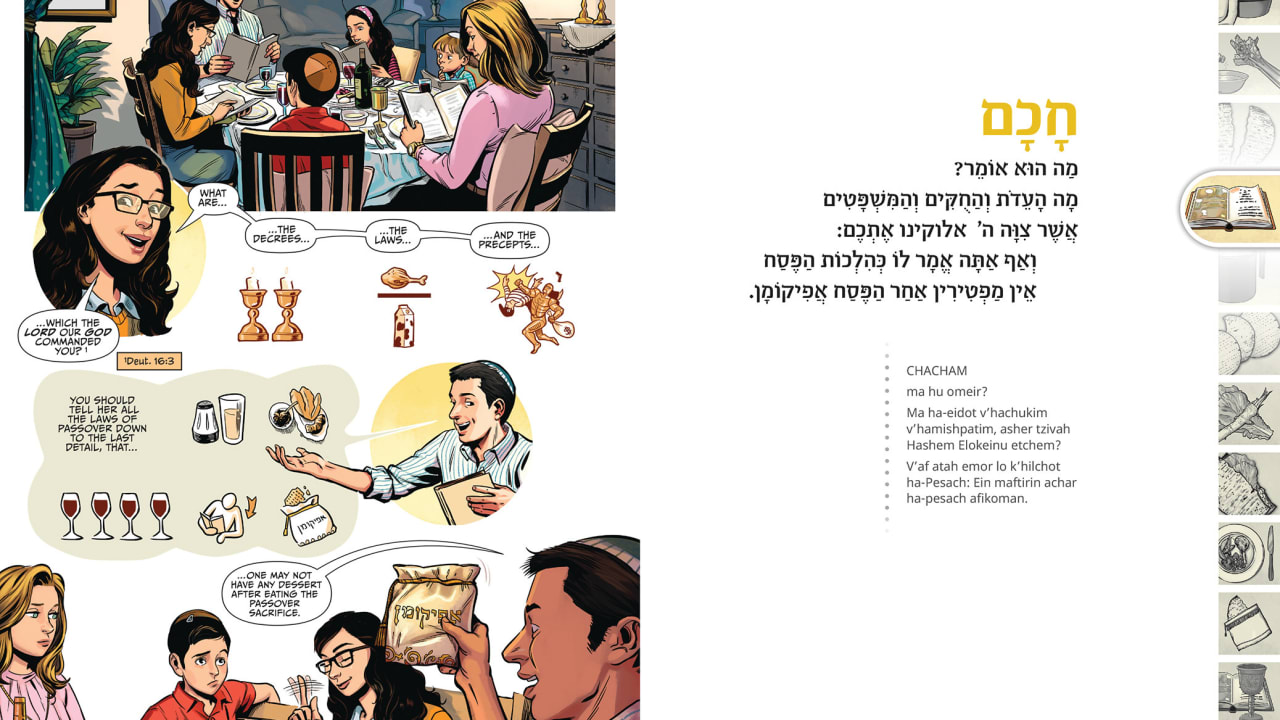
Passover Haggadah Graphic Novel, created by Jordan B. Gorfinkel and Erez Zadok and published by Koren Publishers Jerusalem, approaches that problem from a direction no Haggadah has taken before. Instead of asking readers to imagine the Exodus through text alone, it lets them see it.
The man who built it knows exactly what seeing means. Gorfinkel spent nearly a decade as manager of the Batman franchise at DC Comics, working in the medium where visual storytelling is not decoration but architecture. What he brings to this Haggadah is not novelty but hard-won craft: the understanding that a panel can place a reader inside a moment in a way that a sentence describing that same moment never quite can. Sequential art does not illustrate a story. It inhabits one.
Working alongside Zadok, an Israeli artist whose work combines deep historical research with genuine visual range, Gorfinkel has constructed a Haggadah in which every page is doing what the Rambam said the Seder itself must do: make the ancient feel immediate.

Experience the Haggadah through art
Open the Haggadah, and you feel that. The traditional Seder service runs complete and unabridged, in Hebrew and transliteration. Alongside it, the Exodus unfolds as a full visual narrative. Avadim hayinu, “We were slaves to Pharaoh in Egypt,” is no longer a sentence to be recited but a scene: figures in bondage, the weight of Egypt as a physical world, not a theological abstraction. Moses confronting Pharaoh unfolds panel by panel. The plagues unfold across five vertical panels, each rendered in its own color register, Pharaoh enthroned at the bottom of every one, watching his country come apart above him. The four children are rendered as four generations in the same New York apartment: a grandmother in sepia 1927; the rebellious child in warm ocher; the innocent one dissolving into purple and motion; and the fourth – 1969 – a small girl being guided by an elderly woman lighting Shabbat candles.
Zadok is not decorating the text. He is thinking through it. And throughout “Maggid,” the panels keep arriving, each one pushing the same question further.
At “Bechol dor vador,” a young boy holds up a smartphone; and in the screen, looking back at him, is the entire Exodus: every generation, every face, all of them fitting in his hand.
In the passage declaring that had God not redeemed our ancestors, we and our children and grandchildren would still be enslaved to Pharaoh, Zadok draws the wilderness, then the slave pits, then a third panel: an open-plan office. Cubicles. Security cameras. Workers hunched over computer screens. The caption reads: “And our grandchildren would still be enslaved to the Egyptian Pharaoh.” At “Mi’tehila,” recalling that at the dawn of our history our ancestors worshiped idols, the art opens on a Soviet-era street scene: a Stalin-era statue looming over the city, soldiers in the cold, something being passed in darkness. This Haggadah is not suggesting that idol worship is ancient history. It knows exactly what that looks like.
The Jewish Book Council described the result as an approach to the Seder with irony and humor, yet supported by deep reverence for tradition. These panels are why.
None of that is an accident. There is a reason this format feels native to Jewish memory rather than foreign to it. The graphic novel is, as the book itself notes, a Jewish innovation. From the newspaper comic strips of the immigrant generation to American cartoonist Will Eisner, who understood sequential art as a vehicle for moral and emotional truth, to cartoonist Art Spiegelman, whose Maus: A Survivor’s Tale did not become one of the most important works of Holocaust literature despite being a graphic novel but because of it, Jewish artists have long grasped something about images in sequence that took the broader culture longer to recognize: This form can carry the weight of history and survival in ways that prose alone sometimes cannot reach.
Gorfinkel and Zadok are working in that lineage. They have applied it to the story that precedes and underlies all the others.
All of that history arrives at your Seder table in a single volume. This Haggadah changes the dynamic in a way that is surprisingly faithful to the original intent of the Seder. A child notices a detail in a panel and points it out. Someone across the table catches something others missed. A scene raises a question about the narrative that pulls the table into a conversation nobody planned. The Seder stops being recited and starts being examined together.
That collective attention, the whole table looking at the same image and talking about what they see, is the discussion the rabbis who shaped the Seder were trying to generate. They built the “Ma Nishtana” so that children would ask. This Haggadah gives them something to ask about.
The Haggadah meets you wherever you are. For those coming to the Seder with less background, it includes instructional cartoons depicting each of the rituals, making the structure of the night legible without diminishing anything for those who know every word by heart. Either way, the Seder this Haggadah produces is the same: a table full of people who cannot stop talking.
The Seder has four questions. This Haggadah will generate a fifth: not whether to bring it to the table but how many copies you need so nobody has to fight over it when the Seder starts.
PASSOVER HAGGADAH
GRAPHIC NOVEL
By Jordan B. Gorfinkel
and Erez Zadok
Koren Publishers Jerusalem
172 pages; $25