


America’s 250th birthday, on July 4, 2026, is an occasion for joyful celebration, not least for the American Jewish community and Israel.
For Jews, America has offered a unique Diaspora experience. No, it was not always easy or problem-free, but what a contrast to the lands they had left behind!
Not only did Jews in America find
a safe haven from the intolerance, persecution, pogroms, and inquisitions they had fled, but they also encountered, in many cases, genuine respect for their religious tradition and biblical history.
Roots of respect
The Founding Fathers of the American Revolution were inspired by the Hebrew Bible and saw parallels between the ancient Exodus story and their own search for religious freedom and political liberty.
Indeed, Benjamin Franklin and Thomas Jefferson, serving on the committee charged with designing a national seal, proposed imagery depicting the Exodus from Egypt.
The first president, George Washington, sent a letter to the Hebrew Congregation in Newport, Rhode Island, famously declaring that the new country would give “to bigotry no sanction, to persecution no assistance.”
And in a second letter, to the Hebrew Congregation of Savannah, Georgia, Washington wrote:
“May the same wonder-working Deity, who long since delivered the Hebrews from their Egyptian oppressors, planted them in a promised land – whose providential agency has lately been conspicuous in establishing these United States as an independent nation – still continue to water them with the dews of heaven and make the inhabitants of every denomination participate in the temporal and spiritual blessings of that people whose God is Jehovah.”
Washington’s successor as president, John Adams, wrote in 1809: “I will insist that the Hebrews have done more to civilize men than any other nation.”
And what became the iconic symbol of the American story, the Liberty Bell, contained these words from the Hebrew Bible: “Proclaim liberty throughout all the land unto all the inhabitants thereof.”
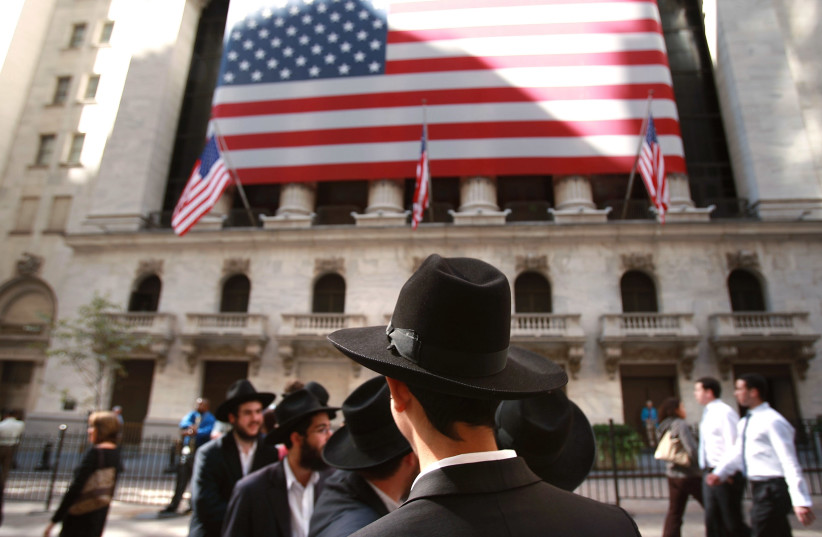
So, even as Jewish newcomers to America, whenever they arrived, faced the inevitable challenges confronting all immigrants, along with pockets of anti-Jewish bigotry and discrimination, compared to what they had left behind, these were mere blips on the screen of America’s beckoning promise and potential.
It is no exaggeration to say that Jews fell in love with America, and the love only grew. And as Jewish confidence in their place in the country increased, Jews became ever more involved in its life, contributing mightily in every sphere imaginable.
A unique refuge
All this led to a widespread Jewish belief that the American diaspora experience, unlike any other, could lead to full protection under the law, equality of opportunity, and physical safety, while ensuring the flourishing of Jewish life, community, and creativity.
A whole new dimension of America’s relationship with the Jews unfolded in the intensified 20th-century quest for Jewish sovereignty in their ancestral land.
That became most striking when president Harry Truman, in 1948, extended American recognition to the newly established state of Israel only minutes after it came into being. He was the first world leader to do so and later referenced both the ancient Persian leader Cyrus, who had allowed the Jews to return from exile to Jerusalem, and one of his favorite verses from Psalm 137: “By the rivers of Babylon, where we sat down, yea, we wept when we remembered Zion.”
True, Truman did not permit the sale or transfer of weapons to the embryonic nation, even as it faced dire threats on all its borders. That was not to happen until the 1960s, first gradually under president John Kennedy, then accelerating rapidly under his successor, president Lyndon Johnson.

By then, America’s role in the life of Israel had become singular and has remained so to the present day. Certainly, in just about every US administration, there were occasional differences, some quite intense, between Washington and Jerusalem. No two countries, not even the closest of allies, are perfectly aligned. Interests occasionally differ. Yet a rock-solid relationship endured.
Partners in history
It would be hard to imagine the trajectory of Israeli history without the irreplaceable friendship, partnership, and collaboration of the United States – whether at the UN and its all-important Security Council, in the global diplomatic arena, in shared intelligence, in military assistance, in the search for peace partners, in the people-to-people dimension, and, not least, in the rescue and repatriation to Israel of endangered Jewish communities from Ethiopia to the Soviet Union.
At the same time, America has derived immeasurable benefits from Israel, most notably in defense, intelligence, and innovation, not to mention Israel’s proven reliability as a fellow democracy and staunch ally.
But this occasion for celebration and gratitude cannot end without looking ahead and asking some urgent – and, yes, sobering – questions, two in particular.
Given surging antisemitism, including the terrifying fact that more Jews have been murdered as Jews on American soil from 2018 to today than in the previous 363 years, is the golden age of Jews in America now at risk of an irreversible decline?
And in light of major cracks in the bipartisan foundation of support for the US-Israel link, is the partnership headed for stormier waters in the years ahead?
Urgent work lies ahead. And the stakes for the Jewish people and Israel simply couldn’t be any higher.
Happy 250th birthday, America, the land of the free and the home of the brave! Mazal tov!■
David Harris is executive vice chair of the Institute for the Study of Global Antisemitism and Policy (ISGAP). He was described by the late Israeli president Shimon Peres as “the foreign minister of the Jewish people.”