
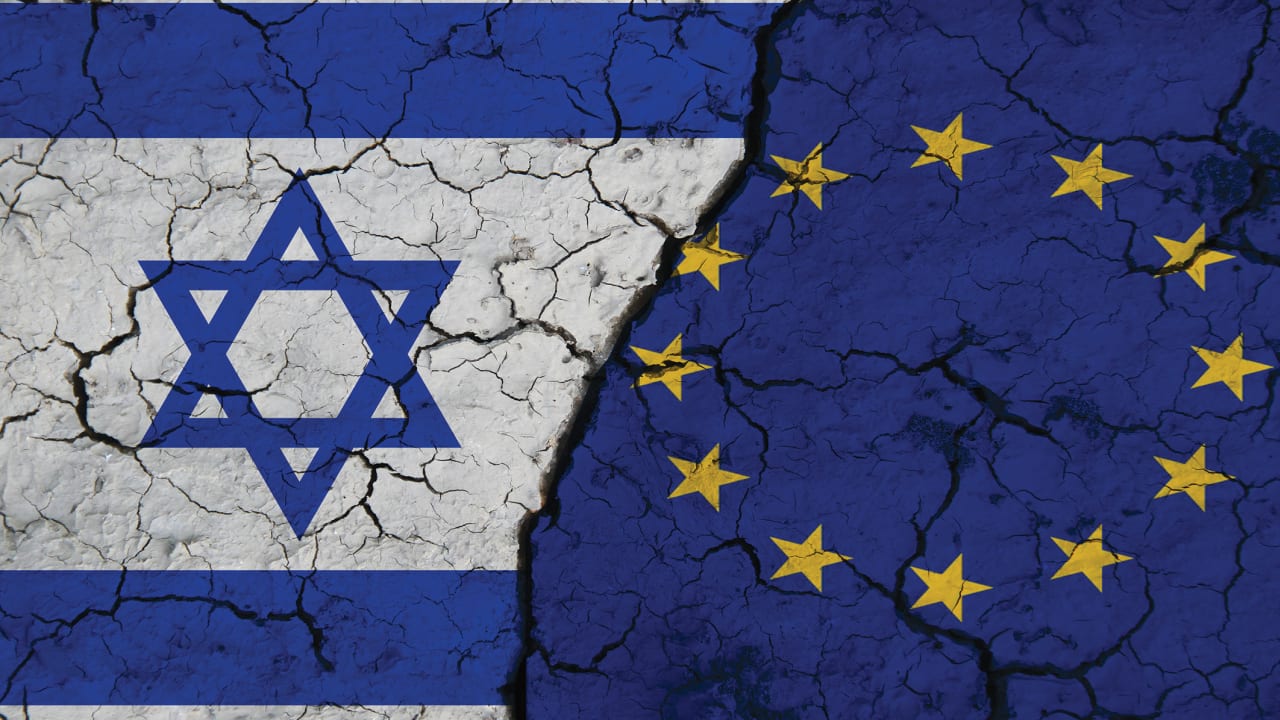
For years, Israel has benefited from preferential trade agreements with the European Union, allowing it to export goods to the European market duty-free and under favorable conditions.
However, the Gaza war catalyzed profound shifts in European sentiment. As the conflict intensified, so too did the criticism against Israel across Europe, with political voices calling to suspend these agreements growing louder.
Such a measure could trigger severe economic damage for Israel, disrupting established supply chains, jeopardizing thousands of jobs, and fundamentally altering the trade landscape that Israeli industries have depended upon for years.
Severe consequences
The EU stands as a cornerstone of Israel’s economic infrastructure. European Commission data reveal that bilateral trade reached approximately €42 billion in 2024, with Israeli exports totaling some €16 billion.
This accounts for more than a quarter of Israel’s total export volume, driven primarily by hi-tech, pharmaceuticals, medical equipment, and chemicals.

A trade boycott need not take the form of an absolute commercial embargo. It can include a variety of measures, from raising tariffs on Israeli goods and tightening regulatory requirements to delaying shipments in both directions.
Even a seemingly “limited” intervention, such as the temporary suspension of tax exemptions, could inflict billions of shekels in annual losses on Israeli industries, suddenly forced to compete against European manufacturers on a tilted playing field.
Technology companies, defense industries, pharmaceutical producers, and farmers would all feel the pressure. Shipping costs would rise, profit margins would erode, and small to medium-sized businesses might not survive the storm.
A decline in exports translates directly and immediately into a decrease in Israel’s gross domestic product (GDP). Each percentage point decline in exports to Europe could deduct hundreds of millions of shekels from Israel’s national output.
The immediate consequence would be severe: Economic activity would slow down, capital investment would freeze, and mass layoffs would sweep through export-dependent sectors.
And the damage would extend far beyond direct exporters. The entire ecosystem of supporting industries, such as logistics operators, insurance providers, cargo companies, and business services, would face equally severe disorder as trade volumes collapse.
Loss of credibility
The damage from a boycott cannot be calculated purely in financial terms. It is also a matter of perception and credibility.
A European boycott would send shock waves through the international investment community, eroding confidence in Israel’s economic stability and prompting multinational corporations to reconsider or abandon plans for establishing operational hubs within its borders.
Furthermore, if Israel comes to be perceived as economically isolated or vulnerable, credit rating agencies would likely respond by downgrading the country’s sovereign rating yet again.
Such a downgrade would trigger a chain reaction: Borrowing costs would rise for the government as it finances public services; banks would face higher capital expenses that get passed to consumers; and major corporations would struggle with elevated financing costs.
Europe functions not only as a destination for Israeli exports but also as a critical source of essential imports, such as automobiles, food products, pharmaceuticals, medical devices, and the raw materials that feed Israeli industry.
A European boycott or sustained delays in import clearance would create supply shortages, triggering price escalations and accelerating the already pressing cost of living crisis.
The disruption to European supply chains would force Israeli manufacturers to pursue more expensive substitute sources, elevating their production costs and amplifying inflationary forces across the economy.
Domino effect
For the Israeli consumer, the implications are immediate: Grocery carts and monthly bills would become noticeably more expensive, with inflation spreading across an array of products and services.
Beyond the direct damage, a European boycott would catalyze broader economic isolation. Countries from Asia, Latin America, and Africa might emulate the move or simply distance themselves from economic ties with Israel.
Such a domino effect would elevate the crisis from regional to global dimensions. Multinational corporations, perceiving Israel as an increasingly risky investment destination, would relocate production centers and transfer capital to safer markets.
HOWEVER, DESPITE the worrying scenario, Israel has courses of action that could mitigate the damage.
First, Israel should pursue an aggressive expansion strategy, establishing and deepening commercial partnerships across Asia, the Americas, and Africa to create genuine alternatives to European markets.
Existing trade frameworks with India, Japan, and South Korea offer a promising scaffold, but these arrangements remain underutilized and require ambitious expansion to serve as genuine alternatives to European markets.
Second, the state must implement comprehensive aid programs combining tax incentives, accessible financing options, and deregulation initiatives to ease exporters’ burden.
Particular attention must be directed toward small and medium-sized enterprises, which lack the financial capacity of larger firms to absorb the costs of economic disruption.
Third, economic strategy must be paired with clever diplomatic initiatives aimed at European institutions to discourage restrictive measures and explain Israel’s strategic position.
These initiatives should also highlight the mutual advantages of sustained cooperation in technology, energy, and defense sectors where Europe itself has significant interests and where Israeli capabilities deliver measurable value.
Such an economic crisis, if confronted strategically, could catalyze a fundamental restructuring of Israel’s economic foundations.
Israel’s current structural imbalance – where over-reliance on technological exports is paired with systematic neglect of traditional manufacturing and industrial capacity – has created an economy vulnerable to external pressure and market disruption.
However, external restrictions, rather than representing pure catastrophe, could become a catalyst for fundamental reorientation: revitalizing domestic manufacturing bases, mobilizing substantial investments in infrastructure and productive capacity, and demanding efficiency across government institutions and private enterprise.
If utilized correctly, the trade crisis could turn into an opportunity for structural change, one that strengthens the economy from within and grants it greater resilience to global turmoil.
At present, the threat of severe European economic sanctions against Israel has been temporarily suspended. Following the achievement of a ceasefire and the restoration of diplomatic dialogue, the EU has decided to defer the expected sanctions.
This temporary reprieve grants the Israeli economy vital space to stabilize and protect exporters and employment from catastrophic disruption, at least in the immediate term.
Israel must treat this suspension with strategic seriousness.
The nation must act decisively to reconstruct trust with European decision-makers, systematically rebuild damaged diplomatic relationships, and convincingly demonstrate its irreplaceable value as a technological and economic partner whose interests align with European prosperity and security.
Only through the careful orchestration of foreign policy and sound economic management can Israel ensure that trade relations achieve lasting stability and prevent its economy from facing renewed risk of disconnection from one of its most essential markets.■
Gali Ingber is head of finance studies at Israel’s College of Management Academic Studies.