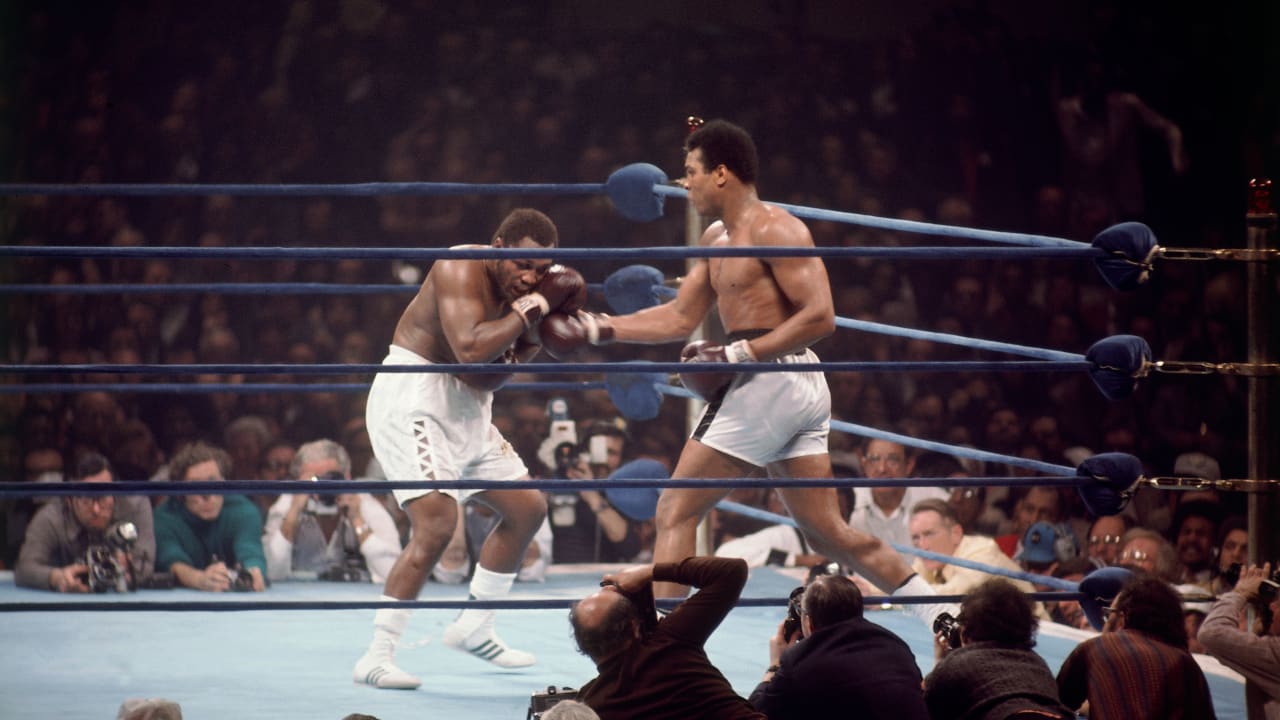
"It will be a killa and a thrilla and a chilla, when I get that gorilla in Manila."
- Muhammad Ali
On October 1, 1975, two men stepped into a sweltering ring on the other side of the world and produced what has gone down as one of the greatest fights of all time. It was the third and final meeting between two of boxing's greatest heavyweights, staged 7,000 miles from home in tropical heat before Philippine President Ferdinand Marcos and a worldwide television audience of hundreds of millions. Half a century later, the Thrilla in Manila still burns in boxing history for its demonstration of human endurance, will, and the bizarre dramas that played out behind the scenes.
The road to Manila
By the time Muhammad Ali and Joe Frazier met in the Philippines, their rivalry had already become legend. Their first meeting in 1971 was billed the "Fight of the Century," two undefeated champions (Ali had been stripped of the title for refusing to fight in Vietnam rather than lose it in the ring) meeting in Madison Square Garden, with Frazier handing Ali his first professional defeat. Ali avenged that loss in a 1974 non-title bout and went on later that year to reclaim the title from George Foreman in Zaire's Rumble in the Jungle. But those results did little to soothe the hatred between the two men.
Ali's verbal warfare had intensified between the second and third fights. He called Frazier ignorant, ugly, and repeatedly referred to him as a 'gorilla' and an 'Uncle Tom', insults that cut deeper than any punch, particularly given the racial dynamics of 1970s America.
Jerry Izenberg of New Jersey's Star-Ledger covered Ali around the world, and likes to call the run-up a "tour through hell."

"Like all great stories, it has a beginning, a middle and an end," he told The Jerusalem Post. "I was on the tour through hell - Zaire, Malaysia and the Philippines. Ali retired at the press conference after beating Joe Bugner, 'I'll never fight no more.' We both knew he was lying. He called me into the room after, saying 'He [Frazier] can't fight no more. He can't fight.' So we knew he was going to fight Frazier."
The contest in Manila had the feel of inevitability given that two fights so far had produced a victory apiece, but in truth, Ali's team thought Frazier was washed up and deserved another payday. For Frazier it was a chance to earn millions and one last chance at redemption. For Ali it was a statement, the final act in a trilogy that had become personal. The build-up was ugly, and not only in the taunts. Ali would walk around Manila punching a small toy gorilla, referring to it as Frazier. Forever the poet, "It will be a killa and a thrilla and a chilla, when I get that gorilla in Manila," he would chant.
Izenberg points to the human damage of Ali's invective, how kids in school bullied Frazier's son, Marvis, and he would return home in tears, calling him the son of a "gorilla." "That," Izenberg said bluntly, "had nothing to do with the first two fights. It had to do with the gorilla." And it had an effect on Frazier.
There were other dramas. Izenberg recounted when US media mistakenly reported companion Veronica Porsche as Ali's wife instead of Belinda (Khalilah), who was back in the States. When she saw the mistaken reports, Belinda was on the first flight out to the Philippines, where she met Izenberg at the airport.
"We swing down the street into the hotel, up the stairs," Izenberg recalled. "Ali is staying in the Presidential Suite. She bangs on the door and puts together a combination of curse words I don't think I've ever heard in my life. Ali is standing there with his mouth open, pointing over her shoulder. I'm standing there. ‘Don't do this now. Come inside.’ She finally pushes her way in. Boom, the next thing I know, she's coming out and going back home."
The fight was promoted by promoter Don King and backed by the millions of President Marcos, who saw it as a way to showcase his regime on the world stage. The purse was unprecedented; Ali received a reported $9 million, and Frazier $5 million.
Even the practicalities were theatrical. The delegates from both camps expected to complain about any referee; the Filipino organisers were determined otherwise. Izenberg remembers the rules meeting vividly.
"In comes this colonel in the Filipino army with ribbons and everything else, he's got a .45 and he puts it on the table. He said, 'I understand there's a debate going on here. I don't think so. I believe a Filipino will referee this fight.'" The message was clear.
Fifteen rounds of hell
On the morning of the fight, the Araneta Coliseum was an oven. Held in the early hours of the day for a prime US TV audience, "it was over 100 degrees before they turned the ring lights on," Izenberg remembered, one of the few people left alive who was ringside that morning.
What followed inside the ropes was less a match than a war of attrition. Frazier's compact, devastating left hook found Ali's body and face repeatedly; Ali answered in desperate bursts, the footwork and poetry of old giving way to grit and guile. Izenberg later revealed a telling detail about Frazier's preparation. "Eddie Futch hired a great middleweight fighter, George Benton," Izenberg says. "He says, 'George, you're not here for conditioning. You're not here for the battlefield. You're here for one thing. You're going to teach that guy to throw a right hand.' He was a one-armed player. I used to tell Frazier on the phone, 'If your right shoe comes on time, call me. I'll come over and tie it for you because I know you can't use your right hand.' Well, I was wrong, as it turned out."
Through the middle rounds, the momentum swung like a pendulum. Ali dominated the early exchanges with combinations, but Frazier's relentless body attack began to slow him. By round seven, both men were marking each other badly, their faces swelling grotesquely in the humid heat.
By the late rounds, both men were spent. Izenberg's account nails the moment: "At one point in this fight - it was probably the 10th, 11th into the 12th, late round - Frazier is standing there with his arms by his side," he told the Post. "His knees are like wet spaghetti. They're trembling. Ali's two feet away. All he has to do is walk two feet. Boom, but he can't walk the two feet. That's how much these two guys left in the room."
The closeness to physical collapse produced extraordinary scenes. By the 14th round, Frazier's eyes were badly swollen, and he could no longer see punches coming. His mouthpiece took a punch from Ali and went flying into the crowd. At the end of the round, Frazier went groping to his corner, where trainer Futch made the coldest, bravest call of the night. He stopped the fight to save Joe Frazier from further - and perhaps irreversible - damage. As instructions flew to cut the gloves off, Frazier shot back, "Don't you dare cut them off. You cut my gloves off, and I'll kill both of you after the fight."
It was a matter of pride to Frazier that he finish the fight against Ali, but Futch wrote himself into boxing lore when he told his defeated champion, "No one will ever forget what you did here today, Joe. Sit down, son. It's all over."
Ali himself barely celebrated. He collapsed, later admitting he had wanted his own gloves cut off but couldn't bear the thought of Frazier outlasting him. Ali, too, was ruined by the bout and was never the same fighter again. As Izenberg explained, Ali leaned over after the bell, pointing to reporters Dave Anderson and Izenberg, and said, "Fellas, fellas, that's the closest you guys will ever come to death." Izenberg's wry reply: "I don't want to come any closer because I'll be dead."
The Thrilla in Manila was the final bell in a cultural phenomenon that had swept America for a decade. In an America still roiled by race, politics, and the Vietnam hangover, Ali was defiant and theatrical, his genius and provocation inseparable from each other. Some loved and adored him; many still hated him. Frazier, the young man from South Carolina who worked his way up to become heavyweight champion, was honest, stoic, and relentless.
Izenberg, who sat later with Frazier, remembers the deeper, human grievance. "He hated him for that," he said of Frazier's bitterness toward Ali's racial taunts. "And yet, in Manila, the two of them gave everything to each other. That fight linked them forever."
The fight took years from both men's lives. Frazier's eyesight never fully recovered; Ali's speech would slur within years, the beginnings of what would turn out to be Parkinson's syndrome.
In Izenberg's post-fight dispatch, he wrote something definitive and unvarnished. "Muhammad Ali and Joe Frazier did not fight for the WBC Heavyweight Championship here in Manila at night. Nor did they fight for the championship of the planet. They fought for the championship of each other, and as far as I'm concerned, that title will never be settled."
Fifty years on, the images of the fight remain indelible. Frazier slumped on his stool, eyes closed, Ali gasping for breath after 14 hellacious rounds. The story, and their trilogy, has elements of myth and tragedy. Fifty years on, The Thrilla in Manila remains a reminder that sport can sometimes transcend and expose the extremes of human nature. In one night, two men who had already been through so much together left parts of themselves inside the ring to be forever entwined in history.