
Parties in the bloc led by Prime Minister Benjamin Netanyahu offered on Monday to vote alongside Yashar party leader Gadi Eisenkot’s bloc in support of its chosen candidate to replace Knesset Speaker Amir Ohana (Likud), while setting conditions and condemning the bloc for relying on Arab party support in the vote.
The offer was made in a letter from Finance Minister Bezalel Smotrich, who leads the far-right Religious Zionist Party (RZP), and was sent to the Eisenkot-led bloc’s candidate for Knesset Speaker, Matan Kahana.
The plenum vote to oust Ohana is set to take place on Tuesday.
Kahana later rejected Smotrich’s offer in a letter addressed to the RZP leader, sharply criticizing him for seeking to disregard the Arab population and its representation in the Knesset through Arab parties.
“I reject your anti-statesmanlike demand and call on you to respect the democratic process and its results,” Kahana wrote.

Kahana further invited Smotrich and his party to support his candidacy for Knesset speaker regardless, saying that doing so would express an “important broad national consensus.”
The conditions laid out by Smotrich would have required Kahana to commit that the Knesset would not appoint deputy speakers from the Arab parties – Ra’am and the Joint List – and to agree that Kahana’s tenure would be conditional on the formation of a government, resigning if requested to do so by the incoming government.
With the expected support of the Arab parties, the Eisenkot-led bloc already has a parliamentary majority and would not require support from parties in Netanyahu’s bloc in the Knesset vote set for Tuesday.
Smotrich's letter places pressure on the Eisenkot-led bloc
However, Smotrich’s letter appeared to place pressure on the Eisenkot-led bloc not to rely on Arab party support in the vote.
The letter states that Kahana has a “genuine opportunity” to be appointed to the “important and statesmanlike position of Knesset speaker with the support of an overwhelming Zionist majority, spanning political camps.”
Smotrich’s letter also stated: “If, God forbid, you refuse and are elected to the position with the votes of MKs who support terrorism, thereby normalizing cooperation with enemies to resolve disagreements between brothers, it will be an indelible stain.”
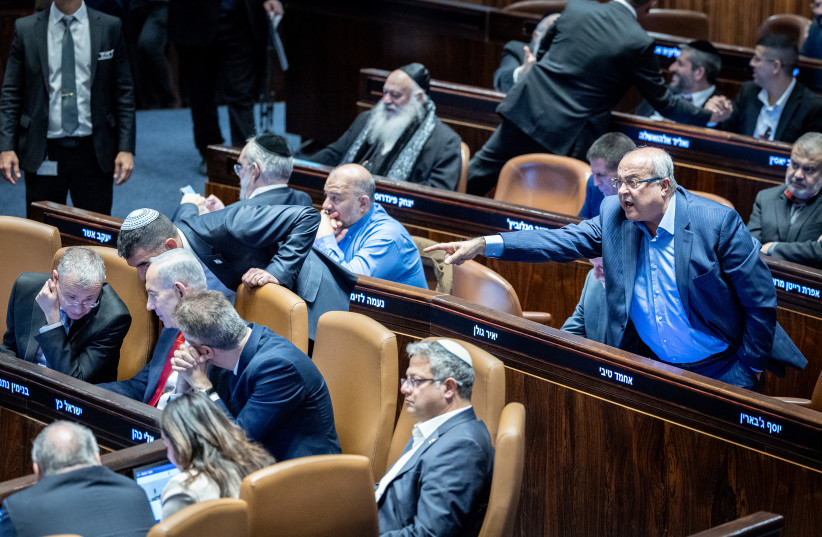
“By contrast, the people of Israel will stand behind you in Zionist unity, if only you so choose,” the letter added.
Smotrich’s outlined conditions for support come after the Knesset’s Arrangements Committee already approved on Monday Waleed Taha (Ra’am) and Ahmad Tibi (Joint List) among the nine MKs recommended to serve as temporary deputy speakers in the Knesset.
In his letter to Smotrich rejecting the offer, Kahana wrote that he was “perplexed” by his “demand to completely disregard the public that makes up 21% of the overall population, and the factions with which you and your partners have cooperated in the past.”
Kahana pledged that, under his tenure as Knesset speaker, the parliament would be a “place of respectful and substantive dialogue, reflecting the will of all Israeli citizens, in which no side will feel defeated, humiliated, or excluded.”
Smotrich later criticized Kahana’s response during remarks at a faction press conferance in the Knesset, stating that the Yashar MK “chose the Arabs over the Jews.”
The RZP leader argued that, following the October 7 massacre, Arab MKs should not be appointed as deputy speakers in the Knesset and that Arab parties should not be relied upon to provide a parliamentary majority.
“Being appointed speaker of the Israeli Knesset with the votes of terror supporters is illegitimate. It is a red line, and anyone who crosses it will be remembered for infamy in the history books of the State of Israel,” Smotrich said.
He reiterated his calls for a unity government comprising Netanyahu’s bloc and the Eisenkot-led bloc, which had drawn a red line to sitting in a government with Netanyahu.
The Eisenkot-led bloc’s move to replace Ohana, a member of Netanyahu’s Likud party, would give the bloc greater control over the parliamentary agenda, including votes, legislation, and committee appointments, even if Netanyahu remains in office as head of a caretaker government.
The bloc had agreed last week to nominate Kahana as its candidate for Knesset speaker.
Vote to take place on Tuesday
The vote is set to take place on Tuesday, after Yashar submitted a letter signed by more than 61 MKs to Ohana last week, demanding his replacement and calling for a vote to elect a new speaker.
Parties in the Eisenkot-led bloc submitted numerous bills last week and have called for the repeal of laws passed by Netanyahu’s outgoing coalition, shortly after the new Knesset was sworn in.
Yashar announced that it had submitted a series of bills, including proposals to establish a state commission of inquiry into the October 7 massacre, which Netanyahu and his government have repeatedly blocked throughout his term.
The election results showed that Eisenkot’s bloc received 67 seats, including 19 from the Arab parties, while Netanyahu’s bloc won 53.
Eisenkot received the mandate from the president last week to form the next government, giving him 28 days to do so, with the option of requesting a 14-day extension.
No government has been formed yet, as most party leaders have drawn a red line against partnering with the Arab parties.
Nevertheless, Arab party support could still allow the bloc to pass key legislation even while Netanyahu heads a caretaker government.