
The Knesset advanced the 2026 state budget in its first reading late on Wednesday night, following a full day of tense coalition negotiations with the haredi (ultra-Orthodox) parties, Shas and United Torah Judaism, ahead of the vote.
The vote came amid the ongoing crisis in Prime Minister Benjamin Netanyahu’s coalition over the controversial haredi draft law.
The budget passed by a margin of 62-55. It will now be brought to the Knesset's Finance Committee for debate before returning to the plenum in its second and third readings to fully pass.
The state budget's first reading comprises a series of bills.
The first bill that was voted on was the outline of the 2026 budget that calls for the expenditure amount for the fiscal year to be set at approximately NIS 811.74 billion. The second bill proposes to raise the permitted deficit ceiling for 2026 to 3.9 percent of GDP following war expenses. The third and fourth bills call for a series of legislative amendments to facilitate the new budget.
Members of Shas and United Torah Judaism weighed their stance throughout Wednesday on how to vote after previously threatening to oppose the state budget over the haredi draft bill.
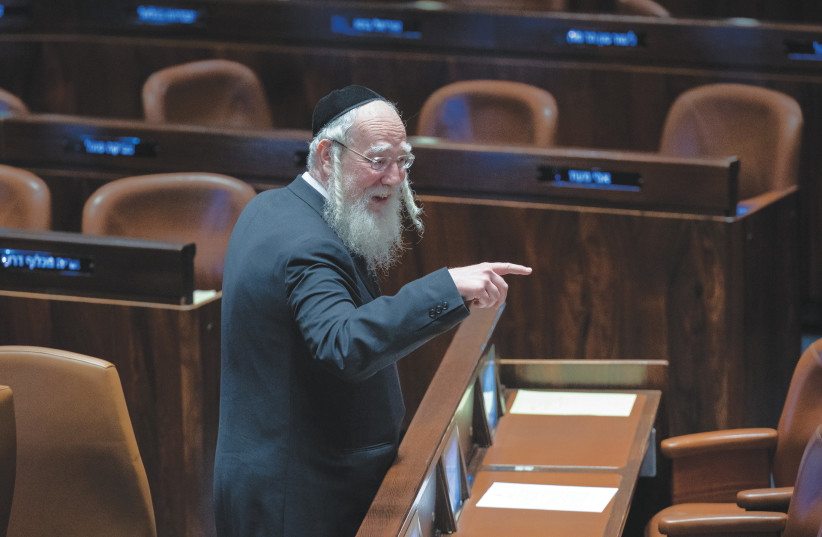
Ultimately, MKs in the Shas Party voted in favor of the budget, though Shas leader Arye Deri was absent from the vote.
The United Torah Judaism Party, made up of the factions Agudat Yisrael and Degel Hatorah, split on how they voted.
Agudat Yisrael objects to the draft bill entirely, leading MK Yitzhak Goldknopf, MK Meir Porush, and MK Yaakov Tessler, from the faction to vote against the state budget.
Meanwhile, Degel Hatorah leader MK Moshe Gafni and others from his faction voted in favor of the budget, under the condition that the haredi draft law be passed before the next readings on the budget.
Degel Hatorah warned that it was not committed to voting in favor of the budget in its second and third readings.
By law, if the state budget is not approved in all three readings by the end of March, when the fiscal year closes, the Knesset will automatically dissolve, and elections will be called.
Finance Minister Bezalel Smotrich gave opening remarks at the Knesset debate ahead of the vote, praising the government's outline of the state budget.
“The state budget before you totals NIS 660 billion. After two years, we are beginning to bring the defense budget back into a reasonable framework while increasing investment in education, welfare, digitalization, and more,” he said.
“This budget is not just an economic document; it is a declaration of intent, telling the world that the State of Israel and Israel’s economy are stronger than ever.”
“The heart of this budget is the reserve soldiers and their families,” he said.
Immediately before the plenum discussion began, the Degel Hatorah faction received a green light from spiritual leader Rabbi Dov Lando to vote in favor of the budget.
Before that, the coalition added several bills to the plenum schedule for debate ahead of the state budget vote, using them as a delay tactic while the negotiations with the haredi parties continued.
The agreement to give the green light by Lando was made on the condition that the draft law be completed before the state budget is brought for second and third reading in the Knesset, Lando's office said.
Lando's decision followed meetings between the haredi parties and Knesset Foreign Affairs and Defense Committee chairperson, MK Boaz Bismuth, regarding the haredi draft law on Wednesday afternoon.
The spiritual leader would only determine his stance on how the faction should vote after the meetings were conducted, Lando's office said.
Netanyahu also arrived at the Knesset in the afternoon amid the negotiations.
Opposition leader Yair Lapid (Yesh Atid) said that the meetings "behind the scenes of the Foreign Affairs and Defense Committee are completely outrageous."
"This is bargaining over the security of the State of Israel, with the encouragement of Netanyahu," he added.
Lapid has also criticized the current state budget draft, vowing that the opposition would vote against it.
“The government has presented a budget of the corrupt and the shirkers, wasteful, negligent, continuing to exploit and grind down working people who pay taxes, serve in the reserves, and keep the country alive,” Lapid said at an earlier Knesset press conference.
The vote on the state budget has been delayed significantly
The vote was originally scheduled to take place on Monday, but was postponed to Wednesday at the last minute due to disagreements over the haredi draft bill.
Haredi political figures have pushed for a framework that would continue to exempt yeshiva students from mandatory IDF service.
Both haredi parties have threatened to withhold support for the state budget unless agreements are reached on the draft law to avoid conscription. They have also threatened to vote against the state budget if the haredi draft bill is not passed beforehand.
Critics of the draft bill outline argue that the current version fails to enforce haredi conscription and serves primarily as a political measure to appease the haredi parties. The IDF has repeatedly said it is in urgent need of more manpower, especially after over two years of war.