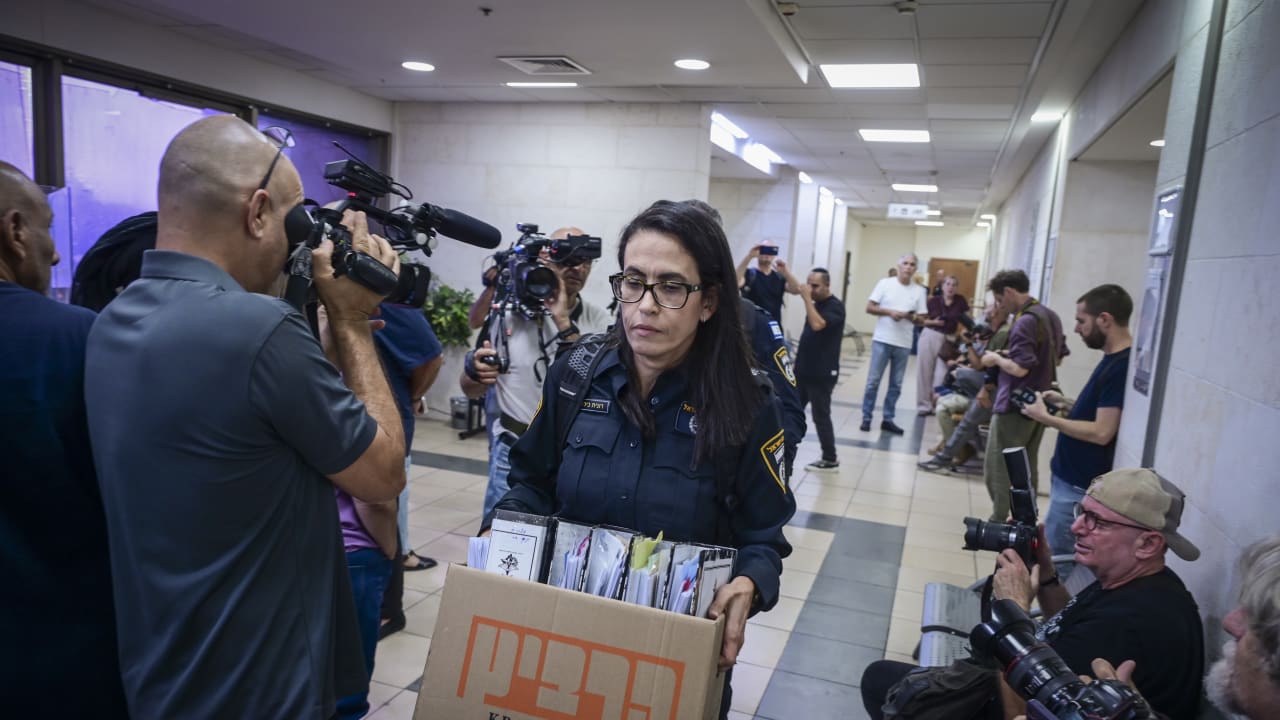
The Courts Administration, responsible for managing the court system, on Tuesday issued a new internal procedure regulating photography in courthouses nationwide, following a recent legislative amendment concerning the publication of images of suspects held in pre-indictment detention.
The move has prompted criticism from journalists, who argue that the procedure goes beyond the scope of the law and will hamper routine court coverage.
The procedure, set to take effect on January 1, accompanies a recently passed amendment to the Courts Law that restricts the photographing and publication of identifying images of suspects held in custody before an indictment is filed. While the legislation itself applies narrowly to suspects in pre-indictment detention, the amended court administration procedure introduces broader approval requirements for photography inside court buildings.
Under the amended procedure, any photography or recording inside a courtroom – whether before a hearing begins, during the proceedings, or after their conclusion – will require a written judicial decision. This applies regardless of whether suspects are involved and includes the filming of judges, attorneys, defendants, and the courtroom itself.
Requests to photograph or record inside courtrooms must be submitted in writing to the court, generally through the judiciary’s electronic filing system or the court registry. Unlike previous practice, approval from court spokespeople or courthouse security will no longer suffice for courtroom filming.

Critics note that the court system is already operating under significant backlog and capacity constraints, raising doubts as to whether such approval requests can realistically be processed in a timely manner.
Separate rules apply to photography in public areas of court buildings. Filming in corridors, entrances, or empty courtrooms for purposes such as background footage, investigative reporting, interviews, or documentary work is subject to prior written approval from the judiciary’s spokesperson and public relations unit.
As a general rule, photographing judges or court employees for journalistic purposes is also prohibited without such prior written authorization.
The Courts Administration said the procedure reflects the implementation of the existing legal framework governing courtroom photography.
Critics, however, argue that it substantially expands restrictions beyond what was approved by the Knesset.
The legislative amendment, which comes into force this week, beginning on Thursday, January 1, prohibits photographing suspects held in custody prior to the filing of an indictment, unless the court determines that a substantial public interest outweighs the harm to the suspect’s dignity.
The publication of photographs identifying such suspects – including images taken in courthouse corridors or other public areas – generally requires either the suspect’s written consent or explicit judicial approval.
New procedure follows restrictions seen in Netanyahu trial
The amended procedure follows recent restrictions that have taken effect in Prime Minister Benjamin Netanyahu’s ongoing criminal trial, during which the judges coordinated his entry into the courtroom to avoid media coverage. Effectively, the new procedure formalizes those restrictions across the court system.
Blue and White MK Eitan Ginzburg, who initiated the legislative amendment concerning the photography of suspects, said the Courts Administration had exceeded its authority.
“The amendment approved by the Knesset deals only with protecting the rights of suspects,” Ginzburg said. “Requiring judicial approval for every type of photography in courtrooms – including general footage unrelated to detainees – is a substantive change that was never discussed in the Knesset and does not derive from the law that was passed.”
Practically, the new procedure may severely hamper real-time court coverage, particularly given the bureaucratic burden of submitting formal requests for routine filming.