Twenty years after Prime Minister Benjamin Netanyahu pledged before the US Congress that Israel would wean itself off American economic aid, he now wants to do the same with US military assistance.
“I want to taper off military aid within the next 10 years,” he said in an interview with The Economist on Friday, adding that he meant reducing it to zero from its current level of $3.8 billion a year.
If Netanyahu fulfills that pledge – as he did the earlier one – it would constitute nothing less than a revolution in US-Israeli ties. It would also reflect the internalization of one of the central lessons of the seven-front war that followed October 7: Israel must reduce its dependence on others for arms and munitions, even when those others are its closest allies.
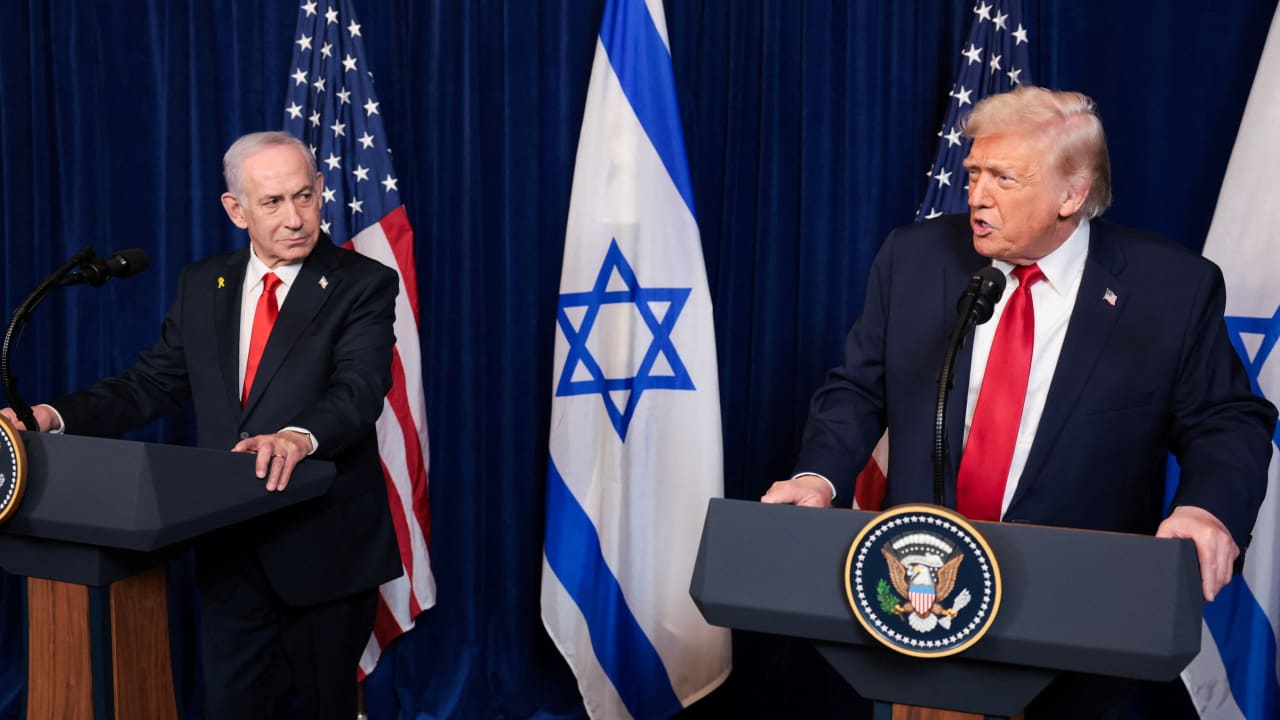
At his recent meeting in Mar-a-Lago with US President Donald Trump, Netanyahu said he told the president that he deeply appreciates the military assistance America has provided over the years – a Congressional Research Service report in May put that figure at roughly $174b. since 1948 – but that “here, too, we’ve come of age, and we’ve developed incredible capacity.”
The word “too” was deliberate. It echoed the argument Netanyahu made two decades ago when he pushed to end US economic aid.

“The United States has given Israel, apart from political and military support, munificent and magnificent assistance in the economic sphere,” he told Congress at the time. “I believe that we can now say that Israel has reached childhood’s end, that it has matured enough to begin approaching a state of self-reliance.”
'Childhood’s end'
Now, in Netanyahu’s telling, that “childhood’s end” applies not only to the $1.2b. in economic aid Israel once received annually, but also to the $3.8b. it now gets in military assistance.
Israel, he said in The Economist interview, has developed “incredible capacity,” and an economy that within a decade is expected to reach roughly $1 trillion is no longer a small one.
“So,” he said, “I want to taper off military aid within the next 10 years.”
To The Economist’s readers, the declaration may sound counterintuitive, but it has been in the making for some time and is the result of several factors.
First, the current framework governing US military aid to Israel – the Memorandum of Understanding negotiated in the final years of Barack Obama’s presidency – is set to expire in 2028. That agreement provides Israel with $3.8 billion annually over a 10-year period that began in 2019. With negotiations for a new MoU just underway, this is a propitious moment to signal that the next framework should be the last – especially at a time when the mood in Washington toward foreign aid, even for close allies, has grown markedly less hospitable.
These MoUs date back to the Clinton years. When Netanyahu first took office in 1995, he inherited an aid structure that had been largely unchanged since 1987: $1.2b. annually in economic assistance and $1.8b. in military aid.
By the mid-1990s, however, runaway inflation had been tamed, and the economy was largely unleashed as trade barriers were dismantled, capital controls were liberalized, and foreign investment surged. The economic assistance that had been vital in the 1980s was no longer needed to the same degree. The security threats, however, remained, so while Israel gave up the economic aid, the military component was increased.
Under the first MoU negotiated during the Clinton administration, Israel received $2.1b. annually in military aid – less than the roughly $3b. it had previously been getting in combined assistance. That figure rose to $3b. a year from 2009 to 2018 and then to $3.8b. under Obama, including some $5b. over the 10-year period earmarked for missile-defense programs in which the US is a partner. This also does not include the billions of dollars Israel has received in supplemental aid since October 7 to fight the war.
Each MoU also imposed limits on how much of that money could be spent inside Israel. Under the Second MoU negotiated with the Bush administration, Israel was allowed to use 26.3% of the funds for local procurement. The Obama MoU phased that out entirely, with the local purchasing rate declining from 25% in 2019 to 11% in 2026 and reaching zero in 2028.
The result was not only deeper dependence on the US but also a growing disincentive to produce arms and munitions domestically.
If Israel could buy bombs more cheaply in the US using US-provided funds, why manufacture them at home? As an Israeli defense analyst told The Washington Post last January, Israel had “refrained, until recently, from producing certain munitions primarily because of profit considerations…. It is cheaper to buy them with the money allocated to Israel by the US.”
Then came October 7, the war that followed, and mounting tensions with the Biden administration over its conduct. In May 2024, as the IDF advanced toward Rafah, Biden said in a CNN interview that he had made it clear to Netanyahu and the war cabinet that the US would withhold support – including weapons and artillery shells – if Israel entered densely populated areas.
And, indeed, the US paused the shipments of heavy bombs out of concern they would be used in Rafah. Other munitions were slow-walked, reinforcing in real time the strategic risks of reliance.
As it became clear that weapons supplies could be used as leverage, Jerusalem began shifting course. In March 2024, the Prime Minister’s Office said Israel needed “to be much more independent in the ability to manufacture the war materiel that we need.”
That was not an empty declaration. Israel has since significantly expanded domestic munitions production, including types of bombs the US had withheld. Netanyahu said in the Knesset last month that Israel would allocate roughly NIS 350b. over the next decade to build independent production capacity.
“I don’t know if a country can be completely independent,” he said, “but we will strive… to ensure our arms are produced as much as possible in Israel.”
That is only one part of the equation leading to the decision to end US military assistance gradually. The other lies in political trends within the United States.
The May report by the Congressional Research Service cited above noted that American public attitudes toward Israel have “shifted somewhat when compared to previous eras. Though lawmakers continue to vote in favor of US assistance to Israel, there have been calls from some political and ideological groups to reevaluate the long-standing US-Israeli assistance relationship.”
That careful phrasing understates the trend.
In November 2024, Senator Bernie Sanders introduced three resolutions aimed at blocking future arms sales to Israel. All were defeated, but roughly one-third of Democratic senators supported them.
At the same time, as the MAGA wing gains prominence within the Republican Party, so do voices openly questioning aid to Israel – from Tucker Carlson and Marjorie Taylor Greene to Steve Bannon. Their reasons vary, ranging from opposition to all foreign aid to criticism of Israel’s conduct in Gaza to the argument that Israel should be fully self-reliant.
This remains a minority view within the GOP. But it is no longer fringe. And Netanyahu’s move to wean Israel off US military aid reflects a recognition that these voices, as well as the Sanders-like voices in the Democratic party, are likely to only grow louder, and Israel cannot afford to find itself at their mercy.