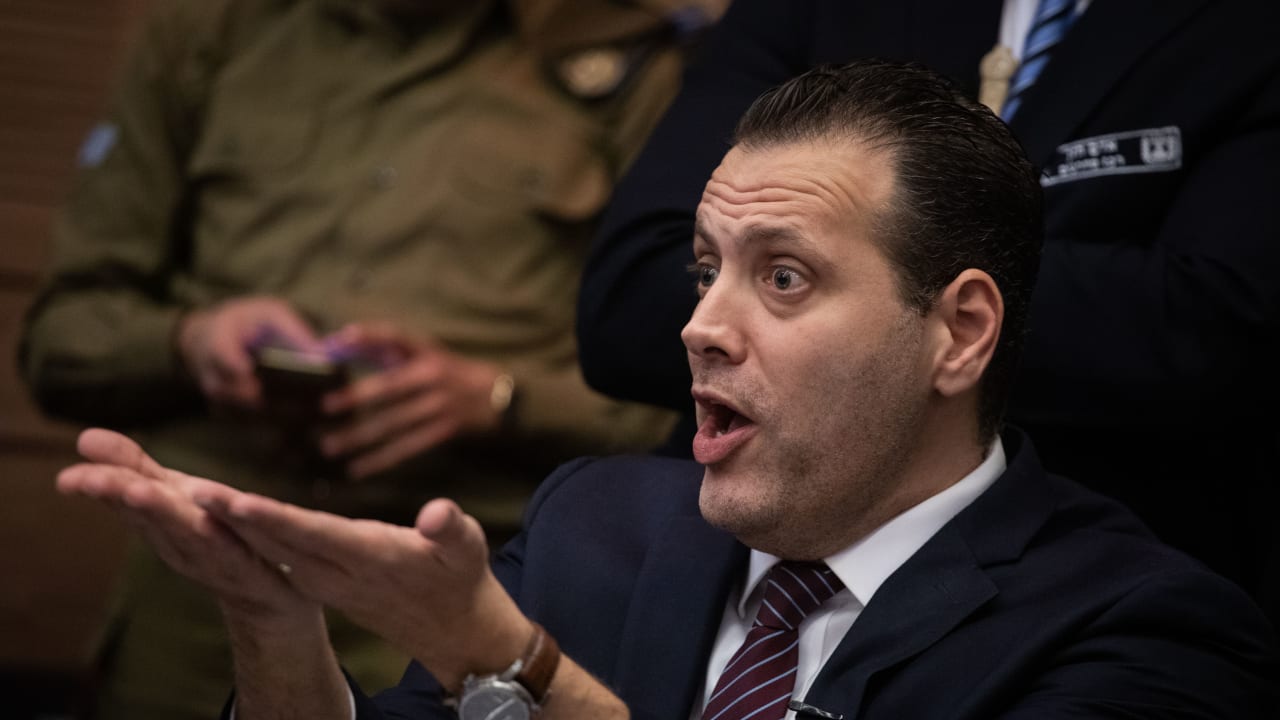
A dispute over the future of Israeli cinema, which erupted between the country’s filmmaking community and Culture and Sport Minister Miki Zohar, has been heating up this week. On Monday, Zohar announced the establishment of a professional committee to reexamine government budgeting for the cinema industry, which may lead to the withdrawal of all funding.
The Cinema Law currently guarantees about NIS 130 million for movies made in Israel.
He delivered another blow to the industry on Monday, announcing that public funding for professional creators’ unions in movies and television will be discontinued beginning in 2026. These unions include those for directors, actors, producers, and editors.
A letter sent to industry organizations by the Culture Ministry’s department for cultural unions informed them that “in 2026, no call for funding applications will be opened for the support of professional unions.”
These announcements follow Zohar’s decision to create the Israeli State Film Awards, a new state-sponsored film awards ceremony, scheduled to hand out its prizes on December 30. A growing list of artists, however, is withdrawing their names from the competition.

Zohar established these new awards after the Ophir Awards, which are sponsored by the Israeli Academy of Film and Television, gave the Best Picture Award to The Sea by Shai Carmeli-Pollak. It’s a sympathetic story of a Palestinian father and son, made by a mixed Jewish and Arab cast and crew. Zohar was displeased by the Academy’s choice and said he would withdraw government funding for the Ophirs.
He denounced the Israeli Academy’s choice of The Sea in September as “absurd,” “anti-Israeli,” and a “slap in the face of Israeli citizens… Under my watch, Israeli citizens will not pay from their pockets for a ceremony that spits in the faces of our heroic soldiers.” He pledged to withdraw state support for the Ophirs.
The Ophirs have been presented for 35 years, and the winner of the Ophir Award for Best Picture automatically becomes Israel’s submission for the Academy Award in the Best International Feature category, as in the case in most countries with a large enough film industry to give out awards.
Prize pool of NIS 1 million
Zohar’s alternative event, which will be held at Jerusalem International Convention Center, has a total prize pool of NIS 1 million, with NIS 100,000 for winners in each of 10 categories – from Best Feature and Director to acting and technical awards – selected by a panel of judges, whose identities have not been revealed.
On Monday, actress Nur Fibek and screenwriter Mindi Ehrlich – both nominated for the government awards for their work on Nir Bergman’s Pink Lady – rescinded their nominations. Fibek wrote in a Facebook post, “As long as the Culture Ministry does not back down from its ridiculous threat to silence art and stop funding the awards of the Academy, I am withdrawing my candidacy from the ceremony.”
While she criticized the Ophirs for often neglecting some of the best movies and noted that, “I would be happy to stay in the [new government] competition if it were truly sporting, and if there was an alternative to the Ophir Awards from a clean place – and not from a tainted place.” She added that she felt “trapped” between the appeal of recognition and the political overtones now surrounding the awards.
Ehrlich, who is from a haredi background and was a participant in the reality series Married at First Sight, wrote on Facebook that she chose to withdraw her nomination for the award, “Not out of disdain for the recognition I was given, but out of a sincere feeling that I cannot take part in an event that is taking place in a reality of deep, painful, and frustrating controversy, and which these days is perceived by many as a symbol of division rather than an invitation to dialogue.”
They joined four other nominees who have already withdrawn from the competition: Matchmaking 2 director Erez Tadmor, one of the most commercially successful and critically acclaimed directors in the country; Matchmaking 2 lead actress, Irit Kaplan; Matchmaking 2 editor Einat Glaser-Zarhin; and Double Panther cinematographer Amit Yasur.
The state film awards have only three nominations in each category, in contrast to the Ophirs, with five nominees in the major categories and occasionally six in the acting categories. Now that Kaplan and Fibek have withdrawn their names, Hila Saada, the star of Heaven & Earth, would seem to have won by default, since she is the only actress left in her category.
Zohar responded to the artists’ withdrawals on Monday, accusing his political enemies of orchestrating a campaign of “intense harassment.”
“I will not let a handful of thugs from the extreme Left take over the film industry and damage the state ceremony. The public has no interest in continuing to fund the film industry, and we will pass an amendment to the law that will cancel the funding…
“Israeli citizens are tired of paying out of their own pockets to a handful of extremists who harm IDF soldiers and who are not willing to have additional voices in Israeli cinema,” said Zohar.
Assaf Amir, chairman of the Israeli Academy of Film and Television, issued a pointed statement condemning the minister’s moves as part of a wider attack on democracy and freedom of expression. “Those who claim there is no reason to oppose another ceremony that awards prizes to creators are burying their heads in the sand. The ceremony initiated by the minister is an attempt to replace the Ophir Awards competition, which has been held for 35 years and has conferred honor and recognition on Israeli cinema in Israel and around the world,” he said.
“We must not be naive. From the minister’s perspective, this is not about another ceremony, but about the single ceremony that should take place in Israel – one in which the minister both appoints the judges and dictates the results.”
In addition to Zohar’s decision to defund the Ophirs and repeal the Cinema Law, in February, he spearheaded a reform to that law that prioritizes films with the potential for commercial success over more serious films and strengthens regional film funds at the expense of other funds. Amir criticized the way this reform was implemented and questioned its legality.
Zohar’s attitude toward the film industry is a major policy reversal for a government that once treated filmmakers as its pride and joy, trumpeting achievements of Israeli films at festivals around the world on its official website. The Cinema Law was passed by the Knesset with great fanfare and support from all major parties in 2001. Reuven Rivlin, then Knesset speaker, praised the law at a celebration of its 10th anniversary in 2011.
The Cinema Law was deemed necessary because, while the Israeli movie industry won local and worldwide recognition in the Sixties and Seventies with movies such as Ephraim Kishon’s Sallah Shabati and The Policeman, Menahem Golan’s Operation Thunderbolt, and Avi Nesher’s The Troupe, in the Eighties and Nineties, the industry was in the doldrums.
Few movies were made, and fewer found an audience, either in Israel or abroad. While there was some government support for the film industry – as there is in virtually all countries outside of the US – it was thought to be too little. The new law approximately tripled what had been available.
It paid off quickly, and after a few years, Israeli movies began to win over audiences both at home and abroad, with movies such as Nesher’s Turn Left at the End of the World (2004) selling over half a million tickets in Israel. In quick succession between 2008-2012, four Israeli movies received Oscar nominations: Beaufort and Footnote by Joseph Cedar, Ari Folman’s Waltz with Bashir, and Scandar Copti and Yaron Shani’s Ajami.
But relations between the filmmaking community and the government began to sour during Miri Regev’s tenure as culture minister, and reached a breaking point in 2017 around Samuel Maoz’s Foxtrot. The movie featured a sequence in which Israeli soldiers mistakenly killed several Arab civilians and hid their bodies. Regev denounced the film, which was the last Israeli movie to make the Oscar shortlist in the Best International Feature category.
Now, the Israeli film industry is under siege from within and without, as over 5,000 movie industry professionals, including famous actors such as Emma Stone and Javier Bardem, signed a letter sponsored by a British group called Film Workers for Palestine, pledging to boycott the Israeli film industry because of the war in Gaza. By the criteria detailed in its letter, even a film such as the Israeli-Palestinian collaboration The Sea would be boycotted. No one was surprised that it failed to make the Oscar shortlist last week.
Many film festivals that once welcomed Israeli movies have been engaging in a de facto boycott of Israeli movies over the last two years, and the International Documentary Festival Amsterdam (IDFA) made this boycott official, refusing to grant credentials to representatives from Docaviv, the Tel Aviv International Documentary Festival; CoPro – the Israeli Content Marketing Foundation; and KAN, Israel’s state broadcaster.
“It’s not a good time for Israeli filmmakers,” said one film industry professional, who preferred not to be named. “The film funds never gave enough money to produce an entire movie, so filmmakers have been relying on European co-production money for decades. Now that money is gone, they won’t work with Israelis anymore. The last thing Israeli directors need is to have the government take what little money is left for the industry.”
Of the proposed alternate awards, he said, “This just goes to show this government is so inept it can’t even be spiteful, right. The big movie of the year was Saving Shuli San, a comedy that sold millions of tickets. They should have said, ‘Hey, we’re nominating the movie you loved, the one the snobs at the Ophirs ignored,’ and they should have pressured the stars to show up.”
But Saving Shuli San was only nominated for editing and cinematography. “Instead, they nominated three movies for Best Picture that haven’t been released yet, and only one of them really has any commercial potential. Why should the public care which one wins? They’ve never heard of them.”
According to sources in the film industry, many stars and filmmakers are weighing their participation in the government ceremony. More professionals are expected to withdraw their names from the competition in the coming days.