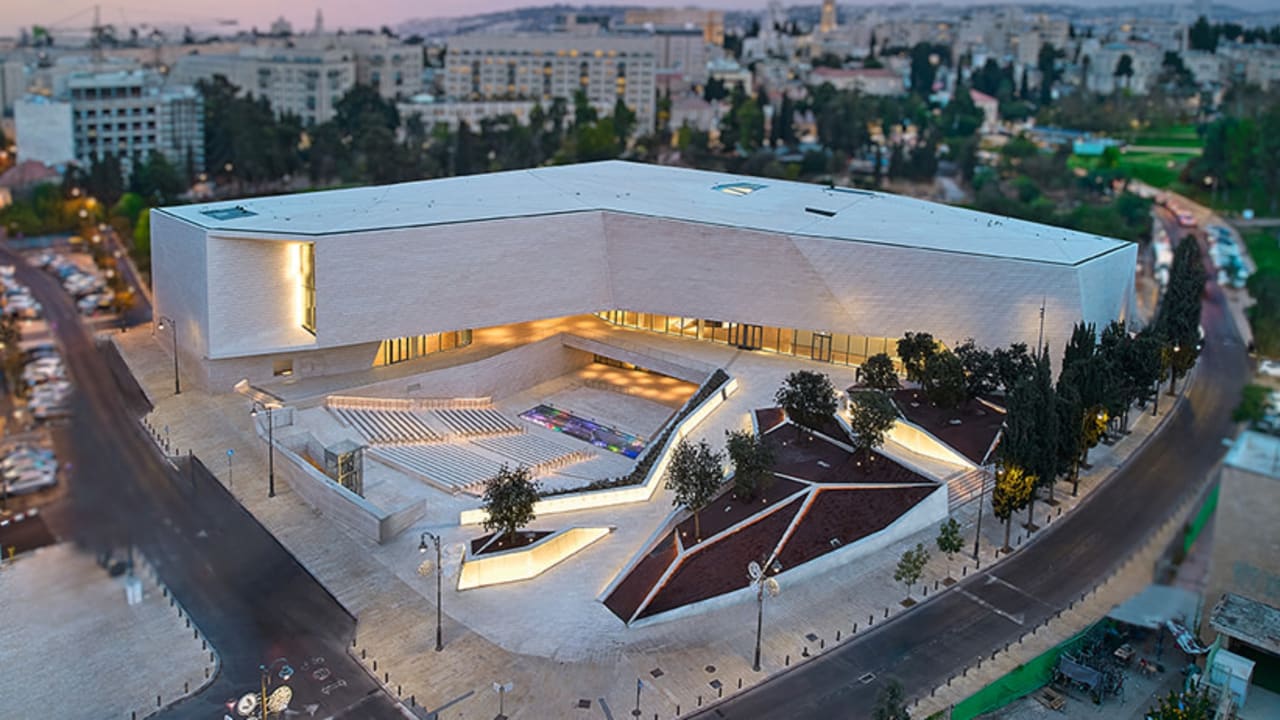
The Museum of Tolerance Jerusalem (MOTJ) has quickly become one of Israel’s most dynamic cultural and educational institutions. Since opening in 2023, it has hosted exhibitions, performances, international delegations, and groundbreaking educational programs — all while positioning itself as a hub for dialogue, moral clarity, and monotheistic values in a complex world.
To look back on an extraordinary year — and ahead to what’s next — we sat down with Jonathan Riss, Managing Director of MOTJ, to reflect on the Museum’s highlights, vision, and what lies ahead.
Q: How would you describe the Museum of Tolerance Jerusalem’s vision and what sets it apart?
Jonathan Riss: The Museum of Tolerance Jerusalem is a lighthouse of human dignity, a modern-day Abraham’s tent open to people of all religions, backgrounds, and cultures. The Museum is also a beacon of light not only in Israel but across the world, envisioned as a home for promoting peace, resolving disputes, and advancing education for the younger generation in tolerance and peace.
What makes it truly unique is the way it operates on four strong pillars. First, the Museum itself, with its three current exhibitions, provides a powerful window into the diversity and resilience of the Israeli people. Second, our permanent exhibits - The People’s Journey and Social Lab - two immersive, AI-fueled exhibits anchor visitors in the enduring values of tolerance and coexistence. Third, our art and culture programming positions the Museum as a hub of creativity and expression. And finally, our fourth pillar which centers on education, consists of our School of Civic Discourse and Leadership Academy, ensures that the next generation inherits these values and tools to build a better society. This year marks our second year of operation, and we are proud to say that all four of these pillars are now fully active, working together to create a vibrant, inclusive, and impactful institution.

Q: What about your current exhibits - what can visitors expect to see?
A: We’re very proud of 06:29 - From Darkness to Light and our exhibit, Love in the Shadow of War. These two exhibitions are deeply intertwined, as together they tell the story of October 7. The former captures the horrors of that day, confronting visitors with the brutality and terror that shook the nation and the resilience that emerged. Alongside it, the latter exhibition offers a powerful counterpoint as it showcases eight couples who found love in the aftermath of war. It reveals how acts of love, compassion, and resilience emerged even in the face of unspeakable evil. Seen together, the exhibitions reflect both the devastating reality of the massacre and the enduring human capacity to find hope, unity, and love in its aftermath.
Q: Can you talk more about the permanent exhibit?
A: While construction is still underway for much of The People's Journey, we’re thrilled that one of its pavilions, Maimonides at the Well of Knowledge, will finally be ready for public viewing in January 2026. This transformative, immersive exhibit is the first of its kind in Israel. Maimonides at the Well of Knowledge invites visitors to engage in real conversations with one of history’s greatest scholars about today’s most pressing challenges—information overload, the rise of artificial intelligence, and how to separate truth from falsehood. Maimonides understood that knowledge without moral clarity could mislead, and he built a framework for evaluating new ideas while staying rooted in Torah and ethics. By recreating that dialogue in an interactive, face-to-face encounter with “Maimonides” himself, we offer an experience unlike any other museum: a living conversation between past and present, where timeless wisdom helps us navigate contemporary dilemmas.
This exhibit will be one of the many compelling features in our People's Journey, an AI-powered, data-driven experience that challenges visitors to navigate today’s complex media landscape. Taken together with our other impressive permanent exhibit, the Social Lab, our visitors will be inspired and enlightened by these innovative and interactive experiences where they will walk away learning how to see themselves in the other and see the other in themselves.
Q: Over the past Jewish year, the Museum of Tolerance Jerusalem has hosted countless events and initiatives. Looking back, what moments stand out most to you?
A: The past year at MOTJ has been remarkable not just for the number of events, but for the depth of human connection and resilience they’ve fostered. We’ve emerged as a place where memory, resilience, and unity come together—hosting events that not only honor the past but also give strength and direction to the present. Each of our major gatherings has carried the same thread: in the face of tragedy and division, we must choose courage, gratitude, and open dialogue.
For example, in April, together with Ein Prat: The Academy for Leadership, we convened the Courage Conference—a day of reflection and strength on the eve of Yom HaZikaron and Yom HaAtzmaut. Survivors, soldiers, bereaved families, and young leaders gathered to honor acts of bravery from October 7 and beyond. The stories we heard reminded us that courage is not only found on the battlefield but in the human spirit’s refusal to surrender to despair.
In May, our amphitheater was filled with voices of prayer during a moving Hallel on Israel’s 77th Independence Day. The gathering carried profound meaning as hundreds came together—religious and secular, young and old—singing and celebrating life even as grief remained fresh. That morning, the Museum became not just a cultural landmark but a spiritual home, reminding us that gratitude and faith are essential to national strength.
In June, we hosted a deeply emotional memorial for Chief Inspector Yetav Lev Halevy, who fell in battle at just 28 years old. In the presence of government leaders, soldiers, family, and friends, his name was engraved in our Tikkun Olam Garden as a “Keeper of the Promise.” The evening was a powerful reminder that stories of sacrifice must be told, not only to remember but to inspire.
And most recently, in July, on the eve of Tisha B’Av, the Museum launched the Women’s Jewish Unity Project under the leadership of Professor René H. Levy. One hundred and fifty women gathered to take on the challenge of healing Jewish divisions—a mission rooted in the belief that empathy and self-awareness can break cycles of polarization that have plagued our people for centuries.
Q: What are you looking forward to in the coming months ahead?
We’re looking forward to hosting the US Marine Corps this coming November, where together we will celebrate 250 years of American independence. The event will bring together high-level politicians, dignitaries, and change-makers for a memorable and inspiring evening that we’re proud to be a part of.
Taken together, these events form more than a calendar of programs—they are a collective story. They show how the Museum has become a place where grief is honored, unity is forged, and the human spirit is lifted.
Q: The Museum recently hosted a remarkable Independence Day celebration in partnership with the U.S. Embassy. What made that evening so special?
A: That evening was unforgettable. To see the Museum draped in red, white, and blue and to feel the energy of celebrating Israel’s most important ally here in Jerusalem was truly powerful. We were especially honored to welcome U.S. Ambassador Mike Huckabee and his wife Janet, who have become dear friends of the Museum. Ambassador Huckabee deeply understands our mission of fostering tolerance, unity, and resilience, and he brought that spirit with him. In his impassioned remarks, the Ambassador spoke about the resilience of the U.S.–Israel bond—even in the face of rockets and conflict—and reminded us that these ties rest not only on shared strategic interests but on shared values. Then, in an unexpected and uplifting turn, he picked up his guitar and led the crowd in a set of classic American rock songs. People sang, danced, and for a few hours, joy triumphed over fear. That moment captured exactly what we strive for at the Museum: bringing people together across divides, lifting spirits even in difficult times, and showing that unity is stronger than adversity.
Q: Beyond exhibitions, what role do you see the Museum playing in Israeli society and globally in the years ahead?
A: We see the Museum as a bridge-builder. Israeli society is polarized, and the global Jewish community faces tremendous challenges. At MOTJ, we provide a platform for dialogue without erasing differences. We’re not afraid of complexity — in fact, we embrace it.
The School of Civic Discourse and the Leadership Academy are at the heart of this mission, training high schoolers, soldiers, gap-year participants, and young leaders to navigate civic issues thoughtfully and ethically. Already, 17,000 pupils are enrolled this year.
At the heart of it all, our mission remains the same: to strengthen moral clarity and tolerance grounded in Jewish values, and to share that with the world.
Q: Finally, as we celeberate the new year, what message do you hope the Museum of Tolerance Jerusalem sends to visitors and to the world?
A: My hope is that people see MOTJ as a place of light. In a time when our society feels fragmented, when misinformation spreads so easily, and when intolerance threatens communities everywhere, the Museum offers an alternative. It says: yes, we can build a future rooted in truth, respect, and moral clarity. Yes, we can find inspiration in our Jewish tradition while engaging openly with the wider world.
If visitors leave here feeling more thoughtful, more inspired, and more connected to one another, then we’ve succeeded. That’s the message we want to carry into the year ahead.
Written in collaboration with the Museum of Tolerance Jerusalem