
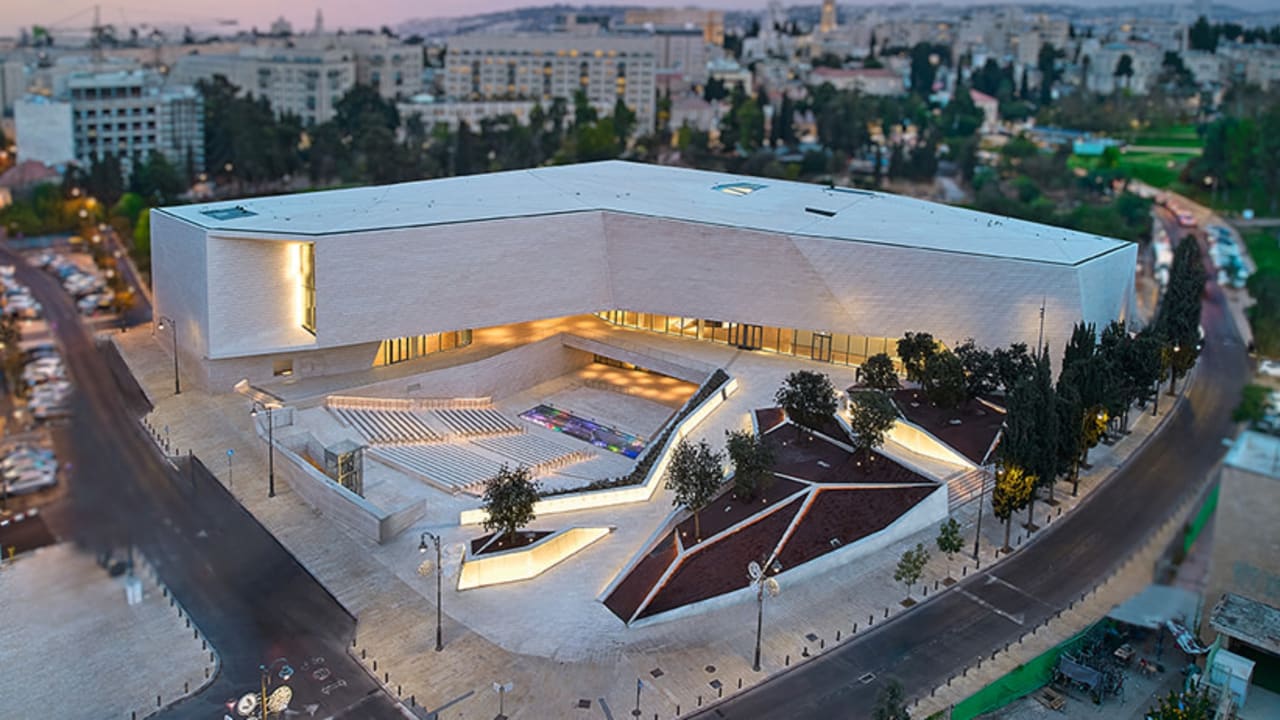
This September, the American flag will proudly fly in Jerusalem as the US Embassy hosts its Independence Day celebration at the Museum of Tolerance Jerusalem (MOTJ). For Rabbi Marvin Hier, the museum’s founder and co-chairman, this symbolism carries deep significance. “The presence of the United States Embassy at our museum is incredibly meaningful,” Hier said. “As an American, I am very proud that the embassy chose to hold this event here in Jerusalem.”
Though delayed from early July by the Iranian attacks on Israel, the celebration stands as proof that even rockets cannot sever the unbreakable bond between the United States and Israel. When Israeli leaders, international ambassadors, US dignitaries, and Grammy-winning singer Lee Greenwood – whose “God Bless the USA” has long echoed American pride – gather at the museum, the setting will embody resilience and the enduring friendship of our two nations.

This decision is about more than logistics; it is a testament to MOTJ’s rising role as both a cultural landmark and a diplomatic platform, a space where memory, identity, and shared values intersect with diplomacy and global engagement.
Rabbi Hier often describes the museum as “a modern-day Abraham’s tent.” It is, he said, a place welcoming Jews, Christians, Muslims, Druze, and others into dialogue. “It fosters culture and shared learning,” he explained. “What could be better than that?”

This vision has already made the museum one of Jerusalem’s most ideal venues for worldwide gatherings. Recently, it hosted the Genesis Prize ceremony honoring Argentine President Javier Milei; the World Jewish Congress Assembly with representatives from 72 countries; a bipartisan delegation of US senators led by Lindsey Graham; and delegations of African religious leaders from across the continent.
Meanwhile, a Newsmax mission brought dozens of American influencers to its halls, while AIPAC’s National Board held strategy sessions on regional security. “Look,” Hier said, “they have all chosen the Museum of Tolerance Jerusalem as their headquarters.”

Urgent mission
Behind the celebration and events, there is a mission that both Hier and MOTJ Managing Director Jonathan Riss emphasize as urgent. Riss described the museum as “an international embassy for peace and a spiritual lighthouse for human dignity.”
This mission has gained urgency since the Hamas attacks of Oct. 7. One of MOTJ’s most powerful exhibitions, 06:29 – From Darkness to Light, tells remarkable stories of resilience from several intrepid women who experienced the horrors of that day. Curated by Malki Shem Tov, whose son Omer was taken hostage and later released, it features testimony, film, photography by Ziv Koren, and an interactive map developed with Israel’s military intelligence. The journey ends on a hopeful note as visitors leave colorful sticky notes wishing for more peaceful days ahead.
“It’s an empowering exhibition,” Riss said, “because it tells the story from a personal perspective – painful yet resilient and hopeful.”

The museum recently launched another exhibition which continues telling the story of Oct. 7, but from the perspective of those who found love when they least expected it. Love in the Shadow of War, curated for Tu B’Av, Judaism’s holiday of love, displays portraits of couples who found love amid conflict – soldiers, widows, new immigrants, and seniors. Each couple is photographed twice: once reflecting pain, and again showing renewal.
“It’s about choosing love, even in tough times,” Riss explained.
Educational emphasis
Education is a central pillar in the MOTJ’s vision. Its Leadership Academy trains soldiers, policymakers, and community leaders, equipping them to bridge divides.
Complementing this is the School of Civic Discourse, created to address Israel’s increasing polarization after Oct. 7, with students including high schoolers, mechina participants, gap year students, and soldiers. In classrooms, Muslim, Christian, and Jewish boys and girls debate civic issues in a beit midrash style, with an emphasis on democratic participation.
“We are not shy about discussing difficult issues sensitively,” Riss said, adding that thus far, 17,000 students have enrolled in the two programs. “We want to prepare the next generation to lead democratically in a divided world,” he said.
But civic discussions are not the only goals promoted, as the museum seeks to contribute to Jerusalem’s community in other ways as well. Every Thursday night, MOTJ’s 1,000-seat amphitheater hosts film screenings with wine and popcorn under Jerusalem’s summer sky.
Families gather for the children’s theater every Monday. Exhibits like Walk in My Shoes encourage visitors to step into another’s shoes in the most literal sense and experience life from their perspective. Guided tours take groups through Jerusalem’s diverse neighborhoods, fostering understanding through lived experience.
Riss stated, “We are bringing livelihood to the city, not just memory, but joy, coexistence, and shared experiences.”
Resilience that’s personal
MOTJ’s story is one of resilience. The 188,000-square foot complex, designed by American and Israeli architects, was built against the odds. MOTJ’s Chairman of the Board, Larry A. Mizel, faced antisemitism growing up in Oklahoma and envisioned a space that would stand against hate and promote coexistence.
For both Mizel and Hier, then, the project was personal. Hier remembers Holocaust survivor Simon Wiesenthal, who lost 89 family members to the Nazis but dedicated his life to hunting war criminals and memory preservation. Wiesenthal chose to celebrate his 90th birthday in Hitler’s favorite hotel in Vienna. “Hitler is no longer here, but the Jews are still alive and still singing!” Hier explained.
Riss recalled, “We built this building ourselves, buying a construction company in liquidation, a crane on eBay, and bringing in hundreds of workers at different stages. It was a monumental effort. But what you see today is unmatched.”
Hier’s personal collection includes a chilling artifact: a replica of Adolf Hitler’s 1919 letter calling for the “total removal of the Jews altogether.” Few know it exists.
“It took the world too long to understand his intentions,” Hier reflected. “We don’t want to repeat that mistake again.” He sees a direct link between Hitler’s letter and the hatred indoctrination seen in Gaza today, warning that indifference is perilous.
Remembrance and renewal, intertwined
To date, 100,000 visitors have discovered that MOTJ is more than a museum – it is a living intersection of memory, resilience, and creativity.
One gallery upstairs features photographs of Israel’s early immigrants enduring hardship. Another shows a film about Oct. 7 through the eyes of women who experienced the unimaginable. Downstairs, an AI-powered installation invites conversations on ethical dilemmas from past to present, while outdoors in the amphitheater under the majestic Jerusalem sky, children can watch an engaging play. A few meters away, students participate in workshops on civic discourse.
The range of activities reflects the museum’s belief that remembrance and renewal are intertwined. As Riss described it, “a place that refuses to look away from history but pairs it with hope and life.”
But on September 9, as the US flag is raised over MOTJ, it will stand for more than American independence. It will reaffirm a partnership rooted in resilience and shared values, committed to memory, coexistence, and dignity.
As Hier summarized, “The Museum of Tolerance Jerusalem tells the world: ‘Let’s build a future of human dignity, tolerance, and love – a world where people respect each other, not hate each other.’
“In that vision, Independence Day finds its perfect home.”
This article was written in cooperation with MOTJ.