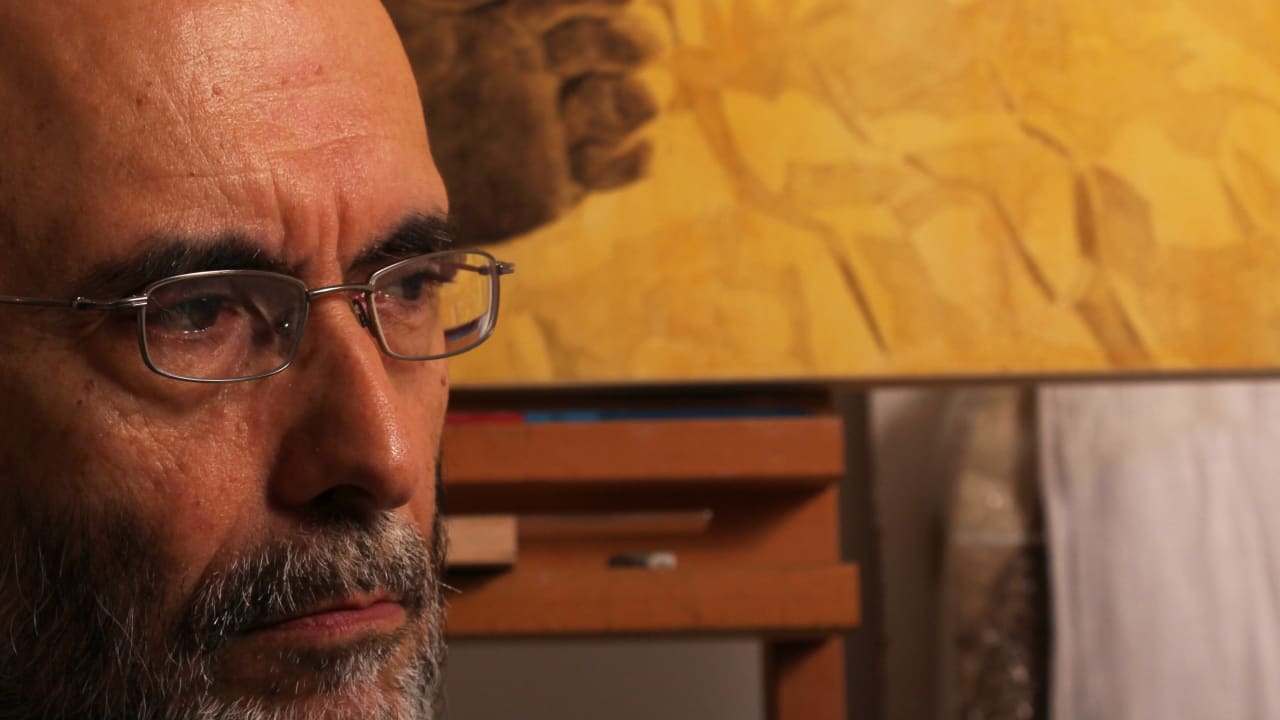
Yossi Mark, a renowned Israeli realist artist and winner of last year’s Haim Shiff Award for Figurative-Realistic Art, opens his solo exhibition Bona Nox, Mater at the Tel Aviv Museum of Art.
The exhibition, whose name means “Good night, Mother,” presents a comprehensive view of his oeuvre, spanning five decades: from his early works in the 1970s to his painting “Bona Nox, Mater,” completed just weeks before its opening (originally planned for June but postponed to mid-July due to the war with Iran).
Part of the exhibition extends into two additional galleries which house a permanent exhibition of paintings from the 16th to the 19th centuries. This reveals not only the artist’s inspirations but also establishes Mark’s paintings within the canon of art history.
His paintings are now hanging among works by Canaletto and Rubens, something he never dreamed of, he told the Magazine, but makes him very happy and proud.
Mark’s paintings remind me of those of the Old Masters. They’re focused on detail, leaving nothing haphazard, yet are simultaneously intimate and transparent. The artist opens up his private world to the viewers, depicting his family in moments of joy (for example, his wife’s pregnancy) and sadness (his mother in her final years).
Observing his mother, Mark explores the fragility of human existence and the connection between sleep and death, drawing on Greek mythology and the twins Hypnos and Thanatos.

He is also inspired by Venetian art and Christian iconography, which he cites in his work, as well as the films of Pedro Almodóvar.
Mark was born in 1954 in Petah Tikva. He studied philosophy and social sciences at Tel Aviv University and painting at the Avni Institute of Art and Design, where he later taught for many years. He is the founder and director of the Institute of Visual Arts at the Petach Tikva Museum of Art, where I visited him several months ago and observed him teaching others.
But primarily, Mark is a painter who has developed a distinctive artistic style: He systematically and precisely examines his subjects and creates measurement marks (small crosses and pencil lines), demonstrating his complete control over drawing and painting techniques in both acrylic and oil.
As he told the Magazine, his works are the result of many hours, sometimes months, of contemplation. “Looking at them is also work,” he noted.
His works are mostly monochromatic, characterized by very analytical observations of reality and body image; they are very intimate and nearly silent in their message.

We met at the Tel Aviv Museum of Art just a few days before the exhibition’s official opening. This conversation about the nuances of his work is a continuation of last year’s interview with him for my column “Three Artists, Three Questions” (The Magazine, June 28, 2024), shortly after Mark accepted the Haim Shiff Award, chosen from among 160 artists.
We said we would meet again when his solo exhibition was on display.
It’s a great pleasure and honor to meet with you again, this time at the Tel Aviv Museum of Art, just days before the opening of your solo exhibition, a part of the Haim Shiff Award for Figurative-Realistic Art 2024, ‘Bona Nox, Mater.’ This exhibition, curated by Emanuela Calò, showcases many decades of your work but focuses largely on your late mother.
The pleasure is mutual. Thank you for talking to me. And yes, there is an entire room in the exhibition dedicated to my mother, who passed away two years ago. This is the last 10, 13, 14 years of her life, when I was with her every day.
You take your viewers through the process of your work, showing, for example, seven versions/stages of your self-portrait; or in another work, four portraits of your mother. Is it one painting or four?
I called it together Feature. This is the underpainting, the first stage. It has developed into more and more and [has now become] the complete image.
When we spoke last year, you said that you first drew things with a pencil and then added colors and that you aimed for transparency.
That’s right, and here you can see the pencil and the markings for measuring. The first stage of my process is to be enchanted by a certain image, which most of the time is my surroundings, my family, and those in my intimate circle.
Most of my paintings deal with my inner, private, and intimate space. A fragment of reality captured by the eye, which demands attention and asks for profound observation.
And when it comes to the measuring?
First of all, I choose a very special moment that [catches] expression, gaze, and body language. When these elements reflect a certain state of mind, I start to draw.
The drawing is very analytical. In the methodical examination of the object, carried through measurements, I try to catch every nuance, every detail. The traces of drawings emerge beneath the layers of color. I’m a linear painter.
What do you mean by ‘linear’ in this context?
I mean that my tool in reflecting or inquiring [about] reality is a line, not a patch, located in a curve, which belongs more to the discipline of the early Renaissance. The Renaissance is different from the Baroque and some of the modern realist painters, who are looking to the empirical world with analysis of patches.
Venetian, and also other early Renaissance painters, used the line as a tool to inquire into reality.
Looking again at the portrait of your mother in four stages, was it planned as four separate canvases: a sketch, the next one with some color, then with more color, and then with multiple colors?
No, I didn’t plan it. But suddenly I saw a very interesting dialogue between the lines and the pattern, the patch. From the aesthetic point of view, and also from the artistic point of view, it’s something quite minimalistic compared with my final idea, but something happens here, which is the essence of the thing.
Is it all in pencil and acrylic, or did you add oil at the end as well?
Pencil and acrylic on canvas, mounted on wood. There’s a little bit of oil. [Mark points to the third and fourth stages.] The white patches are already in oil.
How long did it take you to paint it?
The whole process? At least four months.
Did you have breaks between the stages?
Yes, because of my dilemmas: [whether] to jump from here to there or to continue developing the painting, the drawing by itself, and to see what goes with this artistic and aesthetic adventure.
Did you have the final image in your mind at the beginning?
I always have, but not exactly. I always say, ‘I want it like this, approximately.’ But the stages become stations by themselves. I mean, the volumetric value is quite in the full range.
To me, the third one is stronger in emotions than the last one (in full colors).
Could be, yes, yes... It’s something more flat here. I’m not a coloristic painter.
You are very monochromatic.
That’s right.
The name of the exhibition, ‘Bona Nox, Mater,’ is also the title of your latest painting, portraying your mother… dying?
Yes and no. This is the enigma – maybe dying, or sleeping. Like in Greek mythology, the idea of the relation between Hypnos and Thanatos. Like in Caravaggio’s Death of the Virgin, you don’t know if she’s alive or not. Sleeping is very close to an image of somebody who’s passed away.
The other character in the painting, bending over your mother, looks like the Virgin Mary...
This is exactly Maria of Botticelli. In the original work, she was looking at the baby Jesus, who was born here, and she’s praying for him.
Why did you put her in the painting of your mother?
That is a very good question. At first, I painted only my mother. All this background was empty, and for close to two years I didn’t know what to do with it. Although I was satisfied with the composition, I said something was lacking here.
Suddenly, I realized it was missing the element of grace. So I was searching for an [image of an] angel for over a year. I searched in all the Western traditions, but I couldn’t find the right one, so I started to look for images of Madonna, and it took me to Botticelli, and I said: ‘This is it!’
The face and posture are directly from Botticelli. For me, she reflects that grace and compassion. Maybe she is in grief. The situation still has some enigma in it.
The name of your exhibition in Hebrew is Layla tov, ima; but in the English title you use Latin. Why?
Because I want the religious motif to accompany the works.
Do you mean Christian motifs?
Yes. I see my paintings as contemporary icons. I want them to be suggestive to the viewers. Something that will touch the viewer’s heart, open their hearts.
But the icons in Christianity have a slightly different role. People pray looking at them…
Of course, I don’t want people to pray. I just want to feel that something is opening in their mind and heart. I try in contemporary life to create the mental [spiritual] atmosphere, the same as the old icons reflect, and ask those who pray.
You grew up in Petah Tikva. Was it a secular home?
In my early childhood, yes. My family was from Transylvania, Hungary. They survived the Holocaust and moved to Israel just after the war. My grandmother was an Orthodox Jew, and I was very close to her. She was very tolerant.
So, more Jewish influences. Where did the inspiration for Christian art come from?
From the history of art.
In the exhibition’s introduction, I read that it’s in the spirit of Pedro Almodovar. Although he is one of my favorite film directors, I didn’t expect references to him in your art. What’s your connection to Almodovar? Is it the movie ‘All About My Mother’?
Of course! What I observe and feel through his films, especially about his mother, is that he is very touching and also working on something very emotional.
Also very intellectual.
That is the point. At the same time, he’s very analytical, especially with his aesthetic view, and very precise, like [in] paintings.
Interesting observation. Your exhibition, however, blends with the past, extending to the rooms of old masters of art. Did you ever dream that your paintings would be hung next to those of Canaletto or Rubens?
No… But this is the realization of it, and I’m over the moon!
This is a huge achievement! A few months ago, I visited you at the Institute of Visual Arts at the Petach Tikva Museum of Art. I watched you teaching people of different ages.
From 18 to 80.
What are the differences in teaching students of such a broad age range?
It depends on the personality and the thirst for doing good art.
How did you start learning art?
My mother showed me art. From my early childhood, I copied masterpieces I saw in books and reproductions, and then I studied at the Avni Institute of Art and Design in Tel Aviv. When I was a student (1977-81), there was a modern area, and I seemed very strange to my teachers and colleagues because I always looked for a kind of classic art as a base.
I became an assistant to the headmaster of the Avni Institute, Prof. Yaakov Wexler. (I really adored him.) With all these abstract and conceptual things that went around, he saw my work and said: ‘Go with yourself. Do what you want.’
All the other teachers told me that I was very serious and very talented but I didn’t belong in our area.
Not contemporary enough?
Not contemporary and not avant-garde. I said I was very appreciative of avant-garde, but I didn’t belong to it. When I saw the works of Edward Hopper, I said: ‘Wow, he’s from the 20th century.’ Nobody talks about him here. I feel at home in his paintings.”
And then I found Andrew Wyeth, like a soul in a figurative world.
I thought you were going to say that Caravaggio was your inspiration – the light, his color tones...
Of course he was. This is the worldly inspiration for me, like other artists I grew up with – Rembrandt, Georges de La Tour, Raphael, Leonardo da Vinci, and [Andrea] Mantegna. But these two artists are from the 20th century. They were still alive when I was a student. That was amazing! [I thought that] I could paint in the 20th century, realistic paintings like that
What would the Yossi Mark of 2025 say to the Yossi Mark of 50 years ago?
I would say that I’m very satisfied with the journey. It has been a great adventure, with lots of hesitation and many dilemmas, but I went through them. I’m closer to myself, and nowadays my paintings are much more me, the inner me. I feel that I have greater insight now.
www.tamuseum.org.il/en/exhibition/yossi-mark-bona-nox-mater/