
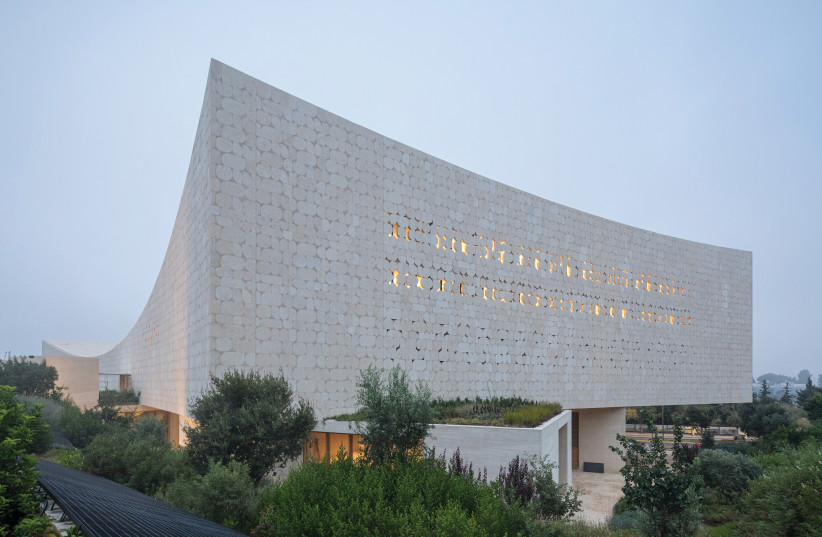
Last Friday marked the close of the Kafka: Metamorphosis of an Author exhibition at the National Library in Jerusalem. It commemorated not only a century since Franz Kafka’s passing but also the deposit of Max Brod’s estate at the National Library of Israel, following a protracted legal battle.
This significant collection includes some of Kafka’s papers and manuscripts, alongside Brod’s own extensive, often overlooked, papers and manuscripts, notably his musical compositions. Brod completed 39 opus numbers, encompassing over 100 lieder (art songs), chamber works, and his Requiem Hebraicum.
Today, Brod is primarily known as Kafka’s closest friend and literary executor, famed for defying Kafka’s wish to burn his manuscripts. However, Brod was also a recognized writer of his era, often mentioned alongside literary figures such as Thomas Mann, Stefan Zweig, or Rainer Maria Rilke.
A lesser-known aspect of Brod’s multifaceted career is his significant engagement as a serious classical composer. The recent depositing of Brod’s estate at the National Library offers a crucial opportunity to reexamine his musical contributions.
The life and career of Max Brod
Zdenka Fischmann identifies two distinct periods in Brod’s compositional life: his early years in Prague, before World War I, and his later period in then-Palestine, following his forced emigration in 1939.
In Prague, concurrent with his literary career, Brod was often engaged in musical matters: he pursued music from an early age, even considering a career as a concert pianist while studying composition under the Czech Jewish composer Adolf Schreiber, who tragically later committed suicide.
From 1924, Brod further solidified his reputation as a music critic for Prager Tagblatt. All this came to a stop in 1939, as the Nazis invaded Prague and Brod narrowly escaped on the last train.
Upon his arrival, Brod settled in Tel Aviv and assumed the role of dramaturg for the Habima Theater. He soon became a leading ideologist for Israeli art music, publishing his “Israel’s Music” in 1951, the first seminal document to discuss and delve into Israeli music and its composers.
He resumed his activity as a music critic for Israel-Nachrichten and refocused his energies on musical composition.
As a composer, Brod aligned himself with Israeli “Mediterranean music,” which aimed to express the Middle Eastern locality. He studied with two central figures in Israeli art music at the time, Alexander Uriyah Boscovich and Paul Ben-Haim.
However, Brod stood out among Israeli composers. While numerous composers aimed at sloughing off their former European past – a phenomenon sometimes termed “the negation of the Diaspora” by scholars – Brod consistently drew upon his Eastern European heritage.
As early as 1916, in Der Jude, Brod documented his impressions from the music of Eastern and Galician European Jews who had settled in Prague while fleeing World War I. This influence is well apparent in his 1945 Mediterranean Rhapsody, structured in two movements that incorporate Jewish scales (shteygers) and modes.
The second movement, “Galilee,” is particularly intriguing. Brod utilizes a theme with clear affinities to the folk song “God Will Build the Galilee.” Both Brod’s theme and the folk song employ the Ashkenazi diasporic shteyger “Ahava Raba.” What makes this application unusual is its use to describe the Galilean locality.
Despite the folk song’s overt Eastern European context, Brod contended that the origins of “God Will Build the Galilee” could be traced back to ancient Israel. This suggests Brod’s belief that, despite two millennia in Diaspora, the Jewish people maintained their intrinsic ties to their ancient homeland.
Also, as a metaphor for his personal state of emigration and being a part of the rebuilding of the state, Brod appended an extramusical program to his piano rhapsody, Apollo Musagetes based on the Greek myth. This narrative, delineating the flood and the reformation of a new city on Mount Parnassus, served Brod as a metaphor for Zionist ideals. The drama of Brod’s music descriptively adheres and follows the extra-musical narrative.
ANOTHER COMPELLING example is the two Kafka songs, “Tod und Paradies” (“Death and Paradise”), composed in 1951. Brod constructed these songs from various texts extracted and woven together from Kafka’s diaries and letters.
Scholar Peter Jost described Brod’s setting as highly complex, intimately engaging with Kafka’s work through Brod’s own interpretive lens. For instance, the compositional technique in the first song (“Tod”) leans toward techniques found in Israeli art music, possibly an allusion to Brod’s view of Kafka.
The second song shifts from “Death” to “Paradies,” relying on a theme and three variations. At its conclusion, Brod distills his thematic kernel, implying a redemptive narrative, which may connect to some of Brod’s philosophical ideas. Throughout, Brod is profoundly committed to text-music relations.
Viewed holistically, Brod’s music synthesizes elements of late expressionism, early modernism, Jewish and Israeli idioms, thereby forming a multifaceted musical tapestry. He primarily reveals himself to be a highly talented composer of lieder, standing alongside figures as Robert Schumann or Hugo Wolf. His music merits further performance and investigation.
The National Library’s acquisition of Brod’s archive provides a vital opportunity to gain insight into a significant and fascinating composer. Brod’s music offers valuable illumination into important niches and perspectives within Israeli art music, the history of Czech-Jewish culture, and the wider historical framework surrounding Kafka.
Brod’s archive, including the Kafka manuscripts, has been digitized and available at the National Library’s online site:
www.nli.org.il/en/visit/exhibitions-and-displays/current-exhibitions/kafka-100-years
A selection of Brod’s music is available on the “Max Brod, Chamber works Tod and Paradies” cd, which is available on streaming services.