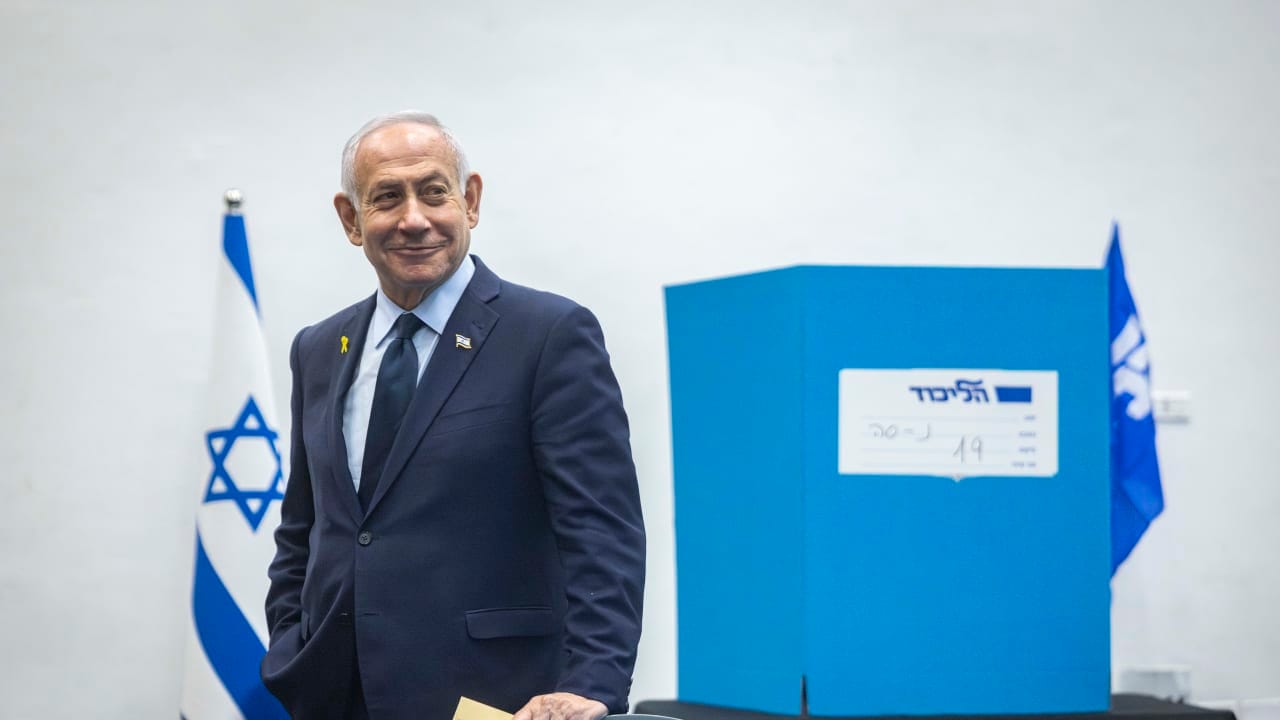
There is no other way to see it: Prime Minister Benjamin Netanyahu’s request for a pardon mid-trial, blatantly inconsistent with Israeli law, is an attempt to bulldoze his way out of his public corruption trial.
In normal times, President Isaac Herzog would simply reject the request, since he does not have the authority to grant the pardon until a verdict is reached. But these are not normal times.
After nearly five years of the trial only indirectly impacting Netanyahu, in recent months, he has been under fire during cross-examination. Legally speaking, it has been brutal.
Additionally, after years of failing to undermine Attorney-General Gali Baharav-Miara, Netanyahu has finally found a wedge issue to isolate her from the High Court of Justice: the scandal surrounding former military advocate-general Yifat Tomer-Yerushalmi, who resigned, and the question of who will investigate that scandal, including any alleged side role of Baharav-Miara in the saga.
Therefore, this is a unique moment for Netanyahu.

Until now, he thought he could intimidate the state prosecution’s legal team into a plea deal that would allow him to remain in office – and without any jail time – simply by scoring points in the trial. And he has scored many points.
Chances are, he will be acquitted of the worst charge of bribery in Case 4000, the Walla-Bezeq media bribery affair.
His defense team had blown several rage holes in that case, which requires proving different issues at once.
Very likely Netanyahu will be convicted in case 1000
Judge Moshe Baram may even vote to acquit him in Case 1000 – the Illegal Gifts Affair – and Case 2000, as well as the Yediot Aharonot-Israel Hayom attempted media bribery affair.
What has become clear during cross-examination, however, is that it is very likely that Netanyahu will be convicted of breach of trust by the other two judges in Case 1000. He simply has not provided as strong a narrative as the multiple witnesses brought by the prosecution, and he admits most of the basic facts, challenging only whether his intent was criminal.
Furthermore, Netanyahu may be convicted in Case 4000 of the minor charge of breach of trust, which has a much lower standard of proof than bribery.
If he gets two convictions, even minor, a 2-1 majority of the panel may rule that he is banned from public office, and, theoretically, he could even get some amount of jail time.
That means his chances of a plea deal from the state prosecution, just based on the progress at trial, have dropped considerably in recent months.
On the flip side, Netanyahu is in his strongest position, exerting pressure over the legal establishment more broadly.
The High Court just left Baharav-Miara out to dry in the grand legal battle over who will probe the Tomer-Yerushalmi case, ceding the power to choose the prosecutor to her arch enemy, and Netanyahu lieutenant, Justice Minister Yariv Levin.
She may dodge this bullet, and it may be a one-time exception, leaving her all of her authorities and her time in office, which is set to run through early 2028.
On the other hand, that probe could unravel her authority further if there is any evidence that she helped Tomer-Yerushalmi cover up her own scandal – no one has presented any evidence to support this to date – as opposed to just not realizing that the former IDF chief lawyer lied to everyone.
But regardless of whether she can dodge that bullet, the High Court choosing to distance itself from her request to keep the probe within the state prosecution was a fundamental turning point – and potentially even a breakup of sorts.
It was as if the High Court said: We want to be on your side, but you got tangled in something, and we need to save our own authority first.
All of this comes as Netanyahu and Levin have spent an extensive period delegitimizing Supreme Court President Yitzhak Amit as they are trying to move forward with a potentially politicized government committee to probe the October 7 massacre.
In a not-so-veiled offer, Netanyahu said: “Let me have a pardon, and I will turn down the pressure on the legal establishment.”
What exactly that would mean – whether firing or restraining Levin, restoring legitimacy to Amit and suspending further judicial-overhaul issues, or even agreeing to negotiate changes to overhaul issues that his government has already passed – is an interesting theoretical question.
Herzog will want to grant the pardon if he can find a legal way to do so. He has wanted to pardon Netanyahu and end the case for years.
Whether he will do so without approval from Baharav-Miara or the High Court is another open question.
There are also other scenarios in which Baharav-Miara and the High Court negotiate indirectly with Netanyahu through Herzog to reach a plea deal, which allows for a pardon and resolves the judicial-overhaul crisis.
Then again, Baharav-Miara may stick to her guns. In that case, Herzog would probably need to take a pass or risk approving the pardon – only to have it overturned by the High Court
One way or another, Netanyahu has forced the issue, seeing this as both his weakest and strongest moment – and the consequences for the country now and deep into the future are practically beyond description.