
Israel Police Commissioner Danny Levi on Sunday pushed back against growing criticism over a wave of killings across the country, saying police were operating in a “continuous emergency” but that some murders were sudden, eruptive incidents that were difficult, and sometimes impossible, to prevent.
His remarks came after one of the bloodiest weeks Israel has seen this year, with a string of killings across Jewish and Arab communities, including the murder of 21-year-old Yemanu Binyamin Zalka, a recently released IDF soldier and Pizza Hut worker who was stabbed to death in Petah Tikva on Independence Day night.
Zalka was attacked after he reportedly asked a group of teenagers to stop spraying party foam inside the restaurant where he worked. The group waited outside for him after his shift, and one of the minors allegedly stabbed him while others beat him or stood by. Seven minors were later arrested in connection with the murder.
But the case quickly became about more than the killing itself. Residents and opposition lawmakers accused police of failing to respond quickly enough, with reports saying that investigators initially treated the incident as a youth brawl that had spiraled out of control and only later escalated the case. Hundreds gathered outside the Petah Tikva branch on Saturday night, lighting candles and demanding more security.
That anger came against the backdrop of a broader murder wave. In less than a week, Meirav Edri was stabbed to death in her Beersheba home; Sabrin al-Ataika was killed in Rahat; Ahmad Issa was shot dead after gunfire at a vehicle; Suar Abbas and her fiancé Oday Shaaban were shot dead in Yarka; Muataz Abu Laban and Muhammad Ayman Abd al-Hadi were shot dead in Ramle; Zalka died of his wounds in Petah Tikva; Majed al-Sheikh was shot dead in Isfiya; and Destao Tsakol, 19, was stabbed to death near his Beersheba home.
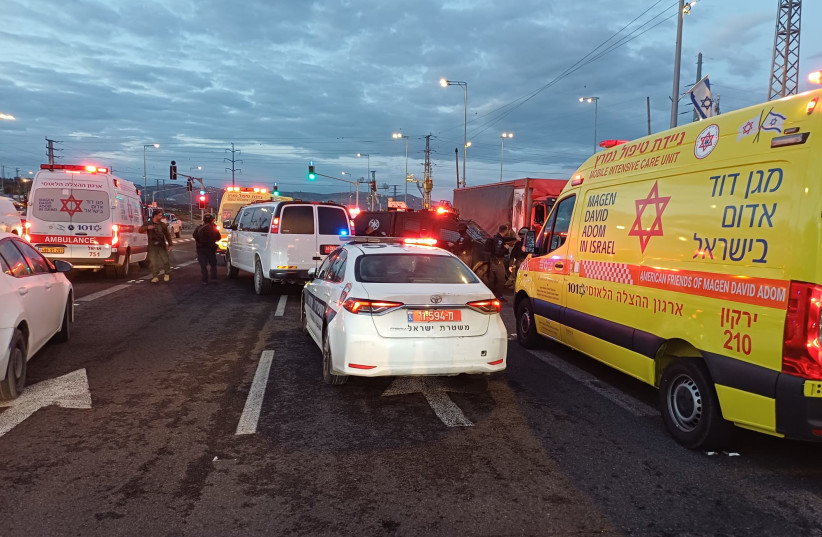
Following al-Sheikh’s killing, the Abraham Initiatives said 97 Arabs had been killed since the beginning of 2026 in circumstances related to crime and violence. The organization said that the figure underscored the scale of the crisis in Arab communities, even as the past week’s killings also spread into Jewish cities and mixed public spaces, feeding a broader sense that violence was becoming more sudden, more public, and harder to contain.
By Sunday morning, the list had grown again. A 16-year-old was stabbed to death in Hatzor Haglilit, and a 43-year-old man and his six-year-old son were found shot dead in Aviel, near Zichron Yaakov, in what police were investigating as a suspected murder-suicide.
'Disturbing and painful' rise in murder cases
Opening a police assessment on Sunday morning, Levi said the country had witnessed a “disturbing and painful” rise in murder cases in recent weeks, both in Arab and Jewish society.
“Every such event of loss of life is an entire world, a family that falls apart and a deep wound in the heart of Israeli society as a whole,” he said.
Levy said some murders stemmed from organized crime, criminal feuds, and struggles over control and power, against which police were acting “forcefully, in a focused and systematic way.”
But he said other cases - naming Petah Tikva, Beersheba, Hatzor Haglilit, and the area near Zichron Yaakov - were sudden, unpredictable incidents that reflected a deeper social crisis requiring not only police action but education, welfare, prevention, prosecution, courts, and government ministries.
“Israel Police is not letting go,” Levi said, adding that he would personally continue tracking the status of murder investigations and ensure that each case was handled professionally and with full resources.
He also called on government ministries, the prosecution, and the courts to stand alongside police, invest resources, toughen punishment, and create deterrence “in order to stop these bloody events.”
The murder quickly became a flashpoint for public anger after residents gathered outside the Petah Tikva branch where Zalka worked, demanding justice and criticizing what they described as a delayed police response.
Hodaya Ran and Tobias Siegal contributed to this report.