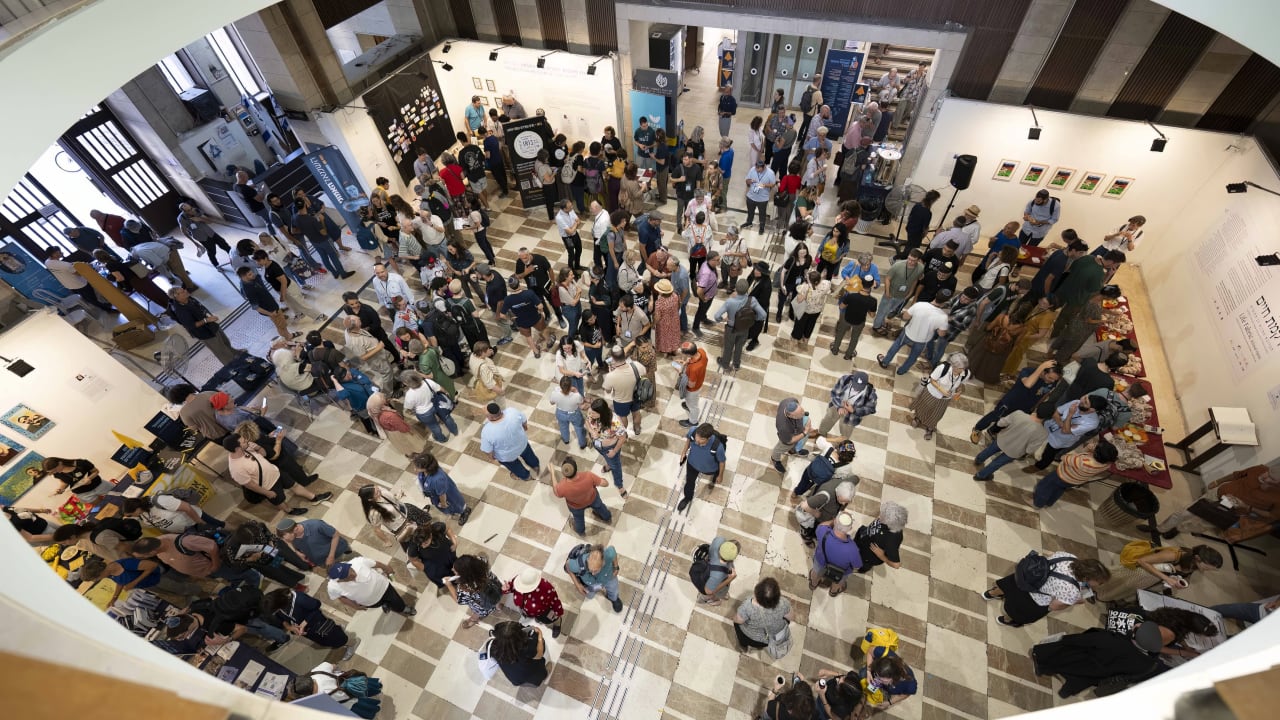
Close to a thousand people filled Heichal Shlomo on Tuesday night for the third annual conference of Smol Emuni in Jerusalem.
Focusing on the theme of safeguarding life during wartime, the conference addressed pressing issues facing Israel today, calling for an end to the war, the release of the hostages, the rebuilding of Israel and Gaza following nearly two years of devastation, and the safeguarding of innocent lives.
Smol Emuni, translated as the “Faithful Left,” is a growing movement that seeks to provide an alternative to what it deems the extreme right-wing religious narrative dominating Israeli politics by introducing a faith-based voice for peace into the discourse.
As a community, Smol Emuni prides itself on becoming a home for left-wing religious and traditional Jews who are committed to justice and peace but feel out of place within wider religious circles and secular left-wing movements.
“The fact that there are religious people on the Left is not a new phenomenon,” said Mikhael Manekin, one of the leaders of Smol Emuni and the former executive director of Breaking the Silence, in a conversation with The Jerusalem Post.
But despite the diversity in the world of activism, Manekin pointed out that “for a long time, there wasn’t a structure that allowed us to all be together and to speak directly to the faith element of the work that we do. And that’s what Smol Emuni was created for.”

This distinction was evident throughout the conference. The plenary session, which opened with the blowing of a shofar, featured a range of speakers, including religious leaders, social activists, academics, and musicians.
Many of them referenced Torah commandments and the significance of repentance in the days leading up to Rosh Hashanah, or quoted biblical and rabbinical sources while calling for an end to the war.
Addressing the conference’s theme and the Torah commandment to guard one’s soul, Prof. Ephraim (Effie) Shoham-Steiner, one of the leaders of the Jerusalem protest movement Saving Our Shared Home, said that this notion can refer to both physical and spiritual well-being.
Shoham-Steiner, whose son, St.-Sgt. Yuval Shoham was killed in Gaza in 2024, discussed the literal loss of life as well as the spiritual damage inflicted by the prolonged war.
Though Smol Emuni’s mission is explicitly rooted in Torah values and Jewish tradition, and its organizers represent a spectrum of religious observance, the conference also attracted nonobservant participants.
“[The movement] generates a lot of excitement also from people who don’t come from religious backgrounds,” Manekin said. “And that’s very important to us, because most Israelis have some sort of relationship regarding the question of faith.”
According to Smol Emuni, the movement’s message resonates with non-Israeli audiences as well. Case in point, its US branch drew in over 400 people at its inaugural gathering in April of this year at the B’nai Jeshurun synagogue in New York City.
Esther Sperber, the executive director of Smol Emuni US, attended the Jerusalem conference and addressed the audience during the plenary session.
Sperber talks about teshuva during Elul
Born in Jerusalem and currently living in New York, Sperber talked about the importance of discussing teshuva (repentance) during the current Jewish month of Elul.
Saying that following the news throughout the war has been a painful experience for her – seeing the suffering of the hostages, the deaths of Israeli soldiers, the destruction of Gaza, and the mounting death toll – Sperber asked, “How is it possible that [people in Israel] use religious language to call for extermination and the flattening [of Gaza] and starvation and occupation?”
Though the conference’s theme lent itself to a heavy mood, speakers also struck a message of hope, telling the audience that there is an opportunity to imagine a different reality and build a better future for both Israelis and Palestinians.
Following the opening session, participants were able to attend one of nearly a dozen parallel sessions taking place throughout the venue.
These included beit midrash (study hall) gatherings, a political imagination workshop, conversations on topics ranging from “Activism in Times of Crisis: Protective Presence Alongside Palestinian Communities in the West Bank” to “War and the Messianic Era,” and a closed circle for reservists.
There was also a simultaneous screening of the 2025 documentary Holding Liat, depicting the story of former hostage Liat Beinin Atzili and her family’s efforts to secure her release.
Participants reconvened in the main hall for closing remarks by Manekin, who spoke about the expansion of the Smol Emuni movement, its activism in the West Bank, and the development of educational programs for both Israelis and Americans.
Musical performances punctuated the evening’s program as well. Spoken-word poet Yonatan Kunda, who also led a writing workshop, performed together with Palestinian rapper Sameh “SAZ” Zakout, and the evening closed with performances by singer Noam Enbar and musical artist Shaanan Streett.