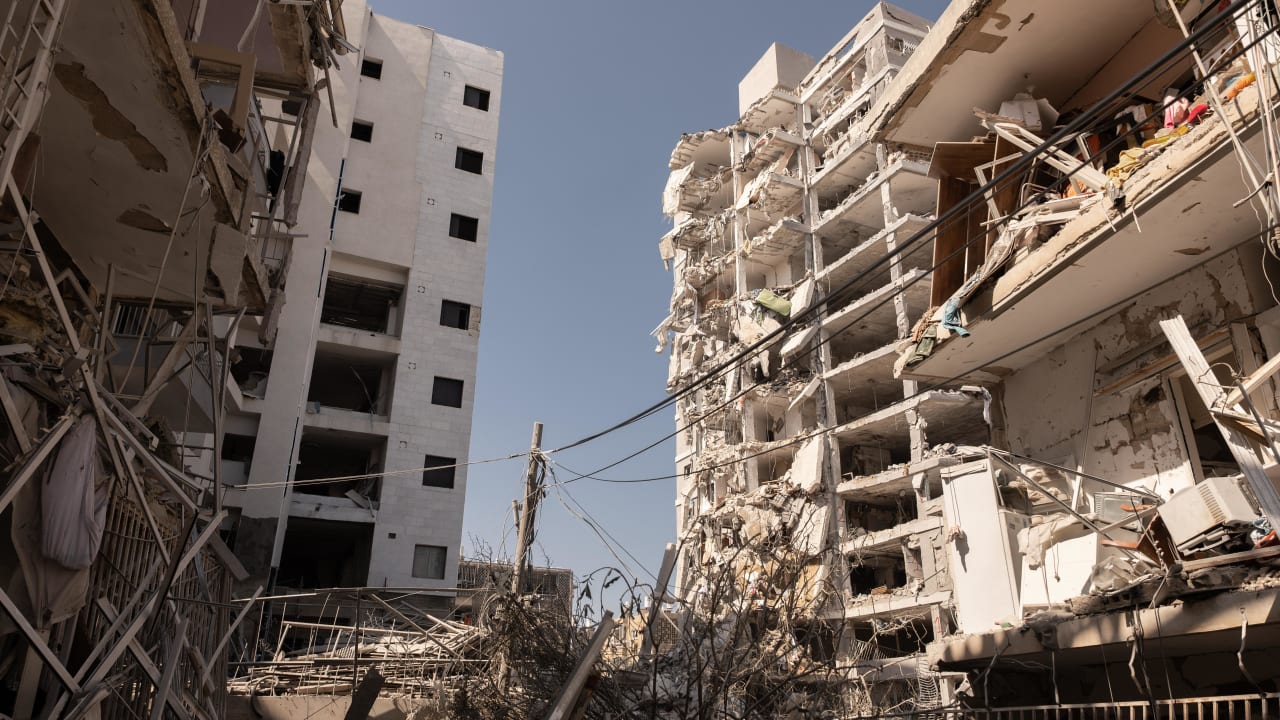
Life has somehow, in typical Israeli fashion, returned to its former shape. Or so it seems for the most of us. The war with Iran – a flash of continuous sirens, constant shelter runs, and innumerable missiles streaking the sky – tormented us all for 12 relentless days. And now, it’s as if someone flipped the switch back to “normal.” People are back at the beach. The roads through Jerusalem and Tel Aviv are full again. The skyline looks almost the same. Almost.
Because if you look closely, you’ll notice a few scattered souvenirs from that 12-day nightmare. Charred concrete, shattered windows, cranes erected by buildings whose spines were cracked by direct hits. A balcony left dangling somewhere in Bat Yam, a tower fenced off in Ramat Gan. Physical scars that serve as silent reminders of a moment when the country held its breath, and of one grand question that still echoes weeks later: What happens now?
What’s being done for the people whose homes were destroyed? How are they being compensated, if at all? To answer those questions, I spoke to Michal Zilberman, CEO of Anglit Laam (“English for the People”), whose apartment building in central Israel was hit during the attack. Our conversation took place over Zoom, not from Tel Aviv, not from a hotel room, but from distant China.
Ramat Gan to Shanghai
“I didn’t expect we’d be having this conversation from China,” she said with a calm smile. “But I suppose it’s a fitting place to begin.”
Zilberman is on a student exchange program in China. It was something she had planned long before the Iranian war, but the distance has only highlighted how surreal her entire situation has become. In Israel, her apartment was situated in the Elite Tower at 16 Jabotinsky St., a high-rise apartment building in central Ramat Gan. “Thankfully, I wasn’t inside the building when the missile hit. I only saw the damage from the outside. The building was declared unsafe, and I haven’t been allowed in since.”

The evacuation process
In the days after the attack, each city set up local evacuation centers. That’s where displaced residents were supposed to register and, in theory, receive temporary housing in hotels or municipality-provided shelters.
“In practice, it didn’t work like that,” Zilberman said. “The lists were handwritten; nothing was digitized. People showed up in their pajamas, literally, because they’d fled in the middle of the night, and there were no guidelines in place to help them.
“When we got to these designated hotels, often situated far from our own neighborhood, we were left in the lobby for several hours with not even a bottle of water to comfort us. I received NIS 500 in cash and NIS 1,000 in clothing vouchers for Fox. That’s all, to this very day...”
A building in limbo
The real complications began when the city engineer declared the apartment building unsafe to enter. “The Tax Authority can’t assess the damage from the outside,” Zilberman explained, “but you can’t go inside, either. So what happens then? You’re stuck. What do I replace? What will I be compensated on?
“We’re still paying rent on our destroyed and inaccessible apartments,” she added. “Families can’t be expected to actually continue their daily routines from a small hotel room on the other side of Gush Dan, so we’ve had to rent other places just to have a proper roof over our heads. And the state hasn’t intervened in any meaningful way.”
No one on the same page
Zilberman is an entrepreneur who describes herself as someone who’s used to solving problems. “But this… this has no single process. No rules. No clear logic. You send an email, you receive five different answers. Each public official has a different approach, and they all claim that their solution is the correct one.
“Dozens of Zoom meetings were held with representatives from the Property Tax Authority and city municipality, but there’s been no clarity, and more critically, no timeline. The Property Tax reps claim that the law gives them eight months to issue compensation. Eight months. Meanwhile, people are taking loans just to stay afloat. Still, the main frustration isn’t the lack of resources, it’s the lack of certainty.
“There’s no streamlining. No single body coordinating this mission. Every form needs another signature. Every approval depends on something else. It’s contradictory bureaucracy. And that’s what breaks people.
“I’m not supposed to rebuild my life from scratch because of a government-level conflict. But that’s exactly what I’ve been forced to do. I’ve spent enormous amounts of money in attempt to steady my world, but ultimately I’m left with zero indication as to when I’ll be reimbursed.”
She described the overall experience as a kind of emotional roulette: “You’re anxious, you’re stressed, you’re in the middle of a war, and then the support system that’s meant to alleviate some of that strain – doesn’t work. No one takes real responsibility for your condition You’re just… in limbo.
“We’re not asking for grand favors. We pay taxes. We serve the state when called upon. We follow the rules. But now, when the roles are reversed, we’ve been left to figure this one out on our own.”
Breaking point
The biggest concern now, she said, is how long the uncertainty will last. “This could be the straw that breaks people,” she said with a hint of sadness. “Some of us have been on reserve duty for many months. Others are juggling work, kids, displacement, ongoing anxiety, and scarring trauma. After October 7, we all hoped things would improve. That the authorities would learn to deal more effectively during times of crises and civic desperation. But well over a year later, there’s still no system in place. And the message is clear: If you fall, it’s really up to you to get back up.”
Zilberman’s words hung heavy in the air. They weren’t bitter, just tired and perhaps slightly defeated. “This is an emotional rollercoaster. Financially, mentally. There’s no stability. You’re not just losing an apartment. You’re losing your peace of mind.”
An invisible crisis
For those of us driving past those damaged buildings with our eyes on the road and our minds already somewhere else, it’s easy to think that things are back to normal. But for those families still waiting for tangible answers, real compensation, or just the chance to go inside their homes and retrieve some beloved objects, normality is a long way off.
This isn’t about political arguments or defense strategies. This is about people trying to start the next chapter of their lives and finding that the system that was meant to support them has left the next page blank.
Not everyone who felt the impact of the Persian projectiles was displaced to a hotel or forced out of their homes entirely. Some stayed put, not because they were unharmed but because the damage, while real, didn’t seem to justify uprooting their lives altogether.
That was the case for Morr Cahana, a young student living in Haifa with her partner. Her building wasn’t hit directly, with the missile landing just one street up, but the blast was close enough to violently shake the building, crack the walls, shatter the balcony doors, and make the entire block feel like a war zone.
‘I had a bad feeling’
It was during the first week of the war, Cahana said, when countless sirens rang across Haifa and the surrounding bay area. The Bazan refineries had already been hit. So had the town of Tamra just across the Kishon River. Cahana had a sinking feeling the next barrage would land closer.
Normally, when the sirens went off, she and her partner would run next door to the neighbors’ protected room. “But this time,” she said, “I didn’t trust it. Something felt off, and so we hurried to the public shelter at the school down the street.”
It turned out to be the right decision. The shelter was packed with neighbors, families, and sleepy children – a mix of quiet tension and community panic. After several minutes of underground anticipation, it hit.
“There was a boom. A really heavy one,” she said. “Dust started falling from the ceiling. Everyone froze, besides the children who began to wail. People started whispering, frantically checking their phones. Some went up to look. That’s when the rumors started: There’s been a hit. One close by.”
Impact on Galil Street
When the all-clear finally came and they left the shelter, Cahana saw the flurry of flashing lights first. Ambulances and rescue teams had surrounded several buildings just one street above theirs. Everyone was saying the same thing, that “It could’ve been us.”
Home Front Command blocked off parts of the area, conducting active searches. Cahana and her partner were told to wait for clearance before returning home. No one seemed to know when it would be safe or who had the authority to decide.
“We were standing there, just trying to get back to our apartment, and the police were saying one thing and the soldiers another. It was like no one was in charge.”
Eventually, they were allowed to go back in. The glass doors to the balcony had been shattered, and part of a wall had come loose. The damage was visible, but minor – at least compared to what happened a few meters up the hill. Still, the apartment was exposed, smoke billowing from the scorched buildings above.
The landlord submitted a claim to the Property Tax Authority, but it took three days before anyone arrived. Until then, they hung up makeshift curtains and stayed in the apartment. “We could have asked for a hotel, but we didn’t want to leave,” Cahana said. “It’s our home. Even like that.”
Chasing down representatives was part of the process. “They don’t schedule appointments. They just show up. And if you miss them, you have to reschedule for a another date,” she said.
The explanation they got was that there were too few personnel and too many damaged homes. Hundreds of claims were submitted, most with more severe destruction than theirs. Cahana said she gets it, but the system still feels fragile.
“They [the Property Tax Authority] were kind when they showed up, professional even. But nothing about this is stable.”
Doing it yourself
Because Cahana and her partner are tenants, the landlord was technically responsible for the repairs. But with no doors in the apartment and no timeline from the authorities, Cahana took matters into her own hands.
“I contacted a contractor myself. I just wanted it done.” The Property Tax reps offered a simplified compensation model, a fixed sum with no estimates needed. It was quick, and the funds came through without issue. But the repair itself still took time. It was over two weeks before the new doors were installed. “Until then, we just lived with it. No real protection, no real privacy. But we didn’t want to leave. Eighteen months ago, we were forced out of Kiryat Shmona. That was already one eviction too many for our liking.”
‘We were lucky’
Compared to others, they were lucky. No one was injured. The apartment was still livable. The compensation came through. But Cahana is cautious about drawing conclusions. “The system worked, sort of, for us. But if you scale it up, if you look at people who lost everything. I don’t know how it holds up.”
There’s a quiet resignation in the way she talked about it. Not anger, just experienced realism. “You get through it by handling it yourself. You figure out what you can control. Everything else? You can only wait.”
A FEW weeks ago, this country was under direct missile attack, not just from Gaza or Lebanon but from their Iranian conductor. It was, by any measure, a historic escalation. And yet, as the dust settles and routines return, so too does the quiet dysfunction of a state apparatus that knows how to mobilize for war but still stumbles when it comes to the day after.
From Zilberman’s unlivable tower block in central Israel to Cahana’s shattered balcony doors in Haifa, a pattern begins to emerge: chaos at the top, improvisation at the bottom. The first response is always confusion, with multiple authorities, contradictory instructions, and no clear timeline. Only once individuals take the lead, chase down officials, or simply absorb the cost themselves, does anything begin to move forward.
What links these stories isn’t just the destruction or even the trauma, it’s the feeling that there’s no one at the wheel. That those affected are expected to be grateful for partial answers, delayed visits, and makeshift repairs, all while still paying rent, taxes, and showing up to class, reserve duty, or work as if nothing happened.
Israel’s strength has never been in smooth bureaucracy. Its resilience has always come from its citizens. But as these accounts make painfully clear, resilience should not be mistaken for consent – or for competence. The missiles may have stopped falling, but for many the fallout continues. And the silence around it is just as loud.■